Shillong, December 10 : The Government of Meghalaya today inaugurated the 4th Edition of the Tri Hills Ensemble at Ward’s Lake, Shillong—an annual festival celebrating the culture, craft, and cuisine of the Khasi, Jaintia and Garo communities. The event, organised by the Department of Arts & Culture under the Ministry of Tribal Affairs, was inaugurated by Chief Minister Conrad K. Sangma, who attended as Chief Guest.
Also present were Arts & Culture Minister Sanbor Shullai, Adviser to the Government Paul Lyngdoh, Chief Secretary Dr. Shakil P. Ahammed, IAS, Principal Secretary Frederick R. Kharkongor, IAS, and senior officials. The festival also saw the participation of Eoghan O’Regan, Head of the Welsh Government in India, underscoring ongoing Meghalaya–Wales cultural collaboration.
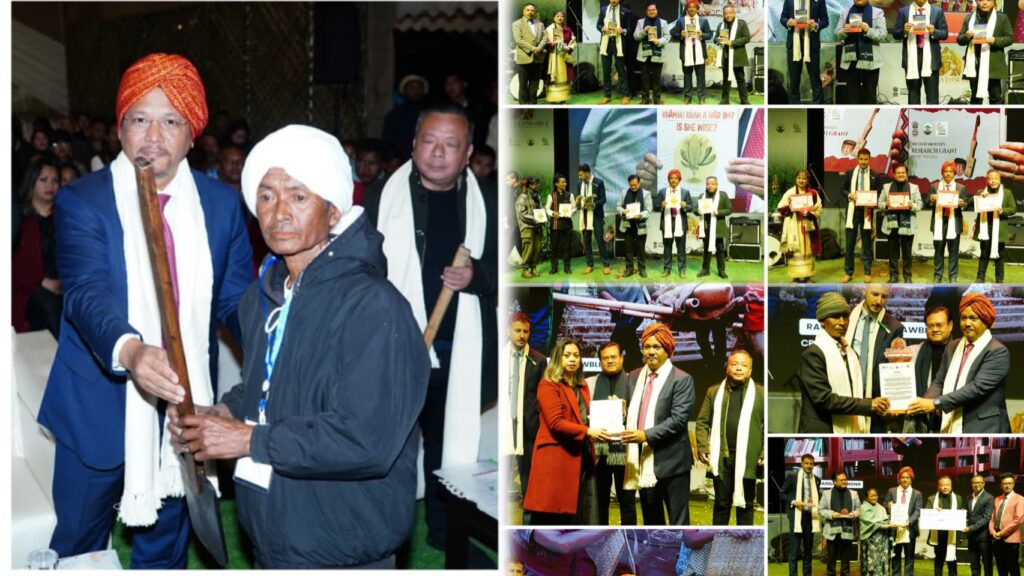
This year’s edition places special emphasis on reviving traditional boating and rowing practices in Darrang and Dawki. The programme opened with the symbolic handing over of oars to local boatmen, reinforcing the festival’s commitment to restoring indigenous water sports and riverside traditions.
In his address, the Chief Minister commended the Department of Arts & Culture for curating a festival that reconnects people with their cultural roots. “This festival brings us back to our roots, showcases our culture to the world, and ensures that the identity and legacy of our people are preserved,” he said.
Speaking on the theme “Rivers, Roots, and Revival,” he noted that the festival captures traditions long forgotten, such as historic rowing competitions once common in Dawki.
Even as Meghalaya emerges as the second fastest-growing economy in India after Tamil Nadu, the Chief Minister stressed that economic progress must go hand-in-hand with cultural preservation.
Highlighting cultural gaps, the Chief Minister drew attention to the lack of formal documentation of tribal histories, rituals and performance traditions. “In Garo culture alone, there are multiple drum beats and steps for the Wangala, but there is no documentation,”he said, calling for deeper research through the Chief Minister’s Research Grant.
He encouraged educational institutions to stage plays on the lives of Tirot Sing, Kiang Nongbah, and Pa Togan Sangma, to instill pride, unity and historical awareness among the youth.
Arts & Culture Minister Sanbor Shullai said the Tri Hills Ensemble celebrates the enduring heritage of the Khasi, Jaintia and Garo people. He highlighted the Meghalaya Arts & Heritage Awards and the Culture & Cuisine Awards, which recognise cultural pillars, innovators in indigenous cuisine, language champions, folklore specialists, and emerging voices shaping the State’s creative landscape. He described the revival of traditional boat races as a return to an important cultural tradition, uniting communities, performers and artisans.
Adviser Paul Lyngdoh said the festival’s performances draw deeply from the wisdom of ancestors and provide young artists with grounding in their cultural roots—an essential need in an era shaped increasingly by artificial intelligence.
Chief Secretary Dr. Shakil P. Ahammed, IAS, highlighted the importance of archaeological research and music in formally recognising cultural histories. He observed that the Chief Minister’s Research Grant has supported 48 scholars documenting indigenous knowledge, traditional medicine, cultural practices and migratory roots. He stressed that respecting culture, protecting natural environments and welcoming tourists are crucial for sustainable community development.
Eoghan O’Regan, Head of the Welsh Government in India, spoke of the shared cultural ethos between Meghalaya and Wales, referencing the legacy of Thomas Jones, who introduced the Khasi language in written form. He highlighted growing cultural exchanges, including Khasi musicians studying the Welsh harp and collaborative art programmes. He noted that Wales’ cultural motto “amarhid”—meaning “still here” reflects a spirit of resilience similar to that seen in Meghalaya’s cultural traditions.
Earlier, Principal Secretary Frederick R. Kharkongor, IAS, delivered the welcome address, highlighting the festival’s theme and the introduction of the Mega Arts & Heritage Awards. He also emphasised the “Revisiting Our Roots”research initiative tracing the origins of the Khasi, Jaintia and Garo tribes.
Cultural performances included:Music by Khasi Cymru, A folk-tale musical by Ground Breakers, Khatsaw Phra College, Twelve-Tet, a medley by the State Institute for Arts & Culture, A performance by Bhutanese rock band Baby Floyd
The event also featured several releases, including a preview of the film Crafting Technique of the Saitar, cultural research publications under the CMRG portal, the Rasong National Tribal Festival Report, and book launches by authors including Ana Notsu (translated into Biate), Silbi Passah, and Khrawbok Shadap.