Article – Manoj Kumar,Chairman, Khadi and Village Industries Commission, Govt. of India
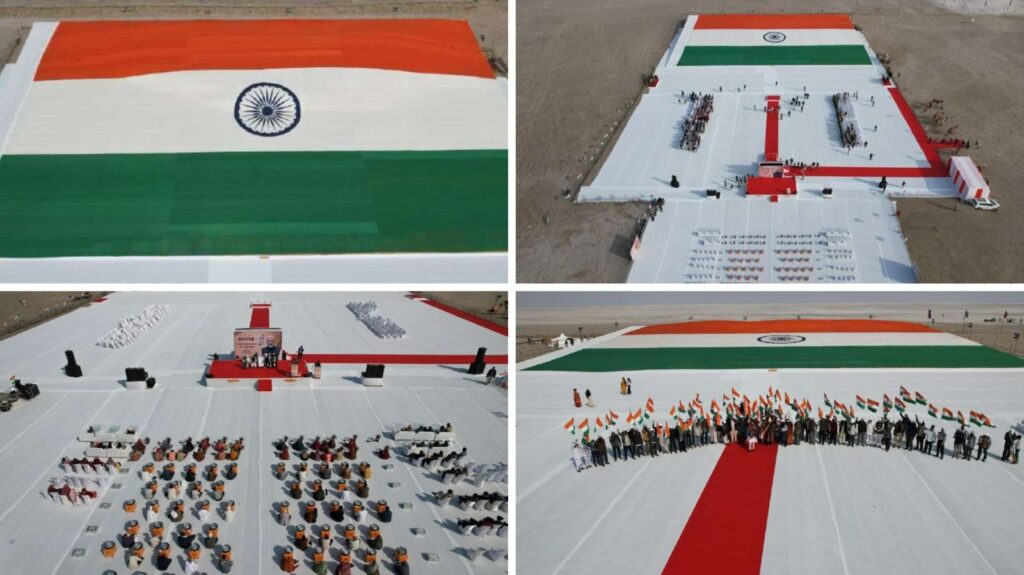
The white Rann of Kutch-where you see horizon of earth and sky-has become not only a natural miracle but also a living symbol of the changing self-confidence of the new India. Amidst this vast spread, a grand and divine display of the world’s largest iconic Khadi tricolor was recently held on the occasion of Republic Day. This was not just an event, but a powerful public manifestation of indigenous tradition, national resolve, and contemporary India’s growth vision under the visionary leadership of Prime Minister Shri Narendra Modi.
This amazing, incredible, and unbelievable spectacle was witnessed by the country’s artisans, armed force personals and citizens. It also created a new record in itself that millions of Khadi artisans across the country created history by saluting the national flag through video messages. This moment emphasizes that nation-building is not the effort of a single institution or class, but the result of collective determination. This tricolor is not merely an extension of cloth, but an extension of thought. Khadi, once called the soul of the freedom movement, is today being redefined as the energy of a self-reliant India. Mahatma Gandhi’s statement-“Khadi is a symbol of India’s economic independence and self- respect”-comes alive with a new meaning in contemporary India.
To understand this national renaissance, one only needs to look at Bhuj. A devastating earthquake once inflicted deep wounds on this city, but in that very moment of crisis, a visionary saw reconstruction not just as a necessity but as an opportunity. Under the leadership of the then Chief Minister and today’s Prime Minister, Shri Narendra Modi, Bhuj was reborn-through planned urbanization, robust infrastructure, and community restoration.
After 25 years of reconstruction, Bhuj is not just standing tall; but it is moving ahead. It is a testament to the fact that when leadership has clarity and resolve, even disaster can become a prelude to development.
Geographically, Bhuj’s importance is further enriched by its location in a border region. Here, development and security are not contradictory, but complementary. The vigilant presence of positioned Indian soldiers reminds us that a nation’s economic progress depends on its strategic stability. Inspired by the spirit of “Operation Sindoor,” the salute to the Khadi Tiranga (world’s largest iconic tricolor) is, in fact, the nation’s collective gratitude to the countless heroes whose sacrifices ensure the uninterrupted flow of development.
If the tricolor is a symbol of national pride, then Khadi is the soul of that pride. Prime Minister Shri Narendra Modi has uplifted Khadi from the memory of the past and made it a part of the strategy for the future. In his words, “Khadi is not just a cloth, but the ideology and mass movement of a self-reliant India.”
This mass movement has galvanized the entire nation. The results are evident. Today, the concept of Gram Swaraj appears to be translating into practical economics. Sales of Khadi and Village Industries products have crossed Rs 1.70 lakh crore and are set to reach Rs. 2 lakh crore very soon. Even more remarkable is that this sector has provided employment to over 20 million persons-a transformation that establishes rural India as a productive force, not just a consumer one.
Initiatives to train, distribute tools, and promote local skills in border areas have presented a decentralized model of development. The distribution of over 2.88 lakh machines and toolkits over the past 11 years clearly indicates that India’s development is no longer limited to metropolitan cities; it is gaining a broader social base through villages, cottage industries, and traditional artisans.
At the heart of this transformation is the dignity of labour. Khadi artisans’ wages have increased to Rs.15 per hank, and the resolution to raise this to Rs. 20 per hank shows that economic development truly means increasing wages, as well as establishing dignity. This phenomenon truly signals an emerging “Artisan Age”-a time period in which tradition and technology are amalgamating to create new prosperity.
The power of symbols is further enhanced in the digital age. #IconicKhadiTiranga’s garnering over 20 million views on social media is not merely a sign of admiration, but also a psychological shift. Gen-Z’s connection to this symbol, in particular, suggests that the new generation wants to embrace its cultural identity with equal conviction, alongside global aspirations.
The tricolor, shining majestically and divinely in the white Rann of Kutch, ultimately leads us to a broader truth- nation-building is not the result of a single policy, a single project, or a single period of time. It is built on vision, steadiness, and collective faith. When heritage is cherished, when development is inclusive, when borders are secure, and when leadership has the courage to envision the future-then change becomes not an event, but an era.
The renaissance of Bhuj, the revival of Khadi, and the new dynamism of Gram Swaraj are together creating an India not only of possibilities, but of achievements- confident, self-reliant, and decisive.
The (iconic Khadi tricolor), Illuminated on the canvass of the ‘white desert, is the flagbearer of this India–a flag that not only flutters in the wind, but also gives a new identity to the consciousness of a nation on the global stage.