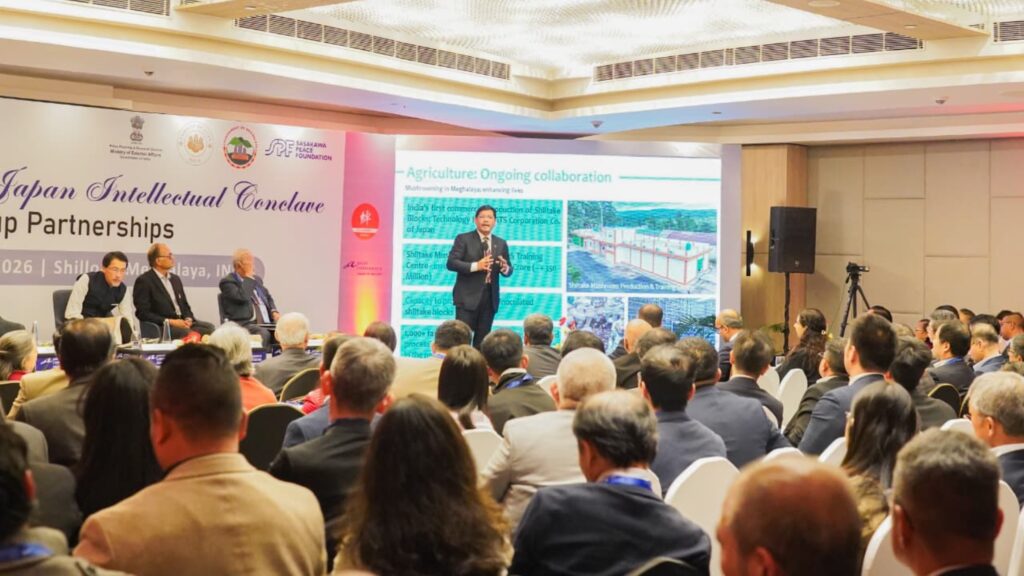
Shillong, February 26 : The Sixth India–Japan Intellectual Conclave titled “Kizuna” was held today at Vivanta, Shillong, with Chief Minister Conrad K. Sangma attending as the Chief Guest.
Among those present during the inaugural session were Ambassador Ono Keiichi, N.J. Gangte, Secretary and OSD (Establishment), Ministry of External Affairs & Acting DDG, ICWA, and Takuro Takeuchi, Chief Representative, JICA India, among others.
In his inaugural address, the Chief Minister stated that India–Japan ties are anchored in mutual respect, democratic values and a shared vision for economic cooperation and sustainable development. He remarked that given the strength of the relationship between the two countries, “Kizuna” — meaning a lasting bond — was the most appropriate theme for the conclave.
Highlighting Japan’s partnership with Meghalaya, Sangma described Japan as a steadfast development partner, noting that the collaboration extends beyond infrastructure to people-centric initiatives. He informed that 47 nurses from Meghalaya are currently placed in Japan. Following his visit to Japan in April 2025, the state signed an MoU with ASEAN One Co. to train and place 500 youth this year, with plans to scale up to 5,000 over the next five years. He also mentioned a partnership with NAVIS HR for placement of skilled resources from Meghalaya in Japan, and the establishment of a Japanese language training centre in Shillong to equip youth with language proficiency.
In the field of agricultural innovation, the Chief Minister said India’s first commercial production of shiitake mushroom blocks is underway in Upper Shillong with support from Japan’s YATS Co. The facility has a capacity to produce 1,50,000 inoculated shiitake blocks annually and is expected to benefit over 1,000 farmers in the state. Meghalaya is also exploring the creation of its own sake using local rice in collaboration with Sasaki Sake Brewery.
Referring to the long-standing partnership with JICA, the Chief Minister stated that the agency is a major development partner in Meghalaya, investing in infrastructure, sustainable forestry and tourism. He informed that 22,500 hectares of forest are being restored under the JICA-supported MegLIFE project, benefiting rural communities across 500 villages in 11 districts.
He further noted that the Umiam Hydro Power Station and the Umiam-Umtru Stage-III Hydroelectric Power Station are being renovated with JICA’s support. Additionally, the nearly 19-km-long river bridge connecting Dhubri in Assam to Phulwari in Meghalaya is primarily funded by JICA.
Pointing out that 74 percent of Meghalaya’s population is under the age of 35, the Chief Minister proposed the establishment of a Meghalaya–Japan Skill Corridor, stating that the youthful energy of Meghalaya can be paired with Japan’s technological expertise.
On cultural collaboration, he mentioned that the Shillong Cherry Blossom Festival has featured an exclusive Japanese pavilion over the last two years, showcasing Japanese traditions, cuisine and performances.
Concluding his address, the Chief Minister invited Japanese businesses and academic institutions to collaborate with Meghalaya in areas such as circular economy, climate resilience, technology, agriculture and sustainable tourism. Expressing gratitude to the Embassy of Japan, the Ministry of External Affairs and Asian Confluence for organising the conclave, he said the event has created a living bridge that signals commitment to deepening engagement with Meghalaya and the wider Northeast.
Earlier, the Chief Minister also visited an exhibition of artefacts from the Imphal Peace Museum and North East Archives.