
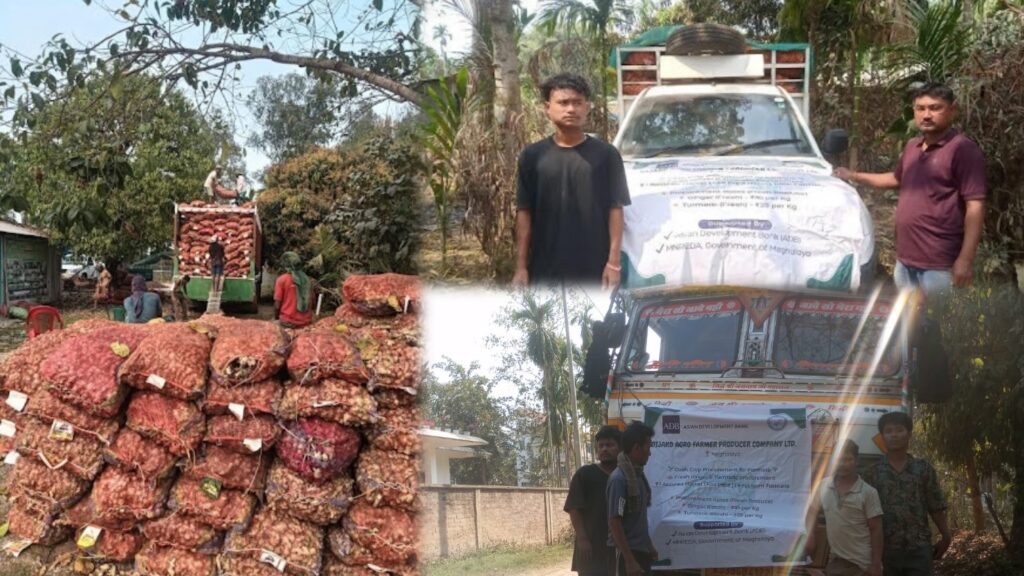
Tura, February 27 : In a landmark boost to hill agriculture, farmers in the Garo Hills region have achieved a major market breakthrough with the direct procurement of 150 metric tonnes of ginger and turmeric, benefiting 870 small and marginal farmers across 54 villages in North Garo Hills .
The initiative marks a decisive shift from traditional market challenges, where farmers were heavily dependent on middlemen, faced volatile prices, and struggled with high transportation costs due to the region’s difficult terrain .
For decades, farmers in remote villages of Garo Hills cultivated high-quality ginger and turmeric but lacked access to organized markets. In the absence of direct buyers, local traders often dictated prices, leaving farmers with minimal bargaining power .
Expensive transportation, post-harvest losses, delayed sales, and the lack of storage facilities further added to their difficulties. Small and marginal farmers were particularly affected, as they produced limited quantities and could not access bulk buyers or distant mandis .
Price fluctuations during peak harvest seasons frequently forced farmers to sell at distress rates, only to see prices rise later in the market .
The programme has been implemented through a collaborative effort involving Save the Nature International and Cultivator Natural Products, Jodhpur, in partnership with Dijako Agro Farmer Producer Company (FPC). The initiative is supported under the market linkage programmes of the Meghalaya New and Renewable Energy Development Agency (MNREDA) and the Asian Development Bank (ADB) .
Under the Business-to-Business (B2B) procurement system, farmers are directly connected with bulk buyers and exporters, eliminating intermediaries and ensuring transparent pricing .
Multiple consignments have already been dispatched, including a recent shipment of 20 metric tonnes, bringing the total procurement to 150 metric tonnes of fresh ginger and turmeric .
A key feature of the initiative is price assurance. Farmers are offered fixed prices of around ₹40 per kilogram for fresh ginger and ₹25 per kilogram for fresh turmeric, providing predictable and stable income .
Dr. Joram Beda, Director, MNREDA, said price fluctuation in cash crops has long been a major challenge for farmers in Meghalaya, and the initiative aims to connect them directly with large exporters through structured procurement systems .
Rupat Momin, Chairman, MNREDA, stated that efforts are underway to invite more large companies such as Everest and Mangalam Organics, along with other organic supply chain partners, to create competitive markets and multiple selling platforms for farmers .
Dijako Agro Farmer Producer Company plays a crucial role as an aggregator and facilitator. The FPC consolidates produce from individual farmers into bulk quantities and coordinates procurement with buyers. It also supports sorting, grading, and packaging to meet quality standards required by exporters .
Beyond market access, the initiative provides on-field aggregation, packaging support, loading and unloading assistance, and transportation coordination. These measures significantly reduce post-harvest losses and ease the burden on farmers in remote areas .
The participation of 870 farmers across 54 villages highlights the scale and acceptance of the programme .
Farmers have reported higher and more stable incomes, reduced dependence on middlemen, greater confidence to expand cultivation, and access to reliable market information .
Garo Hills is known for its aromatic and naturally grown ginger and turmeric, making it suitable for premium domestic and export markets. By linking farmers with companies catering to national and international markets, the initiative is opening new avenues for export-oriented supply chains .
The collaboration between government agencies, international institutions, private companies, and Farmer Producer Organizations demonstrates a scalable public-private-community partnership model .
As more villages and companies join, the initiative is expected to expand to other crops such as spices, fruits, and medicinal plants, further strengthening Meghalaya’s position as a source of high-value organic produce .