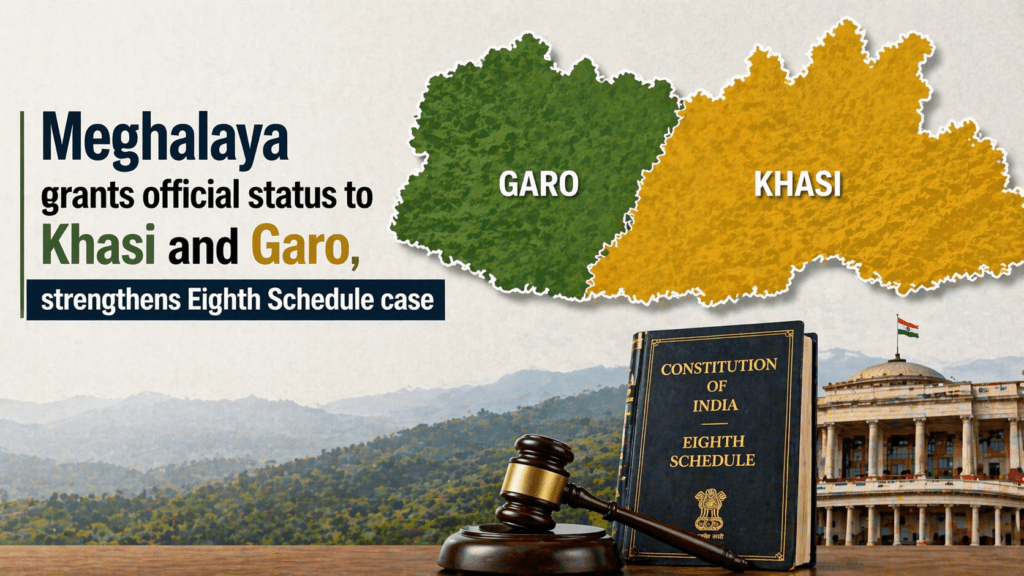
Shillong, April 21 : With the approval of the Meghalaya Official Languages Ordinance, 2026, by the State Cabinet, the Khasi and Garo languages were recently elevated to the status of official language alongside English. The decision, taken by the State Cabinet under the leadership of Conrad K. Sangma, Chief Minister marks a decisive step in strengthening the constitutional case for inclusion of these languages in the Eighth Schedule of the Constitution of India.
A Government-Led Initiative Rooted in Constitutional Commitment : While the demand for greater recognition of Khasi and Garo has long been articulated by various sections of society, the State Government had played a proactive and enabling role in translating these aspirations into actionable policy. The ordinance reflects a deliberate and strategic intervention aimed at reinforcing Meghalaya’s commitment to linguistic federalism and the preservation of indigenous identity within the constitutional framework.
The new ordinance repeals the Meghalaya State Language Act, 2005, under which Khasi and Garo were accorded associate official status in select districts. With this move, both languages are now placed on equal administrative footing with English, enabling their use across official communications, government orders, and administrative processes.
Advancing Linguistic Accessibility and Democratic Participation : The Government has underscored that granting official language status is integral to deepening participatory governance and improving accessibility in public service delivery. It has been indicated that the decision is expected to strengthen engagement with citizens, particularly in rural and indigenous communities, while also enhancing inclusivity in governance and education.
Conrad K Sangma, Chief Minister in his earlier remarks, had also highlighted that such a step was necessary to send a strong signal, both within the State and to the Government of India, regarding Meghalaya’s commitment to promoting its indigenous languages and advancing their case for inclusion in the Eighth Schedule. Hon’ble Chief Minister also acknowledged the contributions of Khasi Authors’ Society and Achik Literature Society for their relentless hard work that has resulted in the landmark decision and seeked their support in moving forward with its implementation.
This move has received positive public response, with widespread appreciation reflected across public discourse and digital platforms, where citizens have welcomed it as a long-awaited recognition of the State’s linguistic heritage.
A Strategic Push Toward Eighth Schedule Inclusion : The ordinance is being positioned as a critical step in Meghalaya’s broader constitutional roadmap. By institutionalising the use of Khasi and Garo within the State’s administrative framework, the Government has further strengthened its case for national-level recognition.
The State leadership has consistently maintained that formal recognition at the State level would serve as a strong foundation for advancing the inclusion of these languages in the Eighth Schedule, thereby ensuring greater linguistic protection, promotion, and access to central support mechanisms.
Institutional Preparedness and Long-Term Vision : The Government has acknowledged that effective implementation will require sustained institutional investment, including the appointment of translators, capacity-building of administrative personnel, and integration of language use across departments.
In this context, it was also noted that future legislative proceedings, including sessions in the new Assembly building, could increasingly reflect the use of Khasi and Garo, signalling a deeper institutional integration of the State’s linguistic identity.