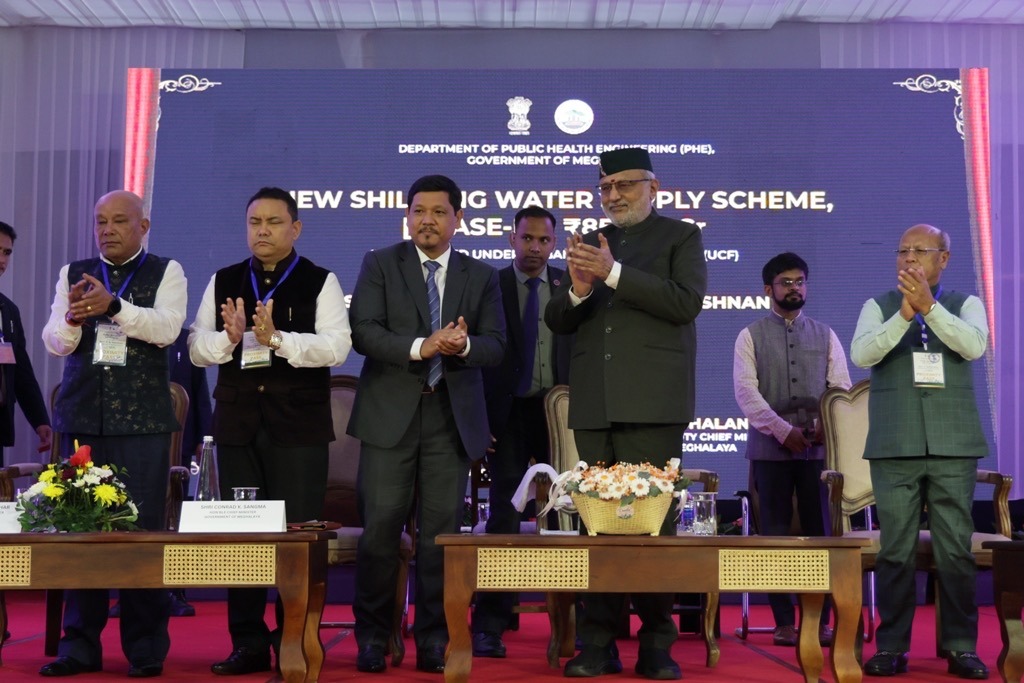
Shillong, September 7: Vice-President of India C. P. Radhakrishnan on Monday laid the foundation stones for five major development projects worth ₹1,010.95 crore in Meghalaya and inaugurated a ₹31.05-crore Maternity and Children’s Hospital at Nongstoin during his maiden visit to the state.
The Vice-President, who attended a public reception organised by the Meghalaya Government and the people of the state at U Soso Tham Auditorium in Shillong, said every state, village and citizen must progress for India to achieve the goal of becoming a developed nation by 2047. Expressing gratitude for the warm reception, Radhakrishnan said he would stand with the people of Meghalaya in the state’s development journey.
The five projects for which foundation stones were laid include the ₹850.58-crore New Shillong Water Supply Scheme Phase II, Part A under the Urban Challenge Fund, two road connectivity projects under the North East Special Infrastructure Development Scheme, a 30-bedded AYUSH facility at Shillong Civil Hospital and a 132/33 KV substation at Mawkhanu under the PM-DevINE scheme. He also inaugurated the Maternity and Children’s Hospital at Nongstoin, constructed at a cost of ₹31.05 crore under the National Health Mission.
The Vice-President said the projects, involving a combined investment of around ₹1,042 crore, would strengthen Meghalaya’s water supply, road connectivity, healthcare and power infrastructure. Highlighting the importance of improving connectivity in the Northeast, Radhakrishnan said efforts are being made to connect remote villages with towns and cities. He said more than 46,000 km of rural roads have been constructed in the Northeast under the Pradhan Mantri Gram Sadak Yojana over the last decade at an expenditure of more than ₹47,000 crore. He also appreciated Meghalaya’s reform-linked Memorandum of Understanding under Jal Jeevan Mission 2.0.
Referring to Meghalaya’s cultural heritage, natural beauty and unique matrilineal society, the Vice-President said the state’s grassroots institutions reflect the diversity and democratic traditions of India. He also recalled his former Lok Sabha colleague and former Speaker P. A. Sangma, describing him as a great leader and outstanding Parliamentarian who made a significant contribution to parliamentary democracy. Radhakrishnan said true secularism means respecting each other’s thoughts and beliefs and stressed the need for people to live together in mutual respect and harmony.
He said development must be inclusive and ensure that no section of society is left behind while Meghalaya’s environment, traditions and cultural identity are preserved. Referring to the living-root bridges and the landscapes of Sohra and Mawsynram, he said Meghalaya offers valuable lessons on how people can live in harmony with nature.
The Vice-President also appreciated several initiatives of the Meghalaya Government, including its infrastructure and tourism programmes, the homestay initiative, CM-Elevate and Green Meghalaya.
Chief Minister Conrad K. Sangma, meanwhile, described the Vice-President’s maiden visit to Meghalaya as historic, saying it made the people of the state feel included and cared for. “I extend a warm welcome to the Vice-President on his maiden visit to Meghalaya. Your visit today is truly historic for us. It makes us feel inclusive, it makes us feel wanted, it makes us feel that our leaders care about us,” Sangma said.
He expressed hope that the visit would mark the beginning of a stronger relationship between the Vice-President and the people of Meghalaya. The Chief Minister said the bond between Radhakrishnan and Meghalaya dates back to his friendship with late P. A. Sangma when both served as members of the 12th and 13th Lok Sabha.
Sangma said Meghalaya, now 54 years old, has witnessed several challenges over the decades but its greatest strength continues to be its communities, traditional institutions and cultural identity, which existed even before formal systems of governance. He said the Northeast, including Meghalaya, has undergone significant transformation over the last eight years with support from the Centre and Prime Minister Narendra Modi.
According to the Chief Minister, Meghalaya, which once remained near the bottom of several national rankings, has made significant progress through sustained government initiatives, teamwork and the contribution of young entrepreneurs, women’s self-help groups and farmers. He said Meghalaya is now among the fastest-growing economies in the country, registering growth of nearly 12.8 per cent.
However, Sangma said economic progress cannot be measured by Gross State Domestic Product alone and stressed that growth must create opportunities for young people, improve farmers’ incomes and strengthen healthcare and education. He said Meghalaya’s Maternal Mortality Ratio, which was earlier above 250 and almost twice the national average, has fallen by more than 55 per cent, which he described as the highest percentage decline in the country.
On education, the Chief Minister said Meghalaya improved from around 410 points in the Akanshi-III category of the Performance Grading Index to more than 520 points in Akanshi-I within two years, describing it as one of the strongest improvements among states.
Despite pursuing rapid economic development, Sangma said Meghalaya would continue to protect its roots, culture, traditions and identity. “We have many challenges, but if community and society work together, we will achieve our goal of making Meghalaya one of the top ten states,” he said.
Deputy Chief Ministers Prestone Tynsong and Sniawbhalang Dhar, Minister Sanbor Shullai, Chief Secretary Dr. Shakil P. Ahammed and other senior officials and dignitaries were present at the programme.