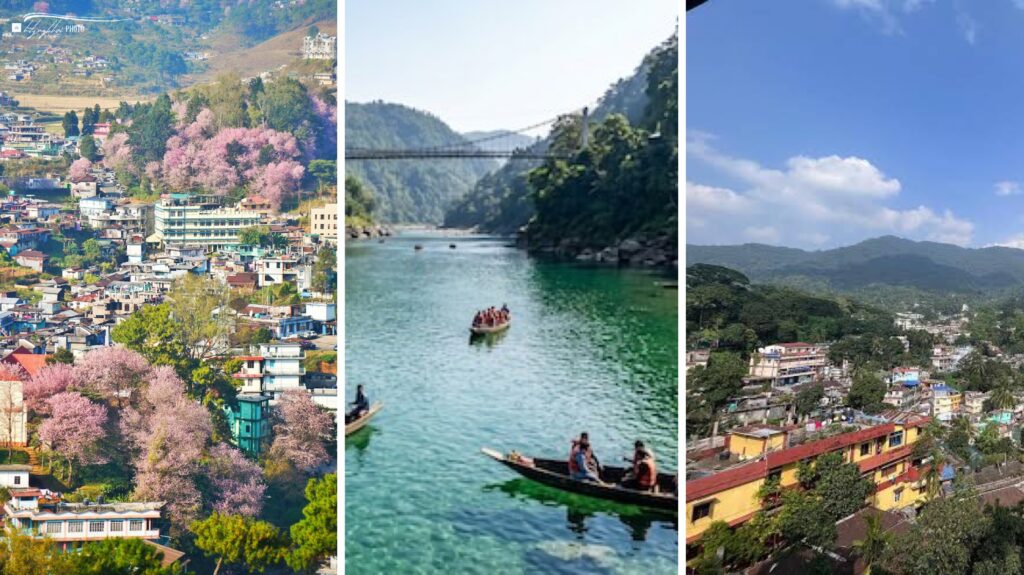
Shillong, September 24: Three towns in Meghalaya—Tura, Nongstoiñ and Dawki—have recorded some of the lowest annual concentrations of fine particulate matter among Indian locations included in the World Health Organization’s latest air-quality database.
An analysis of the Indian entries in the WHO Ambient Air Quality Database Version 8.0 found Tura recording an annual average PM2.5 concentration of 6 micrograms per cubic metre, followed by Nongstoiñ at 7 micrograms and Dawki at 8 micrograms per cubic metre.
The three Meghalaya towns featured among the five Indian locations with the lowest reported readings. Lunglei in Mizoram recorded 6 micrograms per cubic metre, while Kolasib, also in Mizoram, recorded 8 micrograms.
Reacting to the report, Chief Minister Conrad K. Sangma said the recognition reflected Meghalaya’s clean, green and naturally pristine environment.
“Tura, Nongstoiñ and Dawki have been recognised among the five locations in India with the lowest reported annual average PM2.5 concentrations,” Sangma said in a social media post.
He credited Meghalaya’s communities for safeguarding the state’s natural environment and maintaining a close relationship with nature as part of their way of life.
“This is a wonderful reflection of Meghalaya’s clean, green and naturally pristine environment, sustained by communities that have always valued and protected nature as part of their way of life,” he said.
The Chief Minister called on residents to continue protecting the state’s forests, rivers and air and to preserve Meghalaya’s natural heritage for future generations.
Tura, the headquarters of West Garo Hills district and Meghalaya’s second-largest town after Shillong, shares the lowest reading in the Indian dataset with Lunglei.
Nongstoiñ , the headquarters of West Khasi Hills district, recorded the third-lowest annual PM2.5 concentration, while Dawki in West Jaintia Hills registered the fourth-lowest reading.
Dawki, situated near the international border with Bangladesh and around 84 kilometres from Shillong, is widely known for the Umngot River and its border trade and tourism activities.
The data highlights the Northeast’s strong presence among Indian locations with comparatively low particulate pollution, with four of the five lowest readings coming from Meghalaya and Mizoram.
However, the figures should not be interpreted as an official WHO ranking of India’s cleanest towns. The measurements for all five locations are from 2021 and do not represent current air-quality conditions in 2026.
The WHO has also cautioned that its database is not comprehensive and that monitoring coverage and measurement methods differ between locations.
PM2.5 refers to fine particulate matter measuring 2.5 micrometres or less in diameter. Such particles can originate from vehicle emissions, fossil-fuel combustion, industrial activity and other sources. They can pose serious health risks because they penetrate deep into the lungs.
Although Tura, Nongstoiñ and Dawki are situated in predominantly hilly areas with smaller urban footprints than major metropolitan centres, the WHO data alone does not establish geography or forest cover as the reason for their comparatively low readings.
Air quality is influenced by several factors, including traffic, local emissions, industrial activity, fuel consumption, weather, topography and the extent and location of monitoring.
A low annual average also does not mean pollution is absent throughout the year, as short-term episodes of poor air quality may still occur.