Shillong, September 30: A public hearing on the social audit of the Khyndailad MUDA Complex Hawkers’ Market has highlighted discrepancies in records relating to Certificates of Vending (CoVs), stall and space allocation, relocation assistance and other aspects of the rehabilitation of street vendors.
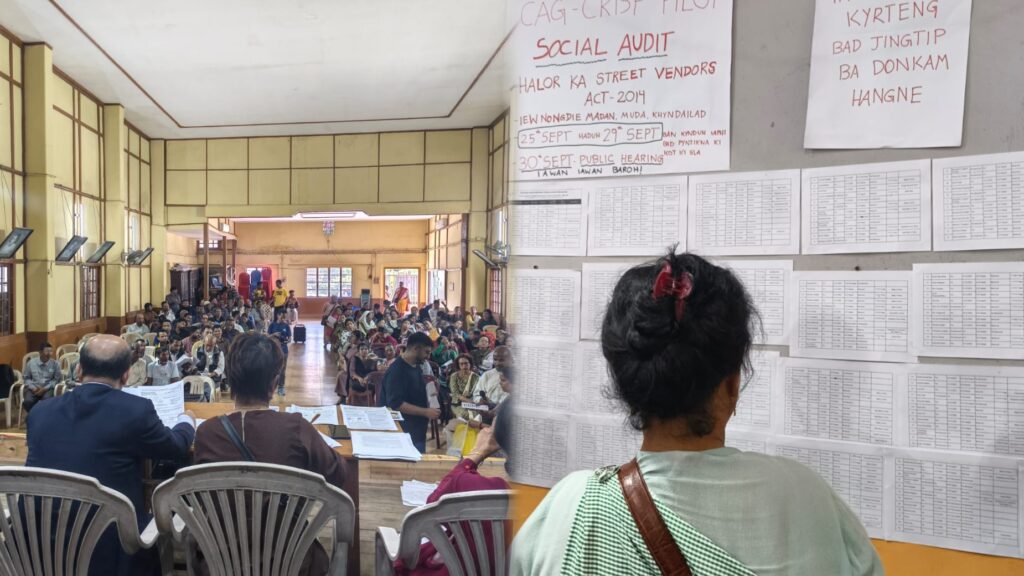
The public hearing on the C&AG–CRISP Pilot Social Audit of the Street Vendors Act, 2014 was held at Bangiya Sahitya Parishad Hall, Jail Road, Shillong, on September 30. It followed verification exercises conducted from September 25 to 29, during which government records were compared with documents held by vendors, their testimonies and conditions on the ground.
The exercise was facilitated by a trained Social Audit Facilitation Team with support from the Meghalaya Society for Social Audit and Transparency (MSSAT). More than 250 hawkers attended the public hearing and registered their grievances. Several vendors produced survey slips, CoVs, bank records and other documents in support of their claims. Officials from the Accountant General’s Office also examined and verified the documents presented.
Many vendors complained of prolonged delays in obtaining CoVs, repeated visits to municipal offices, loss of income and difficulties in sustaining their livelihoods after relocation. The independent jury comprised Deputy Accountant General Binod Bhujel, Deputy Commissioner of Food Safety (Enforcement) B. Mukhim and Highland Post Editor Rikynti Marwein. Representatives of the municipal authorities, Urban Affairs Department and MUDA, though invited, were reportedly absent from the hearing.
Bhujel observed that the absence of responses from the authorities concerned on complaints and grievances weakened accountability. The audit findings pointed to discrepancies between survey records, CoVs and stall allocation records. In some cases, vendors were reportedly marked as “Not Surveyed” despite possessing documents indicating that they had undergone the survey process. Differences were also noted in names and stall numbers.
Vendors further alleged repeated applications and hearings for CoVs, with some claiming to have made more than 20 visits. One case reportedly involved a seven-day hunger strike, while another CoV application allegedly took nearly two years to process. The hearing also noted discrepancies between CoVs held by vendors and official records, including differences in expiry dates, trade details and photographs.
Questions were also raised over stall allocation and occupancy. Some vendors claimed they had been promised space outside the MUDA complex but were eventually allotted stalls inside. In certain cases, the person operating a stall could not be clearly matched with the CoV holder or nominee.
Relocation allowance was another major issue. Vendors reported non-payment, delays and payments ranging from ₹6,000 to ₹18,000, below the stated ₹20,000 amount. These claims will require reconciliation with government and bank records.
Concerns were also raised over the physical condition of the MUDA Hawkers’ Market, including small stalls, inadequate water supply, drainage, ventilation, lighting and toilet facilities. Vendors also complained of reduced customer footfall and declining income following relocation.
The hearing further flagged questions regarding the PTVC, whose tenure was stated to have expired as per notification, as well as gaps in the digital survey trail, including the absence of unique vendor IDs in some of the records examined.
The findings and grievances placed before the hearing will now be forwarded to the concerned government departments. A final report, follow-up hearings and an exit meeting with the state government are expected as part of the social audit process.
In his concluding remarks, Bhujel said field verification through social audits and public hearings was important as it brought the experiences of citizens on record and provided them a platform to raise their concerns. He expressed hope that the government would examine the issues and take appropriate action in the public interest.