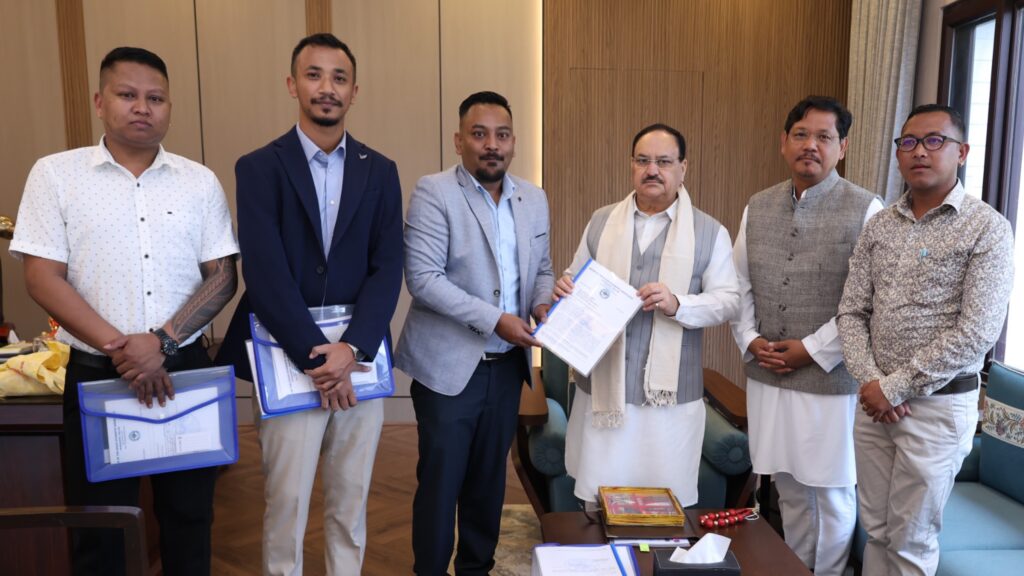
Shillong, October 31: The Khasi Students’ Union (KSU) has submitted an eight-point representation to Union Minister of Health and Family Welfare Jagat Prakash Nadda, seeking his immediate intervention in several recruitment and administrative issues at the North Eastern Indira Gandhi Regional Institute of Health and Medical Sciences (NEIGRIHMS), Shillong.
In a representation dated October 31, 2026, KSU President Raymond Kharjana and General Secretary Reuben A. Najiar expressed concern over what they described as recruitment policies adversely affecting employment opportunities for the indigenous tribal population of Meghalaya.
The union alleged that despite submitting several representations and organising protests over the years, the NEIGRIHMS administration had failed to address its concerns and continued introducing policies that were detrimental to local candidates. Among its major demands, the KSU urged the Union Health Minister to introduce an 80:20 female-to-male ratio in the recruitment of Nursing Officers at NEIGRIHMS, similar to the system adopted by AIIMS and other premier medical institutions.
The union stated that female nursing personnel play an important role in ensuring patient comfort, dignity and appropriate care, particularly in departments such as Obstetrics, Gynaecology, Maternity, Neonatal Intensive Care and Paediatrics. Referring to the recruitment conducted through the Nursing Officer Recruitment Common Eligibility Test (NORCET) in 2023, the KSU claimed that out of 194 selected candidates, 175 were male and only 19 were female.
The union questioned the recruitment process and alleged that the absence of an 80:20 female-to-male ratio had resulted in an imbalance in nursing staff appointments. It also cited the Central Administrative Tribunal’s ruling in Ranveer Singh & Anr versus Union of India, which upheld the provision reserving 80 per cent of Nursing Officer posts for women under Article 15(3) of the Constitution.
The KSU further demanded the removal of the eligibility requirement mandating two years of professional experience in a hospital with at least 50 beds for Nursing Officer recruitment. While maintaining that it had no objection to the two-year experience requirement, the union argued that restricting eligibility to candidates employed in hospitals with 50 or more beds would disadvantage local nurses working in Primary Health Centres (PHCs), Community Health Centres (CHCs) and smaller hospitals across Meghalaya.
According to the union, many healthcare institutions in the state have fewer than 50 beds, although their nursing personnel possess considerable professional experience. Raising another serious concern, the KSU accused the NEIGRIHMS administration of allegedly protecting male Nursing Officers facing molestation allegations involving an indigenous woman and a minor girl. The union claimed that FIRs had been registered in the cases and that police had filed charge sheets. It questioned why the accused personnel had allegedly been allowed to continue working instead of being suspended pending further proceedings.
The KSU also expressed concern over the alleged handling of a case involving a minor girl under the Protection of Children from Sexual Offences (POCSO) Act, accusing the administration of failing to take appropriate action. These allegations were made by the union in its representation, and the document did not include a response from the NEIGRIHMS administration or the accused personnel.
On recruitment eligibility, the KSU opposed the reduction of the upper age limit for Nursing Officers and other posts from 35 to 30 years, and to 27 years for Pharmacist posts. The union maintained that lowering the age limit would adversely affect aspiring candidates, particularly indigenous applicants who had been preparing for recruitment examinations. It demanded that the amended Recruitment Rules be scrapped and the earlier upper age limit of 35 years restored, along with applicable age relaxations for reserved categories.
The KSU also opposed the outsourcing of recruitment examinations through NORCET and other Computer-Based Tests (CBT), urging the Union Government to allow NEIGRIHMS to conduct its own examinations through offline mode. According to the union, the shortage of computer examination centres and inadequate infrastructure in Meghalaya create difficulties for candidates, particularly those from economically disadvantaged backgrounds who may be required to travel long distances to appear for examinations. The union also raised concerns over the involvement of HLL, the agency engaged for recruitment examinations, alleging irregularities in previous selection processes. It called for recruitment examinations to be conducted directly by NEIGRIHMS, as was done in earlier years.
Another issue highlighted in the representation concerned alleged discrepancies in the reservation roster, particularly vacancies earmarked for the Economically Weaker Sections (EWS). The KSU alleged that the recruitment roster included EWS backlog vacancies contrary to Department of Personnel and Training (DoPT) guidelines and demanded that the discrepancies be rectified before a fresh recruitment advertisement is issued.
The union also questioned the existing reservation arrangements for Other Backward Classes (OBC), Scheduled Castes (SC) and Scheduled Tribes (ST) in NEIGRIHMS recruitment. It argued that the existing reservation system provided insufficient opportunities for indigenous Scheduled Tribe candidates from Meghalaya while allocating a comparatively higher proportion of vacancies to other categories. Referring to the 27 per cent reservation for OBCs and 15 per cent for SCs in Central Government recruitment, the KSU questioned their application in Meghalaya, citing the state’s demographic composition and the absence of a state OBC list. The union also cited Supreme Court judgments, including Bir Singh versus Delhi Jal Board and M.C.D. versus Veena & Others, in support of its arguments concerning reservation eligibility for candidates migrating between states. It urged the Union Government to review the recruitment reservation framework at NEIGRIHMS to ensure greater employment opportunities for the indigenous tribal population of Meghalaya.
Meanwhile, the KSU also demanded that NEIGRIHMS be granted the status of an Institute of National Importance (INI) through an Act of Parliament. The union stated that NEIGRIHMS was established as a premier healthcare institution for the North Eastern Region, modelled along the lines of AIIMS and the Postgraduate Institute of Medical Education and Research (PGIMER). It maintained that granting INI status would strengthen the institute’s academic and administrative autonomy, promote medical research and innovation, improve healthcare services and help address regional healthcare disparities.
In its eight-point representation, the KSU called for the introduction of the 80:20 female-to-male nursing ratio, removal of the 50-bed hospital experience requirement, suspension of personnel facing molestation charges, restoration of the previous recruitment age limit, conduct of offline examinations by NEIGRIHMS, correction of EWS vacancies, revision of reservation arrangements and granting of INI status to the institute.
The union urged the Union Health Minister to initiate the necessary legislative and administrative measures to address the issues and ensure the overall development of NEIGRIHMS. It maintained that timely intervention by the Central Government was necessary to protect the interests of indigenous job seekers while strengthening healthcare services in Meghalaya and the wider North Eastern Region.