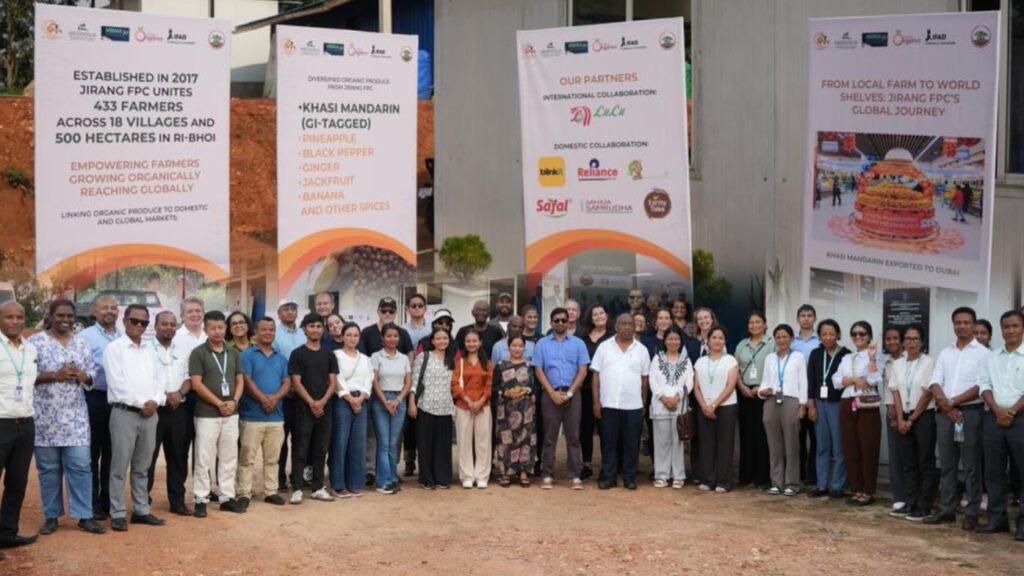
Shillong, November 2: A 21-member delegation of Executive Board representatives of the International Fund for Agricultural Development (IFAD) on Monday began the Meghalaya leg of its Annual Country Visit to India with field visits to the Meghalaya Livelihoods and Access to Markets Project (M-LAMP) sites at Jirang in Ri Bhoi district. The delegation comprised representatives from eight countries, including Brazil, China, Eritrea, Finland, Indonesia, Nigeria, Norway and the United Kingdom, along with officials from IFAD Headquarters, IFAD India Office and the Department of Economic Affairs, Government of India. Among the delegates were IFAD Secretary Claudia Ten Have, Associate Vice-President of the Department for Country Operations Donal Brown, Director of the Independent Office of Evaluation Indran Naidoo, Director of the Asia and the Pacific Division Reehana Raza, and IFAD Country Director for India James Marc de Sousa-Shields. The delegation also included Director S. Divyadharshini, IAS, and Senior Consultant Jay K. Sharma from the Department of Economic Affairs, Government of India.
Implemented by the Meghalaya Basin Management Agency (MBMA) with IFAD support since December 2014, M-LAMP has reached more than 9.1 lakh people across 1.99 lakh households in Meghalaya. The project has a total cost of US$205.75 million, including US$70.64 million in IFAD financing. The initiative operates through village-level Integrated Village Cooperative Societies (IVCS), which currently have approximately 1.13 lakh shareholders and have disbursed around US$5.3 million in loans. The project also follows a hub-and-spoke model to strengthen the processing and marketing of locally produced agricultural products.
During the first day of the visit, the delegation inspected the Jirang Experiential Farm, a 100-acre model farm owned by the Eastern Region Marketing Cooperative Society (EARMACS), established with technical support from Fruit Valley Farm Meghalaya LLP. The farm demonstrates the cultivation of high-value spices and fruits using recommended agricultural practices. The delegates toured the farm and interacted with farm managers and representatives of EARMACS to understand its operations and contribution to local agricultural development.
Briefing the delegation, MBMA Deputy Project Director Augustus S. Suting highlighted the agency’s role as a non-profit entity of the Meghalaya Government dedicated to natural resource management and its longstanding collaboration with IFAD through various development initiatives. He explained Meghalaya’s Service Provider Model, which connects farmers to larger markets through aggregation, certification and logistics support. Suting also highlighted how farmer-owned PRIME Hubs and Collective Marketing Centres, established under the cooperative model, support agricultural aggregation, value addition and market linkages. He further explained the role of Fruit Valley Farm Meghalaya in promoting plantation-based agri-tourism activities, which provide additional income opportunities for farmers while showcasing the state’s horticultural produce.
Emphasising sustainable agriculture, Suting stressed the need to promote and replicate multi-cropping and crop diversification across Meghalaya to increase farm incomes and strengthen agricultural resilience. He also traced the evolution of community institutions in the state, from natural resource management groups to Self-Help Groups and Integrated Village Cooperative Societies, with larger community collectives emerging as the next stage of institutional development.
The delegation subsequently visited the PRIME Hub at Jirang, where a video presentation highlighting M-LAMP activities was screened. The delegates also inspected the pineapple pulping unit operated by Jirang Agro Farmer Producer Company Limited. Briefing the visiting delegation, Jirang Agro FPC Chief Executive Officer Ibalahun Thangkhiew explained how collective farming has improved agricultural practices and strengthened the bargaining power of farmers. She informed that the company supplies agricultural produce to major domestic buyers, including Reliance Retail, Mother Dairy, Flipkart, BigBasket and Swiggy. The company has also been supplying Khasi mandarins and pineapples to international markets such as Singapore and Dubai, with plans to further strengthen export volumes through an upcoming agreement with the state marketing agency. Thangkhiew explained that previously, only Grade A fruits could be sold in the fresh market, while lower-grade produce often went to waste.
To address the problem, the company proposed the establishment of a processing facility to the Meghalaya Government. The pineapple pulping unit, completed in 2025, now enables the company to add value to agricultural produce procured directly from farmers while reducing post-harvest losses. She highlighted that women carry out a significant portion of the processing activities, contributing to employment and livelihood opportunities in the area.
Thangkhiew further informed that organic certification has helped the company secure better prices and establish a stronger market identity. With government support and marketing assistance from MBMA, the company’s revenue increased from ₹1.5 lakh in 2020 to ₹1.2 crore in the financial year 2025–26. The delegates toured the pineapple processing facility and interacted with members of the producer company to gain a better understanding of its operations, marketing activities and impact on local livelihoods.
The field visits provided the international delegation with an opportunity to observe Meghalaya’s cooperative farming model, agricultural processing infrastructure and efforts to strengthen market access and income opportunities for farmers through the M-LAMP initiative.