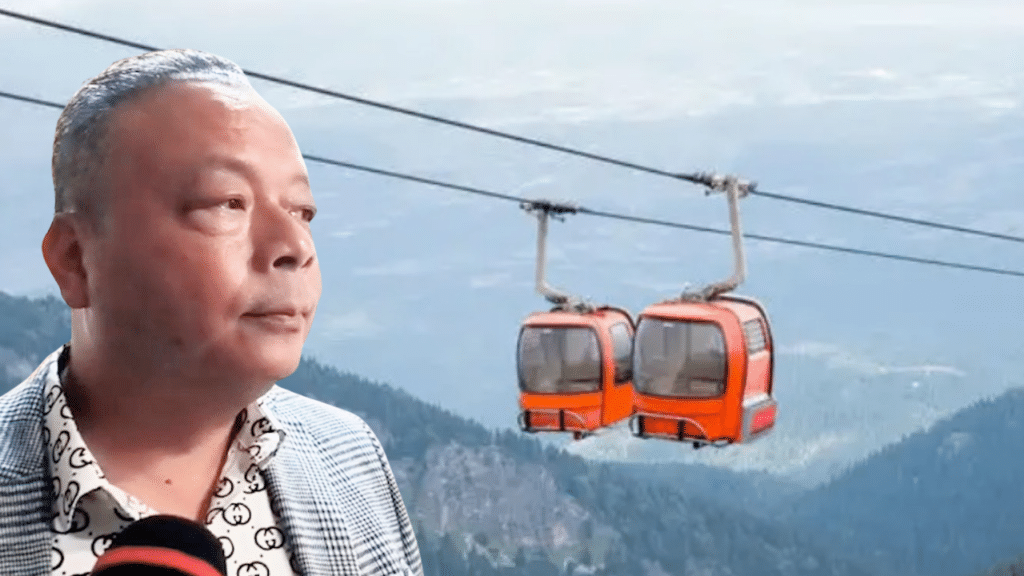
Shillong, November 5: Meghalaya Tourism Minister Paul Lyngdoh on Thursday made it clear that the State Government would not roll back the Shillong Peak Ropeway Project, asserting that the agreement had already been finalised and warning that continued opposition could damage Meghalaya’s investment prospects for the next 40 years or more.
Speaking to reporters after taking charge of the Tourism Department following his return to the State Cabinet, Lyngdoh maintained that the government had followed all required procedures and obtained the necessary clearances before proceeding with the project. “Claims can always be made, but we have all the records with us,” he said.
Addressing concerns raised by groups opposing the project, particularly over its proximity to the sacred Lei Shyllong peak and possible environmental damage, Lyngdoh said the project site was located 3.15 kilometres away from Shillong Peak. “What was the main objection? Water bodies – I have shown you the map. The only major objection is why are you entering into the sacred peak of Lei Shyllong. We have clearly shown you that a distance of 3.15 km separates the project site from the Shillong Peak,” he said.
Displaying a map prepared by the Public Health Engineering (PHE) Department, the Tourism Minister claimed that the ropeway alignment from Terminal 1 did not pass near any water source or stream. He further maintained that disturbances affecting water bodies in the area were caused by residential structures rather than the proposed ropeway project.
Explaining the background of the project, Lyngdoh said the initiative was conceived to address longstanding complaints from tourists visiting the Shillong Peak viewpoint, including identity checks, restricted entry and the closure of gates. He said the proposed ropeway would provide visitors with a three-minute ride from Terminal 1 to the viewpoint, making the tourist destination more accessible.
The Minister also presented details of the approvals and agreements obtained for the project, stating that the government had secured written clearances from the Dorbar Shnongs in 2022. He informed that a 30-year land lease agreement was signed with Riat Laban Dorbar Pyllun, comprising seven Dorbar Shnongs, on January 16, 2023.
According to Lyngdoh, the project had also received No Objection Certificates (NOCs) from the Airports Authority of India (AAI), the Indian Air Force and the Indian Army, besides clearances from various ministries of the Government of India. He further stated that land for compensatory plantation had been transferred in September 2023 as part of the environmental requirements.
Questioning the timing of the opposition, Lyngdoh pointed out that objections to the project had surfaced only last year, despite the agreements and clearances having been obtained several years earlier. “This is a bilateral agreement. There is no cooling-off period. The day the MoU was signed, it was sealed, signed and sealed for good,” he asserted.
The Tourism Minister maintained that the State Government had made repeated attempts to engage with those opposing the project, including discussions held on Wednesday. However, he alleged that the opponents had failed to provide specific grounds justifying their demand for the project to be shifted or scrapped. “The only language was – we are against, we oppose,” Lyngdoh said. He also pointed out that the project had been inaugurated by the President of India following due diligence by Rashtrapati Bhavan.
According to the Minister, the defence forces had also examined the proposal and granted the necessary clearances, despite having the authority to raise objections over security concerns. Addressing environmental issues, Lyngdoh referred to a notification issued by the Union Ministry of Environment, Forest and Climate Change on April 27, 2022, which, according to him, recognised ropeways as environment-friendly and recommended their exclusion from the Environmental Impact Assessment (EIA) Notification, 2006. He also questioned the role of Greentech, an organisation opposing the project, pointing out that it had previously objected to temporary structures at Lumphongdeng. Lyngdoh noted that a permanent boathouse belonging to Meghalaya Energy Corporation Limited (MeECL) had been standing in the same area since 2008 without similar opposition for 18 years. “This raises a big question mark on intent and motives,” he said.
On allegations that residents had not been properly consulted before the project was approved, the Tourism Minister maintained that the Dorbar Shnongs had issued public announcements through public address systems inviting residents to attend meetings. He claimed that attendance at the meetings was poor because the project did not involve private land. To support his statement, Lyngdoh displayed copies of notices issued by the Director of the Meghalaya Institute of Governance.
Asked whether political considerations could be behind the ongoing agitation, the Minister said he could not rule out such a possibility, particularly with the 2028 Assembly elections approaching. “I will not rule that out. We are just a year plus away from general elections,” he said.
Lyngdoh warned that continued opposition to projects that had already received approvals and were backed by signed agreements could have serious consequences for Meghalaya’s reputation as an investment destination. “If we vitiate the environment where Government of India, other agencies or private parties feel that Meghalaya is not safe as an investment destination, then it will not impact just the results of the 2028 elections, it will impact Meghalaya in the next 40 years or even more,” he warned.
He questioned whether investors would be willing to undertake major projects in Meghalaya if agreements could face opposition several years after being finalised. “Who would like to come and invest in a state where projects face opposition four years after signing of agreements?” Lyngdoh asked.
The Tourism Minister reiterated that the Shillong Peak Ropeway Project had undergone the necessary approval processes and that the government remained committed to proceeding with its implementation. He maintained that while concerns could be raised and examined, opposition to projects long after agreements had been signed could undermine investor confidence and affect Meghalaya’s long-term economic development.