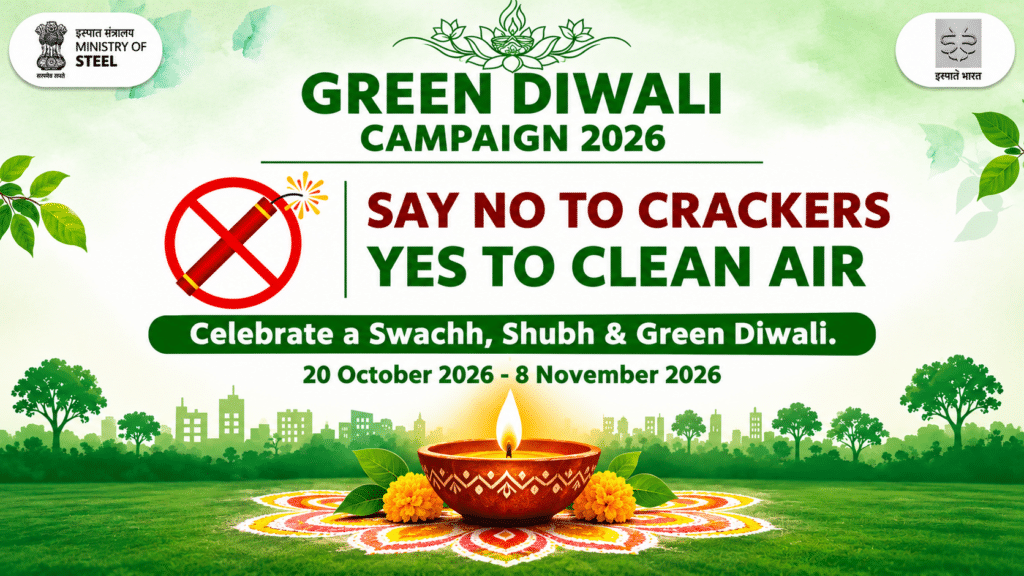
New Delhi, November 5: WWF-India has launched a nationwide Green Diwali Campaign 2026, urging citizens across all States and Union Territories to refrain from bursting firecrackers and adopt environmentally friendly celebrations to reduce air pollution and protect public health. The campaign, being conducted from October 20 to November 8 by WWF-India’s Programme Centre–Resource Partner (PC-RP) under the Environmental Information, Awareness, Capacity Building and Livelihood Programme (EIACP), is supported by the Ministry of Environment, Forest and Climate Change (MoEF&CC).
The initiative, themed around celebrating a Swachh, Shubh and Green Diwali, is aligned with the Government of India’s Mission LiFE (Lifestyle for Environment), which encourages environmentally responsible behaviour. The campaign targets schools, colleges, educational institutions, resident welfare associations and local communities across the country, with particular emphasis on the 130 cities covered under the National Clean Air Programme (NCAP).
Highlighting the harmful effects of firecrackers, WWF-India stated that their use releases significant quantities of fine particulate matter, including PM10 and PM2.5, sulphur dioxide, nitrogen oxides and toxic metal compounds, besides generating excessive noise pollution. The organisation pointed out that Diwali falls around the beginning of winter, when lower temperatures and calm winds can trap pollutants near the ground, allowing harmful emissions to remain in the atmosphere for extended periods.Such pollution poses serious health risks, particularly to children, elderly people, pregnant women and individuals suffering from respiratory and cardiovascular diseases. Firecrackers also contribute to burn injuries, fire accidents and distress among animals and birds.
Referring to the progress achieved under the National Clean Air Programme, WWF-India highlighted that 108 of the 130 participating cities recorded reductions in annual PM10 concentrations during the financial year 2025–26 compared with 2017–18. Of these, 72 cities achieved reductions exceeding 20 percent, while 26 recorded improvements of more than 40 percent. The number of cities meeting the National Ambient Air Quality Standards also increased from six in 2017–18 to 14 in 2025–26. The organisation said these improvements reflected sustained efforts by governments, industries and citizens, and urged households to protect the progress by avoiding firecrackers during Diwali.
As part of the campaign, WWF-India has invited citizens, students, teachers and families to take the Green Diwali Pledge, committing themselves to celebrating without firecrackers and encouraging others to do the same. The pledge also promotes the use of traditional earthen diyas, energy-efficient lighting, natural rangoli materials, locally manufactured products, waste segregation and the avoidance of single-use plastics. Educational institutions and community organisations have been encouraged to administer the pledge during morning assemblies, classroom activities, rallies and community meetings.
WWF-India has further recommended adopting sustainable practices such as exchanging eco-friendly gifts, reusing decorations, organising plantation drives and neighbourhood cleanliness campaigns, donating usable household items and choosing public transport or greener mobility options wherever possible. Citizens have also been advised to monitor daily air quality levels through the Central Pollution Control Board’s SAMEER application and limit outdoor exposure when pollution levels are high. To encourage greater environmental awareness, WWF-India is promoting its Carbon Footprint Survey, which allows individuals to assess how their daily activities and consumption habits contribute to their environmental impact and identify opportunities to adopt more sustainable lifestyles.
Meanwhile, participating schools, colleges, EIACP centres, community organisations and individuals have been requested to document their Green Diwali activities and submit reports through an online form. The submissions should include details of the institution or organisation, location, nature and date of the activity, number of participants taking the pledge, geo-tagged photographs and a brief description of the programme.
According to WWF-India, the information will help assess the nationwide reach of the campaign, while selected activities may be featured on EIACP websites and social media platforms. The organisation has also appealed to State and Union Territory departments, educational institutions and community groups to organise awareness rallies, pledge drives, poster-making, essay and slogan competitions, and cracker-free neighbourhood initiatives. The campaign supports several United Nations Sustainable Development Goals, including Good Health and Well-being, Sustainable Cities and Communities, Responsible Consumption and Production, and Climate Action.
WWF-India urged citizens to celebrate the festival with lights rather than smoke, emphasising that collective participation in cracker-free celebrations can contribute to cleaner air, healthier communities and a more sustainable environment.