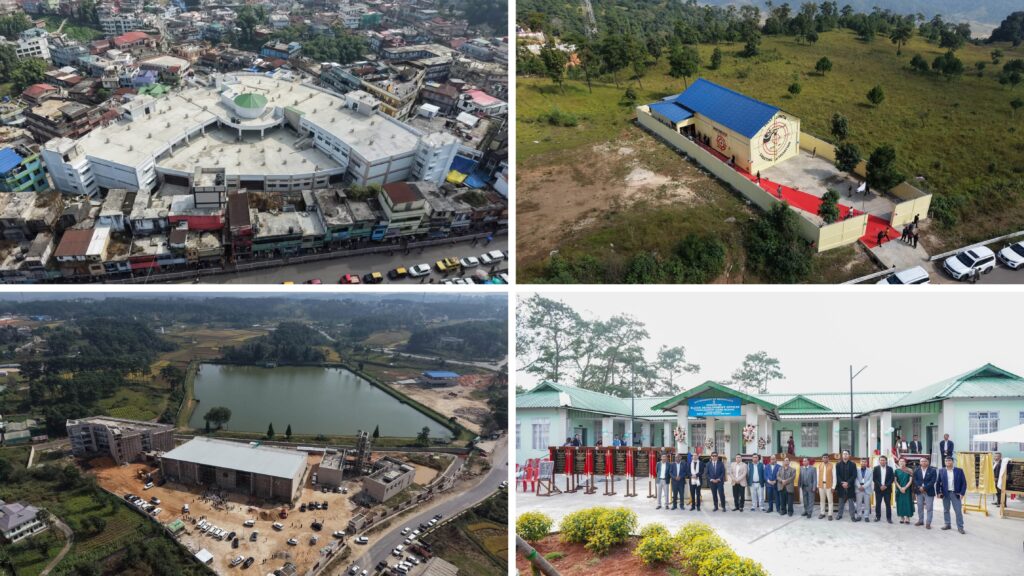
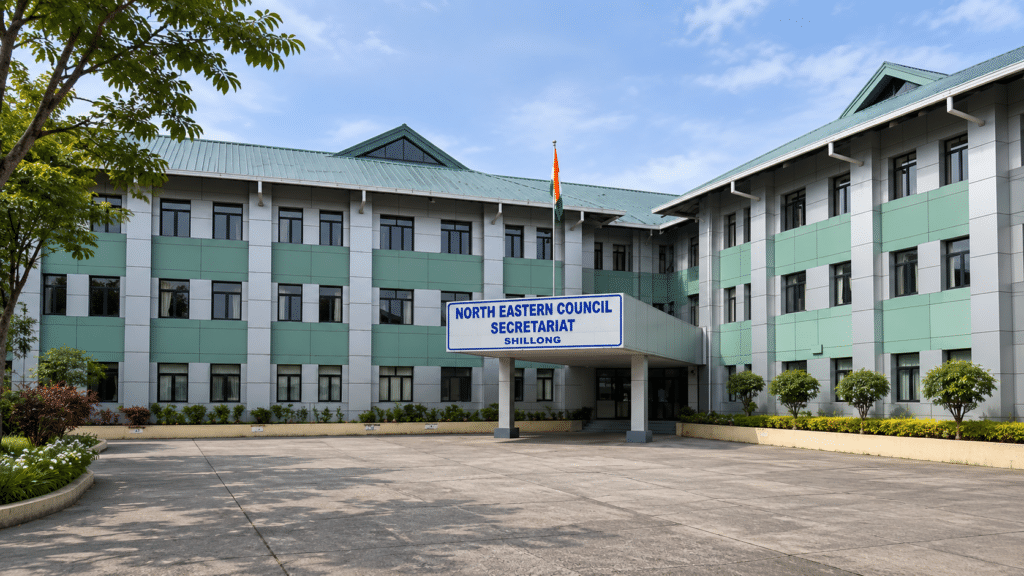
Shillong, November 7: The North Eastern Council (NEC), under the Ministry of Development of North Eastern Region (MDoNER), released ₹79.53 crore during October 2026 to support various development projects across the Northeast, with Meghalaya receiving the highest allocation of ₹26.56 crore.
According to a press release issued by the NEC, the funding was directed towards improving road connectivity, strengthening rural infrastructure, promoting agricultural and industrial activities, expanding scientific and educational facilities, and preserving the region’s cultural heritage. The funds were released under the Schemes of NEC (SoNEC) and the North East Special Infrastructure Development Scheme-Roads (NESIDS-Roads), along with support for other strategic development initiatives.
Meghalaya received ₹26.56 crore, with a major portion allocated towards the rehabilitation and strengthening of the 46.08-km Chokpot–Kharukol road under NESIDS-Roads. The project is expected to benefit 78 villages and more than 15,000 residents by improving connectivity and access to essential services. Financial support was also provided for establishing a Multi-Disciplinary Training-cum-Resource Centre in Shillong.
Meanwhile, Sikkim received ₹15.51 crore for projects aimed at promoting organic agriculture and improving veterinary healthcare facilities. The supported initiatives include the ‘Empowering Organic Growth’ programme, which focuses on strengthening Internal Control Systems (ICS) and facilitating trade. Funding was also provided for upgrading district veterinary hospitals into modern polyclinics in Pakyong, Soreng, Mangan and Gyalshing.
Assam received ₹14.79 crore under SoNEC and NESIDS-Roads for projects covering connectivity, livelihoods, agricultural processing and heritage preservation. Among the supported initiatives were the Mangaldoi–Mazikuchi road, the Bogamati–Umananda road link via Naobandha and Khaagrabari, and the construction of an RCC bridge in Udalguri. The allocation also included support for establishing a 20,000-litre dairy processing plant at Patacharkuchi, strengthening livelihoods among Deori tribal weavers in Lakhimpur and developing the Sepoy Mutiny War Memorial at Hailakandi.
Arunachal Pradesh received ₹11.18 crore, primarily for strategic road connectivity in border and remote areas. Major projects include the Riaga–Sango road in Kra Daadi district and the 21-km Amuli–Athuni road via Leyaka Pass at Anini. Funding was also provided for constructing a girls’ hostel at Donyi Polo Government College, Kamki.
Nagaland received ₹7.99 crore for enterprise development, trade facilitation, mineral-resource assessment and road connectivity projects. The supported initiatives include a proposed Supercritical Extraction Unit and Community Trade Link Centre at Jalukie, assessment of strategic and critical minerals, improvement of the Lampong Sheanghah–Nyasa road in Mon district and development initiatives in Phomching.
Tripura received ₹3.50 crore for establishing the Agar International Trade and Research Centre, aimed at strengthening commercial value chains in the agarwood sector. The NEC also extended support for research documenting the contributions of tribal freedom fighters.
In Manipur and Mizoram, financial support was extended to several infrastructure and livelihood initiatives. These included road projects such as Lamlai–Thoubal Dam and Kamjong–Phungyar, construction of a prestressed concrete bridge over the Leimakhong River, infrastructure for the Barak Heritage Festival in Senapati and facilities at Oriental College in Imphal West. Support was also provided for establishing a modern jaggery processing centre at Phulpui and a market at West Phaileng.
Apart from releasing funds for ongoing and new initiatives, the NEC reported the completion of several projects across the Northeast during October. In Arunachal Pradesh, the six-kilometre strategic road connecting BRTF Road to Pidi in West Siang district was completed at a cost of ₹19.55 crore, improving access to the Mechukha area. The newly constructed Mini Football Stadium at Chowkham in Namsai district was also made operational.
In Assam, the Rain Forest Research Institute (RFRI) at Jorhat commissioned its expanded Tissue Culture Laboratory, increasing bamboo tissue-culture production capacity tenfold, from 3,000 to 30,000 plantlets. Other completed projects included integrated development works at Socheng Development Block in West Karbi Anglong, provision of essential services at Rongmongwe Block in Karbi Anglong and development of a high-tech horticulture nursery.
In Meghalaya, North-Eastern Hill University (NEHU), Shillong, completed a project involving the design and development of low-cost laboratory instruments. Nagaland also completed two capacity-building initiatives, including a post-harvest rubber-sheet processing project that provided roller machines to farmers and a specialised technical training programme in commercial fruit-wine production. In Mizoram, the construction of the Aizawl Institute of Art and Music at Tuivamit Tlang was completed, while a project integrating socio-cultural events with economic value chains was formally closed.
Meanwhile, Manipur completed heritage conservation works involving the historic Panam Ningthou Immortal Fire and ancient monuments at Andro. Academic and infrastructure-related strengthening of Hindi sections in ten government colleges was also completed in the state.
The NEC further highlighted its support for the recently concluded North East Bankers Conclave 3.0 in Aizawl, where discussions focused on financing major development projects and improving institutional credit access. The conclave also examined ways to strengthen credit flows to Micro, Small and Medium Enterprises (MSMEs), Farmer Producer Organisations (FPOs) and women’s Self-Help Groups (SHGs) across the eight Northeastern states.
In addition, the Council supported historical research documenting the contributions of tribal chiefs and freedom fighters of the 18th and 19th centuries. The NEC stated that these initiatives reflect its continued commitment to regional development through improved connectivity, economic opportunities, scientific advancement, livelihood generation and preservation of the Northeast’s distinct cultural and historical heritage.