Shillong, November 11: A 36-year-old woman farmer from Dabram village in South Garo Hills district has demonstrated how scientific vermicompost production can provide additional income and promote sustainable agriculture, with an estimated annual gross income of ₹63,000 from the sale of organic manure and earthworms.
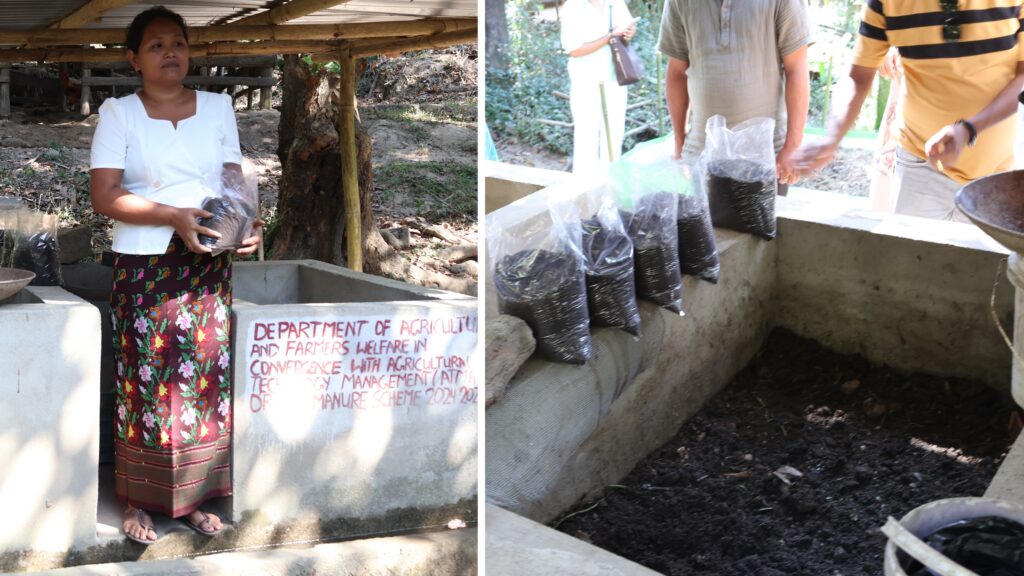
Sengkey Ch. Sangma, a resident of Dabram village under Baghmara Community and Rural Development Block, took up vermicompost production with technical guidance and support from the Department of Agriculture and Farmers’ Welfare and the Agricultural Technology Management Agency (ATMA).
The initiative was supported under the Organic Manure Scheme for the financial year 2024–2025, aimed at encouraging farmers to adopt organic farming practices and utilise locally available agricultural waste productively.
According to a departmental report, Sangma received training in scientific vermicompost production, including the selection of suitable earthworms, preparation of compost beds, layering of biodegradable materials, moisture management and harvesting techniques.
The department also encouraged the use of locally available materials such as cow dung, dried and fresh banana leaves, banana pseudostems and other agricultural residues for preparing organic manure.
Following the training, Sangma established two vermicompost beds on August 28, 2025, each measuring six feet by three feet.
Using agricultural waste and livestock manure, she began producing organic compost through regular maintenance and proper moisture management.
The report stated that each bed could produce more than 150 kilograms of vermicompost per harvest, with the two beds together producing approximately 300 kilograms.
With vermicompost selling at ₹50 per kilogram, a single harvest of 300 kilograms could generate ₹15,000.
Based on four harvests annually, her estimated production reaches 1,200 kilograms, generating gross sales of ₹60,000.
Apart from selling organic manure, Sangma also earns income through the sale of earthworms of the species Eisenia fetida, which are known for their rapid multiplication and effective decomposition of organic waste.
The report stated that she sold approximately 750 earthworms in a year at ₹4 each, generating an additional ₹3,000.
This brings her estimated annual gross income from vermicompost and earthworm sales to ₹63,000, against an initial investment of ₹25,000.
Besides generating income, Sangma uses a portion of the vermicompost in her own agricultural fields, helping reduce expenditure on synthetic chemical fertilisers.
The Agriculture Department highlighted that her experience demonstrates how scientific knowledge, technical assistance and effective utilisation of locally available resources can create livelihood opportunities for rural farmers.
Through her experience in vermicomposting, Sangma has also become a resource person for allied departments, sharing practical knowledge and providing guidance to other farmers and beneficiaries on organic waste management and vermicompost production.
The report further highlighted encouraging progress among other farmers participating in the Organic Manure Scheme in South Garo Hills.
Another beneficiary, Mengstone R. Sangma, reportedly earned ₹18,000 by supplying 6,000 earthworms to the Horticulture Department at ₹3 per worm.
According to the department, the growing awareness of organic manure and sustainable agricultural practices has contributed to increasing demand for vermicompost in the region.
However, local producers are reportedly finding it difficult to meet the growing market demand because of limited production facilities and resources.
The department observed that the demand for vermicompost has begun exceeding the existing production capacity of local farmers, indicating opportunities for both established producers and new beneficiaries interested in taking up vermicomposting as an income-generating activity.
Under the Organic Manure Scheme for the financial year 2024–2025, four vermicompost units were established in Baghmara C&RD Block and one in Rongara C&RD Block.
During the financial year 2025–2026, another nine units were established, including five in Baghmara, two in Rongara, one in Chokpot and one in Gasuapara.
Altogether, 14 vermicompost units were established across the two financial years under the scheme in South Garo Hills.
The department maintained that vermicompost production has helped farmers convert agricultural waste into useful organic manure while creating additional livelihood opportunities and strengthening local agricultural markets.
The initiative also promotes environmentally sustainable farming by encouraging organic nutrient management and reducing dependence on chemical fertilisers.
The experience of Sengkey Ch. Sangma and other beneficiaries highlights the potential of vermicomposting as a supplementary livelihood activity for rural households, particularly as demand for organic manure continues to increase in the region.