Shillong, November 14: Government-supported horticulture initiatives are helping farmers in South West Garo Hills diversify cultivation, adopt modern agricultural practices and increase their incomes, with one farmer earning approximately Rs 7–8 lakh from vegetable cultivation during 2025–26 and an additional estimated profit of Rs 3–4 lakh from watermelon farming.
The progress of these initiatives came to light during a press tour organised by the Directorate of Information and Public Relations (DIPR), during which a team of journalists from Shillong visited several horticulture projects across the district.
The team inspected vegetable farms, dragon fruit plantations, commercial floriculture facilities and black pepper cultivation projects to assess the impact of government assistance on agricultural productivity and rural livelihoods.
At Harigaon village under Rerapara Block, the journalists visited the farm of Nerdaya Koch, who has been practising organic vegetable cultivation since 2013–14. Koch cultivated summer and winter vegetables across approximately 1.5 hectares in 2026 and has received regular assistance from the office of the District Horticulture Officer, South West Garo Hills, Ampati, under the Vegetables Development Scheme.
The assistance included quality hybrid, high-yielding variety (HYV) and open-pollinated seeds at a 75 per cent subsidy. He also received fencing nets, seedling trays, cocopeat and watering cans with 50 per cent financial assistance, while a naturally ventilated polyhouse and permanent trellises for creeper vegetables were provided with 100 per cent assistance. These interventions have helped Koch improve his farming operations, enabling him to earn approximately Rs 7–8 lakh from vegetable cultivation during the 2025–26 financial year.
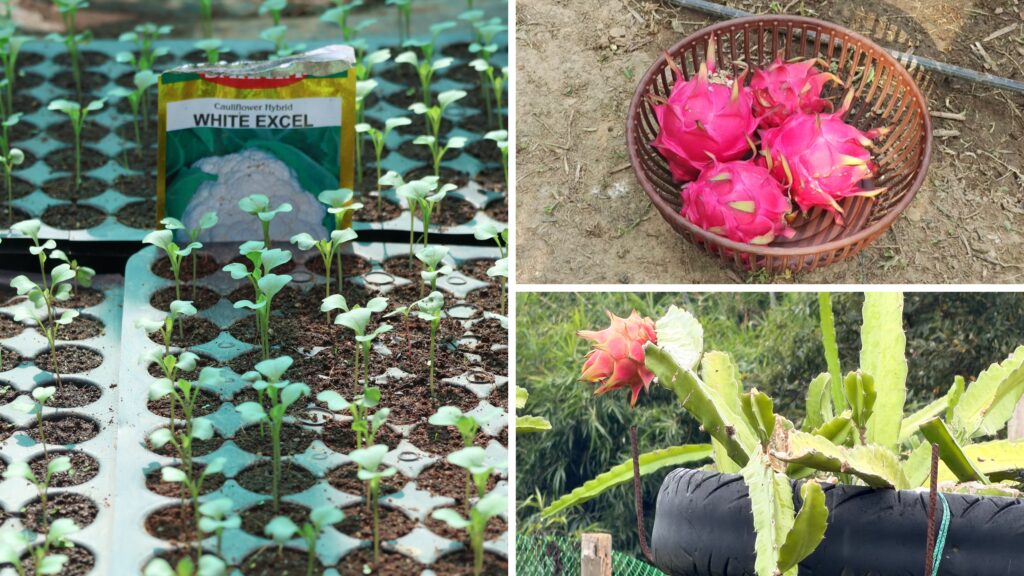
Besides cultivating vegetables, Koch has expanded into commercial nursery production by raising seedlings in trays inside a 100-square-metre polyhouse. He supplies the seedlings to other farmers at Rs 2.50 per plant, providing an additional source of income while supporting vegetable cultivation in the surrounding areas.
Koch has also diversified into watermelon farming, cultivating the crop across 0.4 hectares following the winter vegetable harvest during 2025–26. The initiative generated an estimated profit of Rs 3–4 lakh, with the Horticulture Department providing seeds at 75 per cent assistance under the Vegetables Development Scheme.
To improve water-use efficiency, drip irrigation was installed at his farm during 2025–26 under the Per Drop More Crop (PDMC) component of the Pradhan Mantri Krishi Sinchayee Yojana (PMKSY).
The press team also visited the dragon fruit plantation of Robelson M. Marak at Ampati Songma, who began organic cultivation of the fruit in 2023. Marak harvested approximately 80–100 kilograms of dragon fruit in 2025, generating an estimated income of Rs 35,000–50,000. His plantation received departmental assistance through the provision of planting materials, concrete support pillars and drip irrigation facilities under the Mission for Integrated Development of Horticulture (MIDH) during 2022–23. Further assistance was provided under the Fruit Development Scheme during 2025–26 to support the expansion and maintenance of his cultivation activities.
Meanwhile, at the Zikzak Horti Hub, the visiting journalists inspected three polyhouses developed under the Rural Infrastructure Development Fund (RIDF) for commercial floriculture. The facilities are being used for cultivating Anthurium, Gerbera and Dendrobium, with each polyhouse covering an area of 500 square metres.
The project covers a total area of 1,500 square metres and was developed at an approved cost of Rs 70 lakh. Sanctioned on March 7, 2023, the project was completed on April 1, 2025, and executed through the approved supplier, M/s Phira Enterprise, Shillong. The facility currently generates approximately Rs 2 lakh annually through the sale of cut flowers.
However, the project’s income potential has been affected by delays in payments from institutional buyers, highlighting challenges in ensuring timely returns from commercial floriculture.
The journalists also inspected a project involving the Vertical Column Method for Black Pepper, implemented under the Rashtriya Krishi Vikas Yojana (RKVY) during 2023–24. The project was designed to maximise land utilisation and facilitate large-scale production of quality black pepper planting materials. With an approved cost of Rs 36.62 lakh, the project was originally planned to cover 1,000 square metres, comprising 300 vertical columns supporting 3,000 plants of the Panniyur-2 black pepper variety.
However, implementation fell short of the approved targets, with a smaller area developed, only 198 columns erected and 1,920 plants supplied and planted. Serve Well Agro Solutions, Shillong, East Khasi Hills, was the approved supplier for the project. Despite the shortfall, the facility currently produces two rounds of black pepper cuttings annually, which are used for raising seedlings in the nursery.
The field visits highlighted the growing diversity of horticultural activities in South West Garo Hills, ranging from conventional vegetable production to high-value fruit cultivation, commercial floriculture and specialised planting material production.
The initiatives have demonstrated how government assistance, improved cultivation techniques and irrigation facilities can help farmers expand agricultural activities and create additional sources of income.