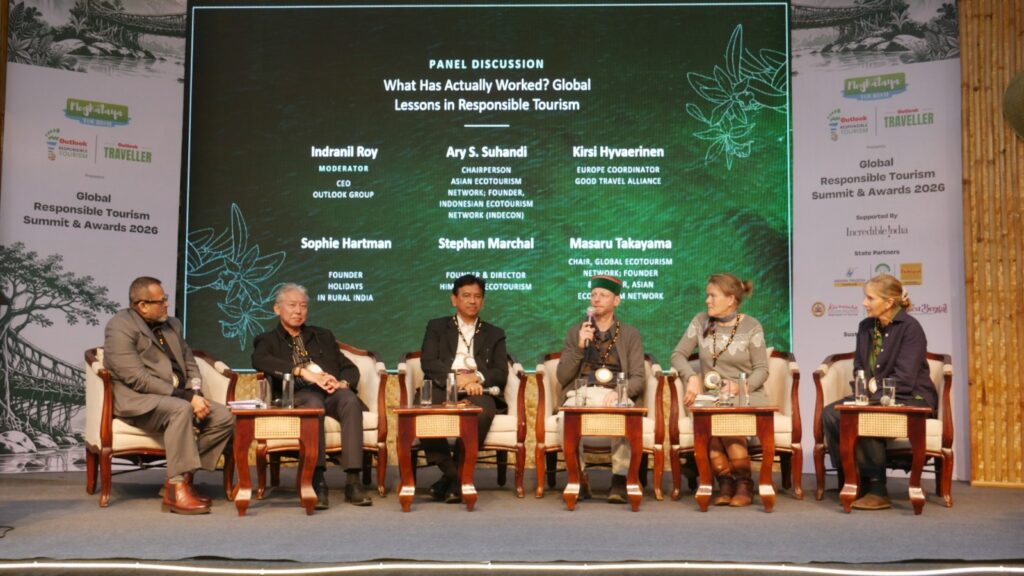
Shillong, November 19: Meghalaya Chief Secretary Dr Shakil P. Ahammed on Thursday inaugurated the Global Responsible Tourism Summit & Awards 2026 at The Grove, Ward’s Lake, Shillong, bringing together tourism experts, policymakers and stakeholders from India and abroad to discuss sustainable and community-based tourism.
The two-day summit, organised by Outlook Traveller and Outlook Responsible Tourism in partnership with the Meghalaya Tourism Department, features more than 50 speakers and 150 delegates, with discussions focusing on responsible tourism practices, environmental conservation and community participation.
The inaugural programme was attended by Commissioner and Secretary of Tourism Dr Vijay Kumar D., Meghalaya Tourism Development Corporation Managing Director Cyril V. Darlong Diengdoh, Bodoland Territorial Council Tourism Secretary Ansula Basumatary, Outlook Traveller and Outlook Responsible Tourism Editor Anindita Ghosh, and other officials and tourism stakeholders.
Addressing the gathering, Dr Vijay Kumar D. said Meghalaya was uniquely positioned to host the summit because of its strong traditions of community-based conservation and sustainable tourism.
“If there is any place in India which should host the Global Responsible Tourism Summit, it has to be Meghalaya, because we are really uniquely positioned to talk about responsible tourism, to talk about community tourism, to talk about sustainability,” he said.
He also welcomed Meghalaya’s inclusion in BBC Travel’s list of the 20 best places to visit in 2027, making it the only destination from India to feature in the global selection.
Describing the recognition as a matter of immense pride, he said Meghalaya’s tourism sector had developed around the strengths of its indigenous communities, traditional institutions and natural heritage.
He highlighted the protection of land under the Sixth Schedule, the conservation practices of Khasi, Jaintia and Garo communities, and the role of traditional institutions across approximately 7,000 villages.
“The greatest strength the State has is communities,” he said, adding that government tourism initiatives had been developed by building upon existing community strengths.
Referring to Meghalaya’s living root bridges, which have been nominated for inclusion in the UNESCO World Heritage List in 2027, Dr Vijay Kumar D. said the bridges represented the state’s unique natural and cultural heritage.
“When you come to India, you should see the Taj Mahal; when you come to Meghalaya, you should see a living root bridge,” he said.
He informed that the nomination dossier, prepared over eight years, was submitted by an apex cooperative society representing 62 villages, making it a significant example of community-led heritage conservation.
The Tourism Commissioner also highlighted Meghalaya’s community-public-private partnership model, citing the development of a lake and cottages at Mawrah near Sohra, which currently provides employment to around 20 to 25 local residents.
He further spoke about the state’s payment for ecosystem services programme, which he described as the largest in the country, covering approximately 60,000 hectares of forest.
Under the programme, communities receive an average payment of around Rs 15,000 per hectare annually, with payments reaching up to Rs 20,000 per hectare, while efforts are underway to connect the initiative with carbon markets.
Crediting Chief Minister Conrad K. Sangma for the state’s tourism development strategy, Dr Vijay Kumar D. said the vision of transforming Meghalaya into a leading tourism destination while generating employment and livelihoods began before the COVID-19 pandemic.
He highlighted initiatives including the Meghalaya Grassroots Music Programme, the Cherry Blossom Festival, government support for traditional festivals and conservation measures adopted by local communities.
He cited Rangthylliang village, where visitor numbers to the living root bridge are regulated, and Mawmluh Cave, where the community restricts entry to a limited number of visitors, charging approximately Rs 3,000 per person.
Delivering the keynote address, Chief Secretary Dr Shakil P. Ahammed stressed that responsible tourism required active participation from both visitors and local communities to protect natural and cultural resources.
“Sustainable tourism is a goal. Responsible tourism is the practice, the specific choices that we all make to reach the goal of sustainable tourism. A destination belongs first to the people who live there, and tourism should leave it better off, not merely busier,” he said.
Highlighting Meghalaya’s 79 community-protected fish sanctuaries, the Chief Secretary urged visitors to respect local conservation efforts and adopt responsible behaviour while travelling.
He expressed concern over littering at Mawlynnong and the presence of plastic waste inside Mawmluh Cave, stressing that maintaining cleanliness should not be the responsibility of local communities alone.
“It is not for you to litter the place and the local community to clean it up for you. It is for you to imbibe the spirit of cleanliness,” he said.
Earlier, Outlook Traveller and Outlook Responsible Tourism Editor Anindita Ghosh recalled the organisation’s collaboration with the Meghalaya Tourism Department since 2019, including three previous editions of the Meghalaya Responsible Tourism Awards.
She emphasised that the success of tourism should be measured by its positive impact on the lives of local residents rather than merely by visitor numbers.
The inaugural programme began with a Shad Mastieh performance under the Meghalaya Grassroots Music Programme.
The summit also features workshops, film screenings and a public marketplace comprising more than 35 stalls showcasing tourism-related initiatives and local products.
Chief Minister Conrad K. Sangma is scheduled to present the Indian Responsible Tourism Summit & Awards 2026 – Meghalaya Chapter, Fourth Edition, on November 20.
The Tourism Department said the summit reflects the state government’s commitment to developing a tourism sector that generates sustainable livelihoods, strengthens community participation and preserves Meghalaya’s natural environment and cultural heritage.