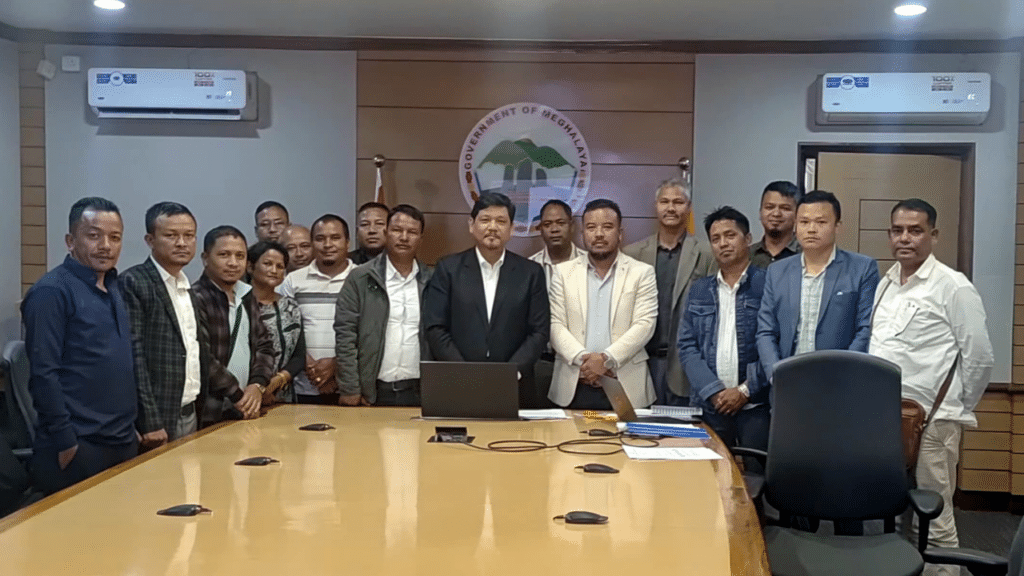
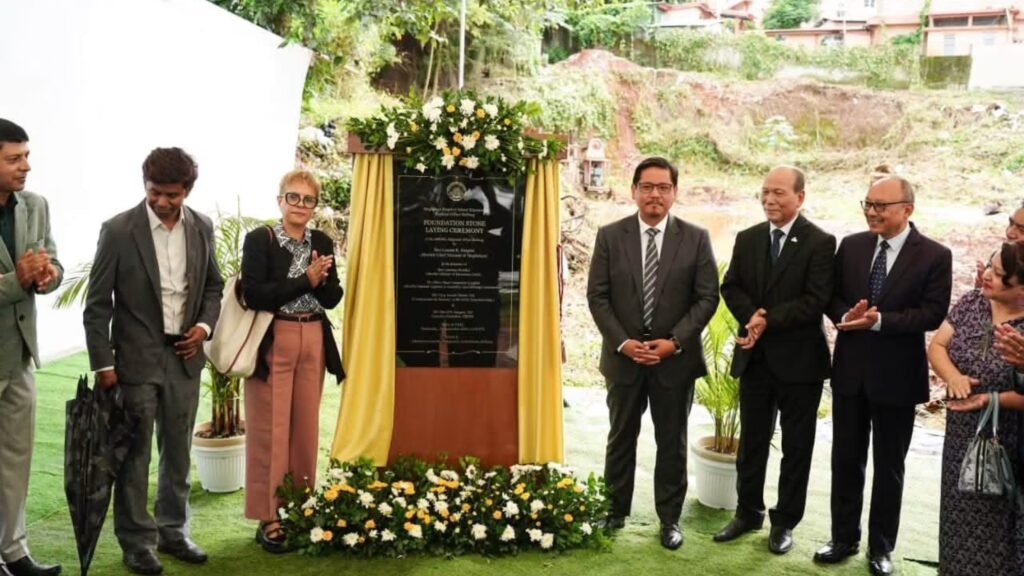
Shillong, September 23: Chief Minister Conrad K. Sangma on Wednesday laid the foundation stone for a permanent building for the Meghalaya Board of School Education’s Shillong Regional Office and virtually inaugurated 81 school infrastructure projects constructed across the state under Mission Education Phase-II.
Sangma also launched the AI-powered CM IMPACT Guide Book and released ₹49.78 crore in grants under Samagra Shiksha for the 2026–27 academic year.
East Shillong MLA Dr. M. Ampareen Lyngdoh and senior officials from the Education Department and MBoSE attended the programme.
The Chief Minister said the Shillong Regional Office had operated from temporary premises for around 45 years. Established as the Shillong Cell in September 1981 to serve the Khasi-Jaintia region, it initially functioned from the Inspector of Schools office at Mawkhar.
The office subsequently shifted to the Education Guest House at Laitumkhrah in 1995, the MBoSE Guest House in 1998 and the Taxation Building at Lower Lachumiere in December 2005.
It currently supervises 1,329 secondary schools and 397 higher secondary schools across the seven districts of the Khasi-Jaintia region. It also oversees 97 SSLC and 78 HSSLC examination centres and appoints more than 1,300 examiners annually.
The proposed building will provide dedicated facilities for the secure storage of examination materials, evaluation work and capacity-building programmes for teachers and examiners.
Speaking at the programme, Sangma said the success of the government’s education initiatives should be assessed by their impact on students and not merely by expenditure or the number of buildings constructed.
“It’s not about the money that we spend or the buildings we create,” he said, stressing that educational outcomes must remain the government’s primary focus.
Lyngdoh said school buildings and other educational infrastructure were not merely physical structures but were essential to strengthening institutions and improving services for students and the public.
Highlighting the scale of investment under Mission Education, Sangma said the government had committed ₹457.41 crore for infrastructure development across 2,230 schools.
The investment includes ₹109.33 crore for 208 schools under Phase-I, ₹97.38 crore for 111 schools under Phase-II, ₹57.12 crore for 117 schools through the Engineering Cell under Phase-III, ₹62.50 crore for 1,608 schools through the Meghalaya Infrastructure Development Finance Corporation and ₹131.08 crore for 186 schools under Phase-IV.
Another 182 schools have been equipped with digital classrooms, STEM laboratories and information and communication technology facilities under the Asian Development Bank-supported Supporting Human Capital Development in Meghalaya project.
The Chief Minister said the state’s school network had been rationalised from 14,582 to 11,443 institutions by merging schools with zero or single-digit enrolment. The exercise was undertaken to improve the deployment of teachers and educational resources.
A total of 118 schools were also upgraded to the higher secondary level, raising the number of such institutions from 427 in 2024–25 to 545 in 2025–26.
The CM IMPACT platform provides students preparing for the SSLC examination with chapter-wise learning materials, chatbot assistance, mock tests and explanations. The government is also exploring an offline version for schools without internet connectivity.
Sangma said focused interventions under CM IMPACT had contributed to a 41.2 percentage-point increase in the examination pass rate.
Meghalaya’s Performance Grading Index 2.0 score increased from 448 in 2024 to 525.71 in 2026, moving the state from the Akanshi-3 category to Akanshi-1. The government aims to cross 580 points and eventually reach 700 points to place Meghalaya among the country’s top 10 states within two years.
Under Samagra Shiksha, a uniform grant of ₹600 each was released for 2,98,013 students, including 1,47,419 boys and 1,50,594 girls. The ₹17.88-crore allocation was transferred directly to the Aadhaar-linked bank accounts of their parents or guardians.
The grants also include composite assistance for 7,541 schools and textbook support for 5,19,816 students.
Another ₹57.62 lakh was released for 3,440 children with special needs. The assistance includes escort allowances for 852 beneficiaries, transport allowances for 908 children, stipends for 924 girls and support for the home-based education of 756 children unable to attend school.
The Education Department said the Samagra Shiksha interventions would benefit 8,21,269 students, besides providing direct support to schools.
Sangma said financial constraints should never compel children to discontinue their education. He cited uniform grants, the Chief Minister’s Scholarship Scheme for nearly one lakh students from Class XI to the doctoral level and the SSLC private-candidate route for dropouts, sportspersons and artistes, which has no upper age limit.
Education Commissioner and Secretary Vijay Kumar Mantri described the new MBoSE facility as a historic milestone and said the board had adapted to changes in the education system while remaining responsive to the needs of students and the public.