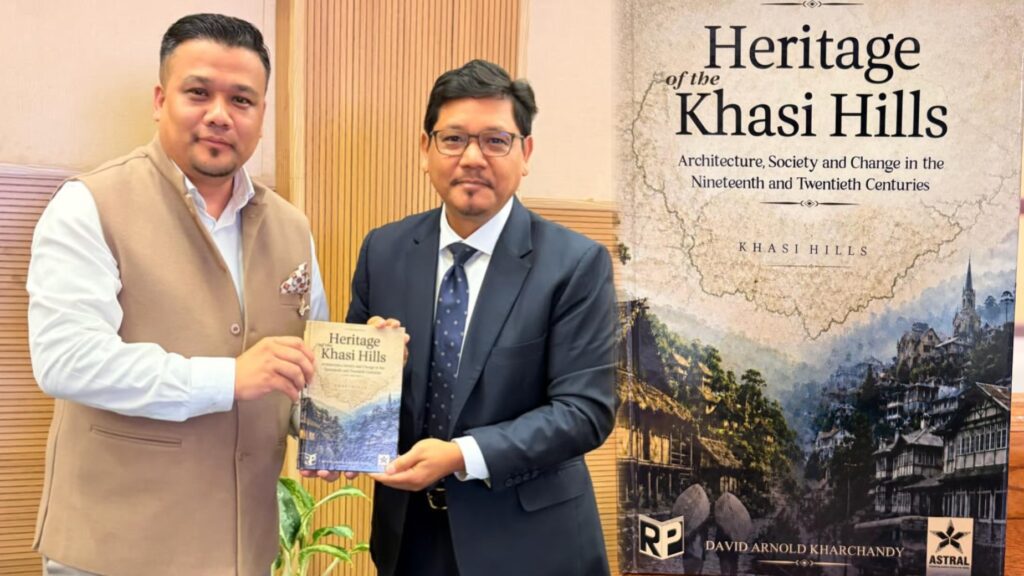
Shillong, June 23: Chief Minister Conrad K. Sangma on Tuesday released a book titled Heritage of the Khasi Hills: Architecture, Society and Change in the Nineteenth and Twentieth Centuries authored by David Arnold Kharchandy at the Taraghar State Guest House in Shillong.
Based on Dr. Kharchandy’s PhD research, the book presents an in-depth historical study of the architectural heritage of the Khasi Hills and its evolution through the nineteenth and twentieth centuries. The work examines architecture not merely as physical structures but as reflections of society, culture, environment and identity.
The book explores traditional Khasi architectural forms, including the Iing Sad, hearth-centred spaces, rituals, taboos, indigenous building materials and community-based construction practices. It highlights how these structures embodied ecological adaptation, social organisation, matrilineal traditions, sacred beliefs and practical wisdom.
A notable feature of the publication is its focus on the role of women in shaping Khasi domestic spaces. The study documents their contribution to maintaining households, preserving indigenous knowledge, preparing building materials and sustaining the cultural significance of the home.
The book also traces the transformations that occurred during the colonial period, examining the impact of British administration, missionary activities, Christianity, formal education and urban growth in Sohra and Shillong. It further discusses how the devastating 1897 earthquake influenced architectural developments across the region.
According to the study, these changes led to the emergence of bungalow-style residences, Assam-type houses, churches, schools, mission compounds, administrative buildings, sanatoriums and other civic institutions that gradually reshaped the landscape of the Khasi Hills.
Through its examination of continuity and change, the book underscores the importance of preserving Khasi architectural heritage as an integral part of Meghalaya’s historical and cultural legacy.
The release of the publication is being viewed as a significant contribution to the documentation, preservation and interpretation of the built heritage of the Khasi Hills, offering valuable insights into the region’s social and cultural history.