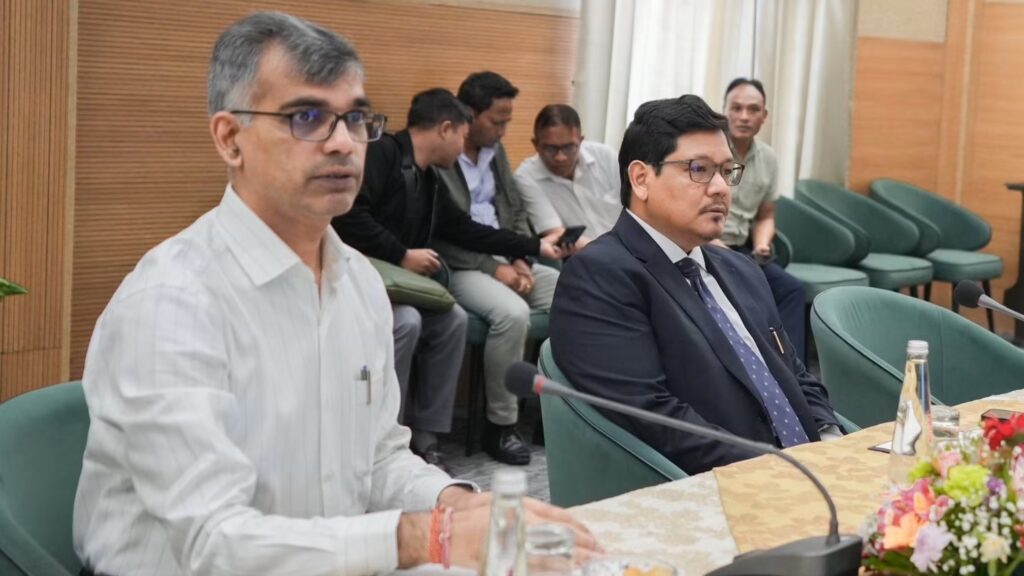
Shillong, June 23: Chief Minister Conrad K. Sangma on Tuesday reviewed the implementation of the PM Surya Ghar: Free Electricity Scheme and called for a comprehensive renewable energy strategy to accelerate clean energy adoption and strengthen Meghalaya’s long-term energy security.
The review meeting, held at the State Guest House in Taraghar, was attended by officials from the Power Department, Meghalaya Power Distribution Corporation Limited, Meghalaya Energy Corporation Limited and other stakeholders.
The meeting assessed the progress of the PM Surya Ghar Scheme, a flagship Government of India initiative that aims to provide up to 300 units of free electricity per month to 10 million households through rooftop solar installations. Under the scheme, eligible households can receive central financial assistance of up to ₹78,000 for installing rooftop solar systems.
Officials briefed the Chief Minister on the current status of the scheme in Meghalaya and highlighted challenges affecting consumer participation. Despite substantial central subsidies, consumers in the State continue to face relatively higher upfront installation costs due to transportation expenses, difficult terrain and the limited scale of solar installations.
Reviewing findings from pilot rooftop solar projects, Sangma discussed measures to make solar adoption more attractive and financially viable for households. Discussions focused on enhancing consumer benefits, reducing payback periods and exploring additional support mechanisms to encourage wider participation under the scheme.
The meeting also explored ways to integrate the PM Surya Ghar Scheme with the State Government’s renewable energy initiatives, including the Chief Minister’s Solar Mission. Particular emphasis was placed on incorporating battery storage solutions to help households maximise solar energy use, improve power reliability and reduce dependence on conventional grid electricity during peak demand periods.
Officials proposed expanding rooftop solar installations across government institutions, schools, anganwadi centres and other public facilities. The Chief Minister directed departments to identify opportunities for accelerating solar adoption in government infrastructure while taking advantage of available central assistance.
The meeting further discussed public awareness strategies to promote renewable energy adoption. Sangma suggested involving educational institutions and youth groups in awareness campaigns aimed at encouraging rooftop solar installations and energy conservation practices throughout the State.
Recognising the importance of demand-side management, officials reviewed measures to improve energy efficiency in government offices and public utilities. Discussions focused on optimising electricity consumption, promoting responsible energy use and reducing peak-hour demand through better planning and management.
The Chief Minister also emphasised the need to explore a broader range of decentralised renewable energy solutions suited to Meghalaya’s geographical conditions. These include biomass and biogas-based power generation, micro-hydel projects, solar-powered community infrastructure and other emerging technologies capable of delivering sustainable energy solutions in rural and remote areas.
Officials highlighted that the PM Surya Ghar Scheme has the potential to significantly reduce household electricity expenses while promoting clean energy adoption and supporting the State’s long-term energy goals. Households with suitable rooftops and valid electricity connections can install rooftop solar systems under the scheme and benefit from central subsidies. Consumers can also export surplus power to the grid through net metering arrangements, generating additional savings.
Concluding the meeting, Sangma directed officials to prepare a comprehensive roadmap for expanding renewable energy adoption across Meghalaya, with a focus on increasing consumer participation, strengthening awareness campaigns, integrating existing solar initiatives and leveraging innovative technologies to meet the State’s future energy needs.