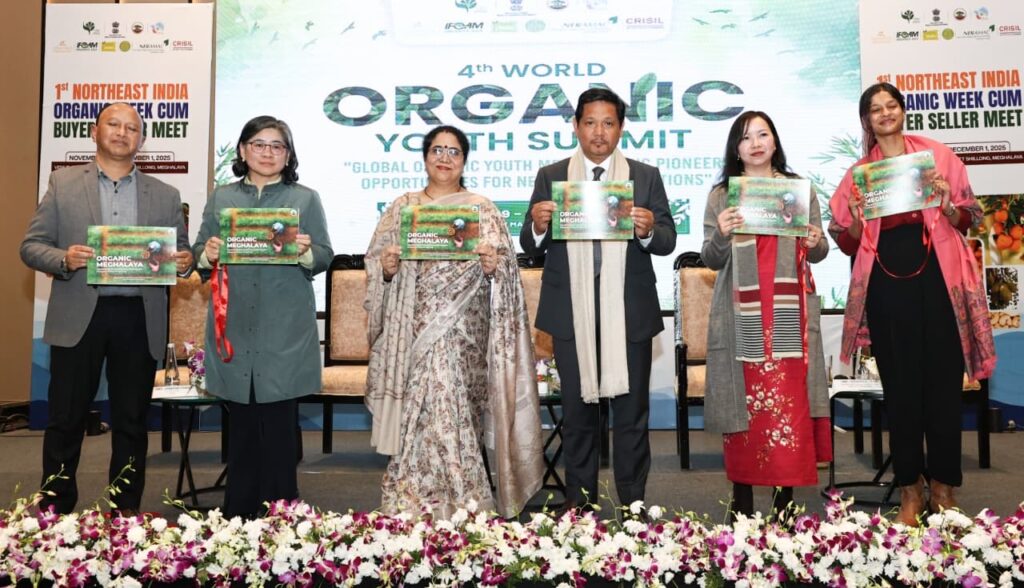
Shillong, December 1 : The curtains came down on the 1st Northeast India Organic Week and the 4th World IFOAM Organic Youth Summit today in Shillong, marking a milestone moment for organic farming and youth-led innovation in the region. The three-day international convergence drew participants from 13 countries, uniting farmers, policymakers, and young changemakers under one roof to discuss sustainable agriculture and the future of organic production.
The closing ceremony was graced by Chief Minister Conrad K. Sangma, who launched the Organic Compendium and the MEGNOLIA website, reaffirming Meghalaya’s commitment to becoming a global hub for organic value chains and agri-entrepreneurship.
In his address, Chief Minister Conrad K. Sangma said organic farming was deeply rooted in Meghalaya’s heritage and traditions. “Organic farming is about our forefathers, our traditions, and how our people have farmed for centuries. It is an intrinsic part of who we are,” he said.
The Chief Minister emphasized that his government’s policies are focused on uplifting farmers, improving agri-infrastructure, and aligning the sector with the state’s tourism and sustainability goals. He also announced major infrastructure developments, including the extension of the Shillong Airport runway by 2027 and new initiatives for rural tourism, featuring 3,000 new homestays with a 75% subsidy.
Highlighting women’s empowerment, he noted that next year will be observed as the UN International Year of the Woman Farmer, adding, “In 2018, only 3–4% of women were in Self Help Groups. Today, 95% of women in rural Meghalaya are part of this network.”
Vinita Sudhanshu, General Manager, APEDA, commended Meghalaya’s bottom-up approach to agriculture and announced plans to take two Meghalaya Farmer Producer Organisations (FPOs) to the Gulfood event in Dubai, providing international market exposure.
Jennifer Chang, Executive Director, IFOAM Asia, lauded Meghalaya as a potential global model for holistic organic development, where agriculture, tourism, and community life coexist harmoniously. “If you teach a woman, you are raising a nation,” she remarked, calling on the state to lead the International Year of the Woman Farmer. She praised the government’s efficiency in hosting the event, adding, “I have never seen a government so organised and proactive in executing a summit of this scale.”
Isawanda Laloo, Secretary, Agriculture and Farmers’ Welfare, outlined the state’s long-term vision to build a globally competitive organic ecosystem with an investment of ₹250 crore. She highlighted Meghalaya’s natural advantage as a state that is “organic by heritage, geography, and practice.”
She further noted that the partnership with APEDA has already enabled the export of over 50 metric tons of Khasi Mandarin, pineapples, and ginger to Gulf nations. “We are ready to take Meghalaya to the world—and welcome the world to Meghalaya,” she said.
Ibalahun Thangkhiew, CEO of Jirang Organic Agro Farmers Producers Company Ltd., shared how 433 farmers across 15 villages are now working under one banner to promote collective organic farming. She highlighted the company’s milestone of exporting Khasi Mandarins to Dubai in 2022 in collaboration with APEDA and the Department of Horticulture.
During an interactive session, Selina Gan, a buyer from Malaysia, praised Meghalaya’s pineapples as “sweeter than Dole pineapples,” reinforcing the global competitiveness of the state’s produce.
The summit concluded with thematic discussions on policy advocacy, youth networks, and organic food in Central Asia, featuring representatives from Uzbekistan and Kazakhstan who shared best practices on crop rotation, certification, and sustainable innovation.
The event showcased Meghalaya’s ambitious goal to certify 1 lakh hectares of organic land by 2028 under a “hub and spoke” model, connecting village clusters to larger processing units and international markets.
Organised jointly by the Government of Meghalaya, APEDA, the Ministry of Commerce and Industry (GoI), and IFOAM-Organics Asia, the summit underscored the state’s rising role in the global organic movement.
By successfully integrating global dialogues with grassroots realities, Meghalaya has not only celebrated its “Organic by Tradition” heritage but has also positioned itself as a leader in sustainable agriculture, climate resilience, and youth empowerment.