Shillong, November 10: A team of journalists from Shillong, as part of a press tour organised by the Directorate of Information and Public Relations (DIPR), visited the Krime Women Multipurpose Cooperative Society Ltd. at Damas and floriculture farms at Jonglapara and Bakra-Haluapara in North Garo Hills to highlight community-based livelihood initiatives and the impact of Government-supported programmes.
At Damas, the team interacted with members of the Krime Women Multipurpose Cooperative Society Ltd., which promotes women’s economic empowerment through Self-Help Groups (SHGs) and access to financial assistance.
Established on July 1, 2020, the society comprises 1,480 members organised under 159 SHGs and 16 Village Organisations (VOs).
Speaking to the journalists, society president Nancy G. Momin said the initiative began in 2017 when women from the area came together to form SHGs. In 2018, these groups collectively formed a Village Organisation, which subsequently paved the way for the establishment and registration of the cooperative society.
She said the society extends loans to its members, enabling them to start small businesses and supplement their household income. Several members have utilised the financial assistance to purchase auto-rickshaws and establish grocery shops, tea stalls and other small enterprises.
Besides providing financial assistance, the society also organises awareness programmes and training initiatives for schoolchildren to help them develop skills and explore employment opportunities.
Momin expressed appreciation to the State Government, particularly the Meghalaya State Rural Livelihoods Society (MSRLS), for its continued support in strengthening the organisation and its activities.
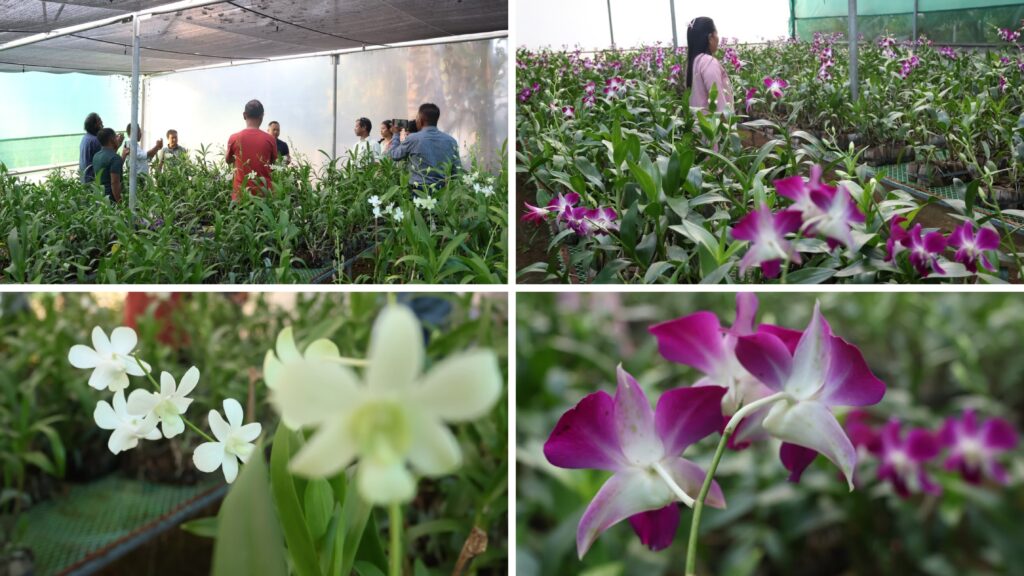
The press team also visited the floriculture farms of Kasan K. Sangma and Nikre Marak at Jonglapara and Bakra-Haluapara, respectively, under Resubelpara block. Both are beneficiaries of the Meghalaya Floriculture Mission and are engaged in orchid cultivation.
During the visit, the team was informed that around 1,100 Dendrobium and Vanda orchid planting materials had been provided to the beneficiaries under the scheme, with cultivation beginning in 2025.
Explaining the scheme, an official said it operates under a buy-back arrangement, ensuring that farmers do not have to independently worry about marketing their produce. An empanelled service provider has been engaged to provide end-to-end support, including capacity building, planting, infrastructure development and marketing.
Under the pricing mechanism for Dendrobium orchids, stems are categorised into different grades, with Grade A+ fetching ₹17 per stem, Grade A ₹15, Grade B ₹10 and Grade C ₹7.
The official said Dendrobium orchids have a flowering lifespan of around five to six years, offering beneficiaries sustained income opportunities. Although marketing activities have only recently commenced, the flowers have potential markets beyond the region, including other parts of the country.
He added that the buy-back arrangement and support from the service provider would allow farmers to focus on cultivation while ensuring market access for their produce. The initiative is expected to strengthen livelihood opportunities, particularly for women farmers.