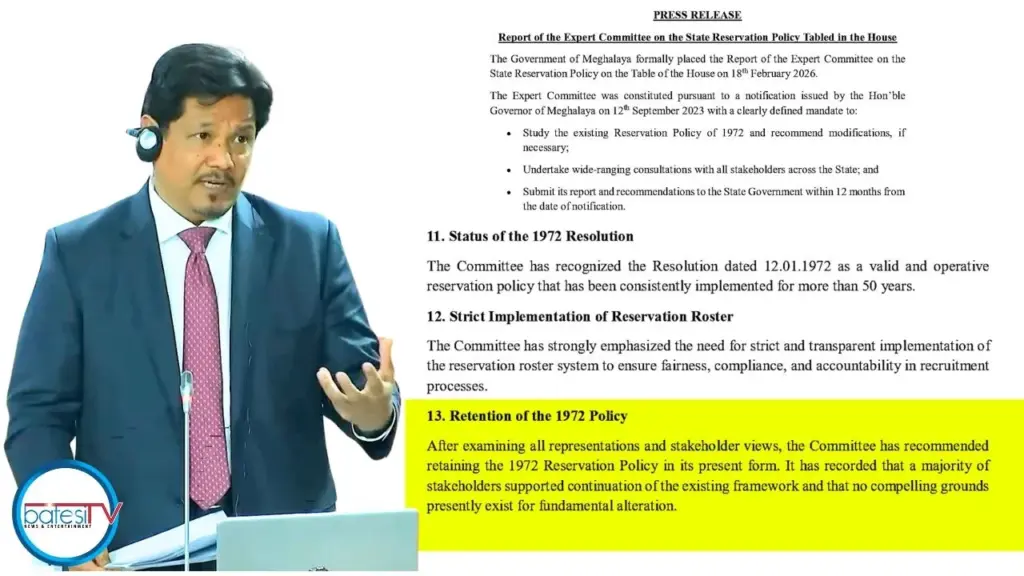
Shillong, February 18 : The Expert Committee on State Reservation Policy has recommended retaining the 1972 Reservation Policy as it stands, citing majority stakeholder support and potential vulnerability to judicial review if changed.
The report tabled by the Chief Minister Conrad K Sangma on Wednesday said, “The majority of stakeholders favor retaining the 1972 Reservation Policy as it stands. The Committee recommends retaining the 1972 Reservation Policy as it stands. A majority of the stakeholders support this view, and any change could be vulnerable to judicial review. The Committee also finds no compelling reason to modify the policy at this time. A lot has been achieved by this policy and a lot more is required to be achieved. A proper implementation and stricter adherence could provide for better results. The policy have been improvised from time to time to meet the requirements of time and the needs of people at large.”
“The Committee recognizes the 1972 Resolution as a reservation policy, which has been in place for over 50 years. Any attempt to change or modify this policy could be subject to judicial review under the Indra Sawhney judgment. Therefore, the Committee advises caution against making any further changes to this policy, as it might impact its legal standing. No policy is perfect, and the same is required to be improvised time to time which is being done in the present case,” it stated.
“These recommendations are made in light of the legal framework, public opinion, and judicial precedents to ensure that the reservation policy continues to serve its purpose of uplifting backward communities while staying within the bounds of constitutional and judicial guidelines. The Committee’s recommendations aim to uphold the constitutional principles of affirmative action, address socio-economic backwardness, and ensure that the reservation system continues to serve the needs of the most disadvantaged communities in the state. It emphasizes that any changes to the existing system must be carefully considered, keeping in mind legal precedents and the socio-economic reality of the tribes and castes in Meghalaya,” the Committee said while recommending maintaining the 1972 Reservation Policy as it is, in light of these findings and judicial guidance.
The Committee advises maintaining the status quo, supporting the strict implementation of the reservation roster system, which is already in practice as per the 2022 Office Memorandum.
“The roster should operate on a yearly basis in accordance with the available vacancies. This system ensures that the reservation quotas are properly maintained and that vacancies are filled in compliance with the principles established in the R. K. Sabarwal case,” the report stated.
The expert committee has recommended retaining the ‘Carry Forward’ system, including the extension from one year to three years, as per the 1972 Resolution.
The committee also emphasized that reservation should prioritize addressing historical exploitation and socio-economic backwardness over population proportion, saying, “Even communities with a smaller population could be given a larger stake in reservation and a large population cannot get the same. The prime consideration is backwardness, historical injustice and the adequacy of representation in service.”
It ruled out extending reservation to religious minority communities, stating that it would be unconstitutional. “Therefore, the recommendation to extend reservation to religious minority communities is not acceptable under the current legal framework.”
The committee said that the issue of extending reservation to educational institutions, covered under Article 15(4), lies outside its purview and suggested that “the state government may independently consider this issue.”
It has however highlighted the need to improve educational standards in Garo districts and recommended that “the state government should consider measures to enhance education in these areas for the socio-economic development of the community”.
The expert committee has recommended keeping the Economically Weaker Sections (EWS) category separate from Scheduled Castes (SC), Scheduled Tribes (ST), and Other Backward Classes (OBC).
It has suggested that while sub-classification or “quota within quota” is permissible as per the Supreme Court’s judgment in State of Punjab vs. Davinder Singh, it requires meticulous data collection.
“While this may be an option, it requires detailed data collection to ensure that the benefits reach the most deserving groups. The state government should decide whether to pursue this option after collection of detailed data as per the judgment.”
It has suggested that the state government consider implementing the “creamy layer” concept for Other Backward Classes (OBC), as outlined in the Supreme Court’s Davinder Singh judgment.
The committee has noted that existing provisions adequately address horizontal reservation for persons with benchmark disabilities and said, “Hence, no additional recommendations are necessary from the Committee on this matter.”
Further, the committee has deemed it unfeasible to prescribe higher reservation for local tribes in Class C and D posts, citing migration from rural to urban areas.
“The idea of prescribing higher reservation for local tribes in Class C and D posts is not feasible due to the migration from rural to urban areas. The existing Office Memorandum dated 10th May 2022 sufficiently addresses this concern by catering to local recruitment preferences.”