Shillong, October 12: The Meghalaya Commissionerate of Food Safety has issued directives requiring food businesses to prominently display their 14-digit FSSAI licence or registration number on bills and menus, while also introducing colour-coded chopping boards and dedicated knives for meat and fish sellers to prevent cross-contamination.
Under the first directive, all Food Business Operators (FBOs) across Meghalaya — including food processing units, self-help groups, manufacturers, milk and meat processing units, restaurants, hotels, bakeries, government wholesalers, distributors and retail grocery stores — have been directed to display their 14-digit FSSAI licence or registration number on cash receipts, invoices and bills, cash memos, as well as physical and digital menus, including online food listings and platform listings.
The Commissionerate said non-disclosure of the licence number could be treated as an unfair trade practice, as consumers are entitled to information necessary to verify the authenticity and safety standards of food service providers.
Food businesses have been asked to ensure that the FSSAI number is clearly legible and embedded in receipt-printing software. Handwritten numbers on printed bills have been discouraged as they may affect legibility. Operators were given 30 days from receipt of the directive to comply, failing which legal proceedings may be initiated under the Food Safety and Standards Act, 2006.
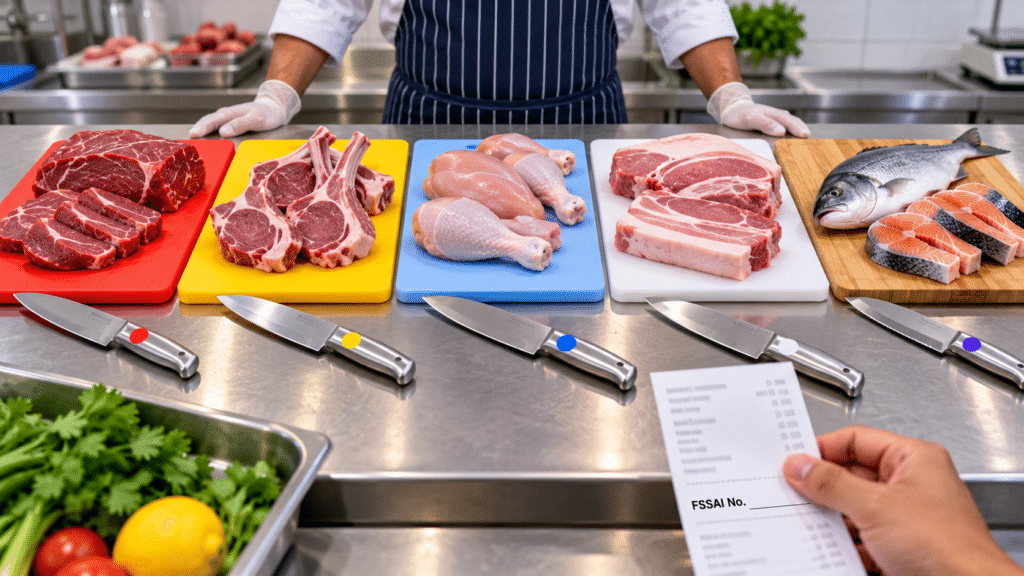
In a separate directive, the Commissionerate has ordered meat and fish sellers to adopt dedicated colour-coded chopping boards and knives as part of an integrated system aimed at preventing cross-contamination in the meat supply chain.
The prescribed system provides for red/orange chopping boards for beef, yellow for mutton, light blue for chicken, white for pork and natural wood for fish, with separate knives marked with corresponding coloured stickers. Fish knives are to carry violet stickers.
The directive requires each chopping board and knife to be used exclusively for its designated meat category. Chopping boards must be food-grade, non-porous and free from cracks or deep grooves that could harbour bacteria.
The Food Safety Commissionerate has also directed that only stainless steel knives be used, citing concerns over oxidation and rusting associated with certain aluminium alloy knives. Knives should be thoroughly washed with soap and/or hot water, while overnight salt treatment for chopping boards has been recommended to inhibit microbial growth.
The department warned that using the same tools across different meat categories or using non-standard knives would be treated as a violation of sanitation and hygiene requirements. Failure to comply may invite penal action under the Food Safety and Standards Act, 2006.