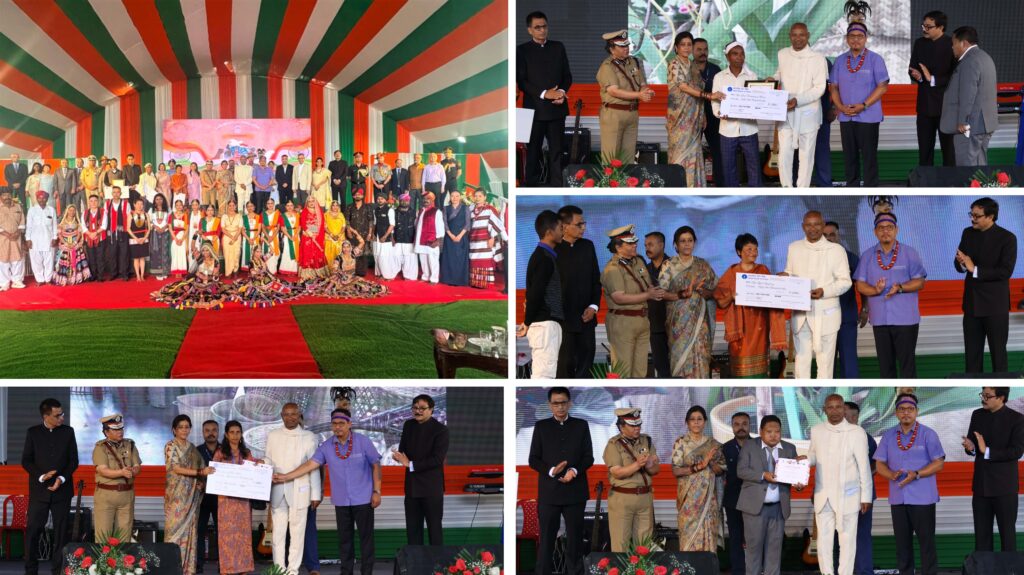
Shillong, August 15 : Meghalaya Governor C. H. Vijayashankar hosted the traditional “At Home” reception at Lok Bhavan, Shillong, on Friday as part of the celebrations marking India’s 80th Independence Day.
Chief Minister Conrad K. Sangma, senior government officials, defence and police personnel, artists, cultural representatives, distinguished guests and other invitees attended the programme, which celebrated national unity, cultural diversity and patriotism.
The Governor began the programme by inaugurating stalls and displays set up by farmers, entrepreneurs and artists on the lawns of Lok Bhavan and inspecting the exhibits. This was followed by the “At Home” ceremony organised under the theme “Colors of India”, curated by the Governor’s Secretariat in collaboration with the Department of Arts and Culture.
The cultural programme showcased performances representing different parts of India as well as Meghalaya. These included Jogari, Jagarna and Rouf dances presented by the Jammu & Kashmir Academy of Art, Culture & Languages; Bhawai Dance and Kalbelia Keshria Balam Song by the West Zone Cultural Centre, Udaipur, Rajasthan; and “Milke Sare Bandhan Todenge Hum” by Karnataka Sangha, Mandya.
Traditional performances from Meghalaya included Ka Shad Mastieh, the Khasi warrior dance; the Wangala harvest folk dance of the Garo community; and Chad Kheit Soh, a traditional Jaintia folk dance. A Bharatanatyam presentation of Vande Mataram by Prajna Kashyap from Mysore, a cultural presentation from Bengal, and performances by the Jazz and Symphony Bands of the Assam Rifles and Assam Regimental Centre were also featured.
The occasion also saw the felicitation of grassroots achievers for their contributions in different fields. Lynti Rynghang of Ri-Bhoi district was recognised for woodcraft, Norma R. Lakiang of East Khasi Hills for bonsai, and Dirot Chambugong Marak of West Garo Hills for traditional musical instruments. Winners of the Flower Show, including the King of Flower Show, Queen of Flower Show and Best Stall, were also felicitated.
Following the cultural programme, Lok Bhavan was opened to thousands of visitors, allowing citizens to explore the historic premises and visit stalls displaying products and works of local entrepreneurs.
The celebration also reflected the larger significance of the transformation of Raj Bhavan into Lok Bhavan, symbolising a shift from the traditional concept of the “house of the ruler” to the “house of the people.”
By opening its doors to the public on Independence Day, Lok Bhavan sought to reinforce the values of openness, participation and inclusiveness, while underlining that the institution belongs to and serves the people.