Shillong, November 4: The Meghalaya Government has introduced a new education support scheme called the Chief Minister’s Initiative to Maximize Pass Achievement and Classroom Triumph PLUS (CM-IMPACT PLUS), aimed at strengthening secondary and higher secondary education through performance-based financial assistance, school upgradation and infrastructure development.
According to a notification issued by the Education Department on November 4, 2026, the scheme will cover recognised private Secondary and Higher Secondary Schools, as well as Government Secondary and Higher Secondary Schools across the state. The notification stated that the government had consolidated various categories of teacher-salary Grant-in-Aid payable to private schools, except those under the Deficit system, into a single Structured Pay Framework (SPF) and discontinued fresh sanctions of teacher-salary Grant-in-Aid. The government observed that Meghalaya has a disproportionately small number of Secondary Schools and even fewer Higher Secondary Schools compared to Lower Primary and Upper Primary Schools.
In view of this, the government decided to introduce a new system of financial assistance that rewards genuine institutional needs and academic performance rather than merely funding salaries. The CM-IMPACT PLUS scheme comprises three major components, including recurring financial assistance to private schools, one-time grants for upgrading private schools and infrastructure development grants for government schools. Under the first component, eligible private Secondary and Higher Secondary Schools will receive recurring Grant-in-Aid to bridge their verified Revenue-Expenditure Gap. The initial annual Base Support has been fixed at Rs 10 lakh for Secondary Schools and Rs 12 lakh for Higher Secondary Schools, subject to determination by the Apex Committee.
However, the amount sanctioned to each school will depend on several factors, including academic performance, student enrolment, financial requirements, location and infrastructure. The government stated that the grants would be adjusted based on the Meghalaya School Performance Grading Index (MS-PGI), SSLC and HSSLC examination results, student enrolment trends and school fees. Additional consideration will be given to schools situated in rural and remote areas, schools owning land and playgrounds, and institutions offering classes from Class 1 to Class 12.
The final financial assistance may range between 60 per cent and 120 per cent of the Base Support, subject to the school’s verified financial requirements and applicable ceilings. To qualify, private schools must be duly recognised and have been conducting SSLC or HSSLC examinations for at least the preceding two academic years. They must also meet minimum enrolment and examination performance requirements, maintain audited financial accounts and have functional School Management Committees or governing bodies. Schools without the required playground facilities may be granted provisional eligibility if they submit a credible plan to develop or acquire such facilities within a maximum period of two years.
The government clarified that the recurring Grant-in-Aid will not be treated as a per-post or per-teacher salary subsidy. Instead, school managements will have the freedom to utilise the sanctioned grants for recurring expenditure, including teacher salaries, or non-recurring requirements, subject to the prescribed financial limits. The scheme further states that receiving such assistance will not create any right or claim for teachers or other school employees to be absorbed or regularised in government service.
Under the second component, the government will provide one-time financial assistance to eligible private schools seeking to upgrade their existing educational facilities. This includes Upper Primary Schools seeking to introduce Secondary classes from Class 9 to Class 10 and Secondary Schools planning to introduce Higher Secondary classes from Class 11 to Class 12. To qualify, schools must have been functioning continuously for at least five years with a satisfactory academic record.
They must also demonstrate the absence of, or capacity constraints in, nearby government or government-aided schools offering the next level of education, along with adequate infrastructure and a sustainable financial plan. The assistance may cover land, school buildings, playgrounds, laboratories, libraries, essential furniture and equipment, besides limited transitional recurring support during the first three academic years. The amount of assistance will be determined by the Apex Committee based on budget availability, enrolment, location, academic performance and other prescribed criteria.Schools completing three consecutive academic years at the upgraded level may subsequently apply for recurring grants under the first component, subject to eligibility.
Meanwhile, the third component will focus on infrastructure development in Government Secondary and Higher Secondary Schools. The government stated that priority would be given to schools with poor infrastructure, particularly those located in rural and remote areas and institutions recording low scores under the infrastructure and access indicators of the MS-PGI. Financial assistance will be provided for repairing and renovating school buildings, classrooms, roofing, flooring, walls and electrical installations. The scheme will also prioritise separate functional toilets for boys and girls, facilities for children with special needs, safe drinking water, accessibility ramps, electricity connections, basic furniture and fire safety arrangements.
The maximum grant under this component will be determined by the Apex Committee, while individual allocations will be based on verified infrastructure requirements and technical estimates. Funds will be released in stages linked to the physical progress of work, with utilisation certificates and updated school performance assessments required for accountability.
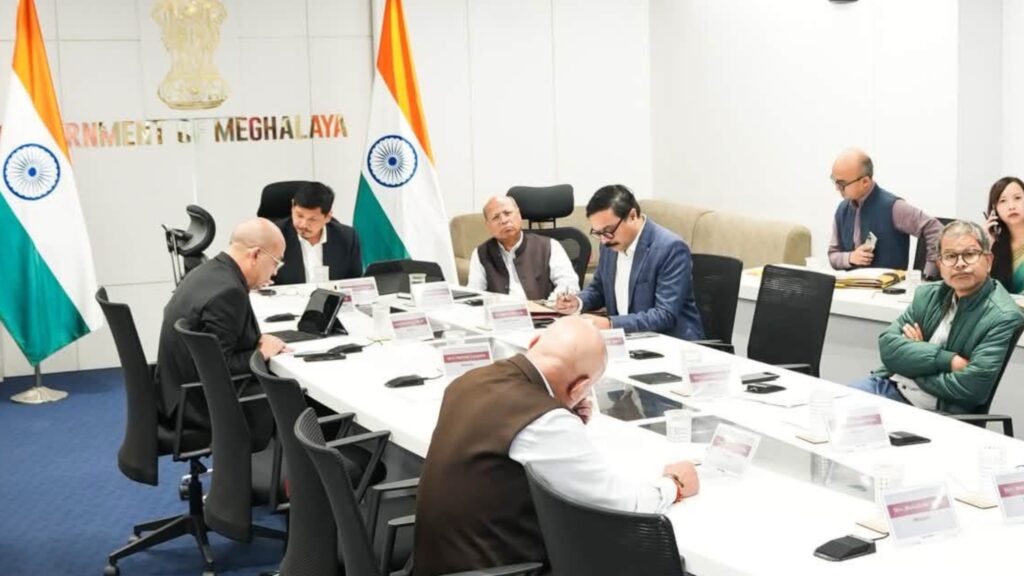
For implementation, the government has constituted an Apex Committee headed by the Chief Minister as Chairperson, with the Minister in charge of Education serving as Vice-Chairperson. Other members include the Chief Secretary, senior-most Secretary of the Finance Department, senior-most Secretary of the Education Department, State Project Director of Samagra Shiksha and Director of School Education and Literacy. The committee will serve as the final sanctioning and appellate authority for all three components of the scheme.
The State Education Mission Authority of Meghalaya (SEMAM) has been designated as the implementing agency responsible for processing applications, verifying eligibility, assessing financial requirements and monitoring the utilisation of grants. Eligible schools will be required to submit applications online in the prescribed format, following which SEMAM will verify the documents and complete its assessment within 30 days. Financial assistance will be transferred directly to the bank accounts of approved schools through the Direct Benefit Transfer (DBT) system. Recurring grants under the first component will be released quarterly, while assistance under the other two components will be disbursed in stages.
The notification further states that continuation of recurring grants will not be automatic and will depend on academic performance, financial transparency and compliance with the prescribed requirements. Schools recording declining examination results or poor performance under the MS-PGI may face reduction, suspension or withdrawal of financial assistance.
The government may also recover grants in cases involving false information, financial irregularities, examination malpractice or misuse of funds. The scheme will operate within the Education Department’s existing Grant-in-Aid budget, with no separate or fixed financial allocation earmarked for its implementation.
The government stated that CM-IMPACT PLUS is intended to improve educational opportunities, particularly in rural and remote areas, while encouraging schools to strengthen academic performance, expand access to secondary and higher secondary education and provide better infrastructure for students. The notification, issued by Commissioner and Secretary to the Government of Meghalaya, Education Department, Vijay Kumar Mantri, IAS, came into effect on November 4, 2026.