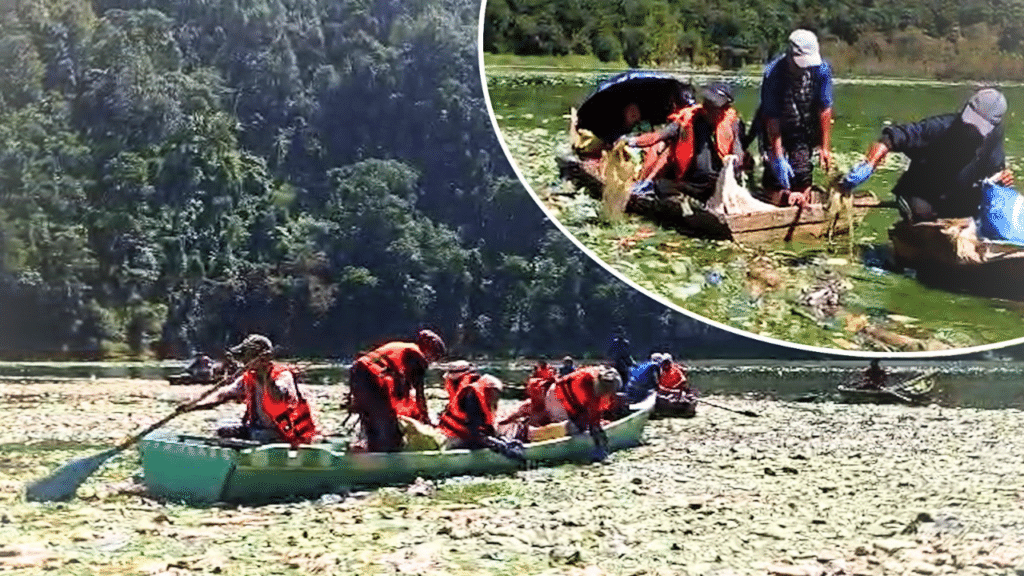
Shillong, October 13: The Green-Tech Foundation (GTF), in collaboration with residents and villagers of Mawdun, launched a massive clean-up drive at Wah Ïap-Ngor on Tuesday in an effort to prevent accumulated waste from spreading into Umiam Lake and to safeguard the long-term sustainability of the reservoir.
The clean-up drive was undertaken at a critical location where waste carried downstream by Wah Umkhrah and Wah Umshyrpi accumulates before being dispersed across the surface of Umiam Lake. The initiative aims to intercept and remove floating waste before water currents carry it further into the reservoir, which supports Meghalaya’s 172 MW Umiam hydropower installation.
Speaking during the initiative, Green-Tech Foundation Chairman H. Bansiewdor Nonglang expressed serious concern over the deteriorating condition of Umiam Lake, particularly the accumulation of solid waste and sedimentation, which could threaten the long-term sustainability of the reservoir.
Nonglang said that estimates indicated that more than 40,000 cubic metres of sediment entered the reservoir annually, raising serious questions about its future storage capacity and its importance to Meghalaya’s electricity supply. “As a Foundation, we cannot simply stand by and watch the condition of Umiam Lake deteriorate. Every year, substantial quantities of sediment enter the reservoir, with estimates indicating more than 40,000 cubic metres annually,” he said.
He maintained that the clean-up drive was not merely another environmental activity but part of a sustained effort to protect one of Meghalaya’s most important water bodies. “Every tonne of waste we remove, every stretch of the river we restore, and every intervention we make to prevent further pollution is a step towards protecting Umiam Lake,” Nonglang said. He added that the Foundation intended to continue its clean-up operations and remove as much waste as possible to prevent hundreds of tonnes of waste from spreading across the lake. However, he stressed that removing accumulated waste alone would not resolve the problem unless effective measures were introduced to prevent pollution at its source.
Highlighting the environmental challenges facing the reservoir, Nonglang said the scenic beauty of Umiam Lake, particularly when viewed from popular tourist viewpoints such as Ryndang Briew, often concealed the serious ecological problems affecting the water body. He said waste accumulation, sedimentation and continuous environmental pressure were gradually affecting the reservoir’s ecosystem. “The real condition of the lake cannot be understood from a viewpoint alone. Beneath that beautiful landscape lies a growing environmental challenge involving waste accumulation, sedimentation and the continuous pressure on the reservoir ecosystem,” he stated.
The GTF Chairman appealed to the people of Shillong to recognise that Umiam Lake was not merely a tourist attraction but also an important hydropower reservoir and ecological asset that required urgent protection. He urged residents, government departments, environmental organisations, community groups and civil society organisations to join hands in addressing the growing environmental threats.
Nonglang maintained that protecting Umiam Lake should not become an exercise in blaming the government, the public or any particular individual, but should instead involve collective responsibility and sustained action. “This cannot be the responsibility of one Foundation or one village alone. It requires a collective response on a scale that matches the seriousness of the problem,” he said.
Calling for a comprehensive and scientifically guided restoration programme, the Foundation urged the State Government to initiate coordinated measures for river rejuvenation, waste interception, sedimentation management, catchment afforestation and ecological restoration. It emphasised the need for sustained interventions along Wah Umkhrah and Wah Umshyrpi to prevent solid waste from entering Umiam Lake. The Foundation also called for regular scientific assessments of sediment inflow, reservoir depth and changes in storage capacity, followed by appropriate sediment-management measures.
According to GTF, restoring degraded catchment areas, protecting forest cover and controlling soil erosion would be essential to reducing sediment runoff into the reservoir. It further recommended continuous waste collection, improved waste-management systems and greater public participation in environmental protection.
The Foundation urged the government to establish a common platform involving technical experts, environmental organisations, local communities and other stakeholders to formulate a long-term strategy for restoring and protecting the lake.
Meanwhile, GTF also raised concerns over development projects that could place additional environmental pressure on the reservoir. It maintained that proposals for luxury hotels and other major developments around Umiam Lake should be carefully assessed in relation to the reservoir’s environmental condition, carrying capacity and long-term public interest. “Development must be guided by the realities of the place. Umiam is a hydropower reservoir and an ecological asset of immense importance to Meghalaya. Its protection must come before any ambition that could compromise its long-term sustainability,” Nonglang said.
He stressed that Meghalaya could not build a sustainable future by neglecting the natural resources that supported its people and economy. Reiterating its commitment to environmental protection, Green-Tech Foundation said it would continue working alongside the residents of Mawdun and other concerned communities through clean-up operations, public awareness campaigns and sustained restoration initiatives.
The Foundation appealed to citizens to move beyond temporary expressions of concern and actively participate in protecting Umiam Lake. It warned that continued deterioration of the reservoir would have consequences not only for the environment but also for communities dependent on the lake and the long-term sustainability of Meghalaya’s hydropower resources. “Let us stop treating Umiam Lake merely as a beautiful landscape to admire. Let us recognise it as a lifeline to protect. Its future depends on what we do today,” the Foundation stated.