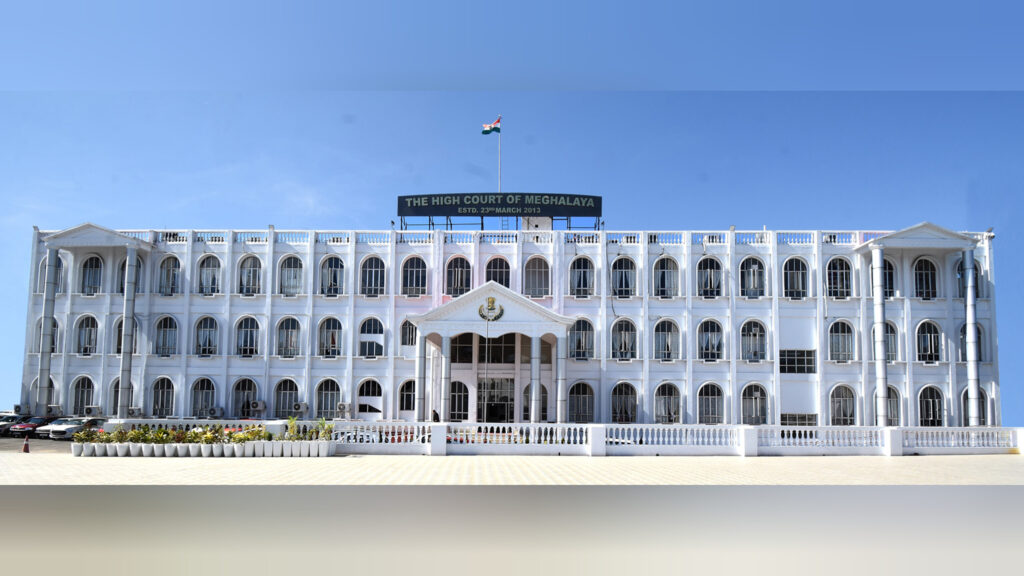
Shillong, November 11: The Meghalaya High Court has expressed serious concern over deficiencies in manpower, scientific equipment, infrastructure and maintenance at the Forensic Science Laboratory (FSL) in Shillong, warning that delays in forensic examinations could adversely affect criminal investigations, trials and the timely administration of justice.
In an order dated November 5, 2026, a Division Bench comprising Chief Justice Revati Mohite Dere and Justice W. Diengdoh directed the State Government to take urgent steps to address the shortcomings identified in a comprehensive inspection report submitted by Advocate K. Ch. Gautam, who was appointed as Amicus Curiae in PIL No. 12 of 2026.
The court observed that the deficiencies at the laboratory required immediate attention, particularly in DNA testing, narcotic drug testing, recruitment of scientific personnel, maintenance of equipment and overall infrastructure.
The matter came before the court following earlier proceedings in which it was informed that DNA testing at the Shillong FSL had been halted due to the non-availability of essential chemicals.
During a hearing on September 8, the State Government informed the court that quotations had been invited from reputed firms and authorised dealers for supplying DNA testing kits and consumables.
The government also stated that maintenance work was being undertaken at the Directorate of Forensic Sciences.
Following these submissions, the court directed the Amicus Curiae to visit the laboratory and submit a report on its condition.
After inspecting the facility, Gautam submitted a detailed report highlighting numerous shortcomings affecting the laboratory’s functioning.
According to the report, several portions of the FSL building and office areas were damp and inadequately maintained, while workstations in different divisions were found to be unhygienic.
The Amicus Curiae observed that the overall working environment was not appropriate for a specialised scientific establishment.
One of the major concerns highlighted in the report was the acute shortage of housekeeping personnel.
The inspection revealed that only one cleaner was available for the entire three-storeyed FSL building, forcing scientific officers and other officials to clean and maintain their respective divisions themselves.
The court noted that the shortage of housekeeping and laboratory support staff required urgent attention.
It observed that laboratory bearers perform essential duties, including handling materials and exhibits, maintaining laboratory facilities and assisting scientific personnel.
The report also identified manpower shortages in several scientific divisions, including Chemistry, Biology and DNA, Document Examination, Cyber Forensics, Ballistics and Physics.
It further revealed that two posts of Deputy Director and two posts of Scientific Officer were vacant.
According to the report, one Scientific Officer was overseeing the Cyber Forensic Unit with the assistance of a single staff member while simultaneously managing the Physical Division.
Another concern brought to the court’s attention was the appointment of a Director who reportedly did not possess a technical or scientific background in forensic science.
The court described the matter as a serious concern and observed that the highly specialised functions of the Directorate required adequate technical and scientific supervision.
The Amicus Curiae’s report also highlighted serious deficiencies in scientific equipment and essential consumables.
It revealed that non-functional equipment in the Chemistry Division had affected laboratory operations and resulted in the interruption of testing under the Narcotic Drugs and Psychotropic Substances (NDPS) Act.
Similarly, the shortage and non-availability of chemicals and consumables had affected DNA testing.
The report also identified the need for additional equipment in the Biology and DNA Division, modern scientific instruments in the Document and Physical Divisions, and updated hardware and software for Cyber Forensics.
Regular maintenance and calibration of scientific equipment, along with adequate air-conditioning and ventilation facilities, were also identified as important requirements.
The Amicus Curiae recommended that the Directorate undertake a comprehensive inventory and assessment of scientific equipment to identify functional, non-functional, obsolete and urgently required instruments.
The court was also informed that a generator installed at the laboratory in 2024 had become non-functional following damage caused by a sudden high-voltage surge.
According to a letter submitted by the Directorate to the State Government on September 23, 2026, the generator required replacement because it could no longer be operated safely.
The Directorate highlighted that the generator served as a critical backup power source for sophisticated scientific equipment requiring uninterrupted electricity supply.
It warned that continued power interruptions could affect daily laboratory operations, data safety and productivity.
However, the request for sanction to repair or replace the generator remained pending before the State Government.
During the hearing, Additional Advocate General N.D. Chullai submitted a report informing the court that the government had received requests from the Directorate for the repair or replacement of the generator and procurement of essential equipment and consumables.
The court was informed that the requests were awaiting approval from the Finance Department.
It was further informed that the procurement process for DNA consumables had progressed, with technical evaluation of participating firms completed and a proposal forwarded to the government on October 8, 2026.
However, the proposal was still awaiting consideration and necessary approval.
Expressing concern over these delays, the High Court observed that the shortcomings identified in the inspection report must be addressed at the earliest.
The court emphasised that criminal investigations depend heavily on forensic examination and scientific reports.
It warned that delays in forensic examinations could have serious consequences for investigations, the preparation of chargesheets and criminal trials.
The Bench further observed that shortages of scientific and technical personnel contribute significantly to delays in forensic examination and reporting, especially when the volume of cases exceeds the laboratory’s available capacity.
The court also pointed out that deficiencies in forensic reports could lead to acquittals in criminal cases.
In view of these concerns, the High Court directed the Additional Advocate General to place a copy of the Amicus Curiae’s report before the Secretary and Joint Secretary of the Home (Police) Department.
The court asked the authorities to take prompt steps to secure pending approvals and address the issues highlighted in the report.
It also stressed the need to fill existing vacancies, including Grade-IV posts, recruit adequate support personnel and undertake maintenance of the laboratory building on a priority basis.
The Bench observed that retired FSL employees could be appointed on a contractual basis, if necessary, until regular appointments are made, to ensure that the laboratory functions effectively.
The High Court also directed the State Government to pay ₹50,000 to Amicus Curiae K. Ch. Gautam in recognition of his efforts in preparing the inspection report and assisting the court.
The Additional Advocate General was directed to file an affidavit detailing the steps taken by the government to address the deficiencies before the next hearing.
The matter has been listed for further hearing on November 19, 2026.