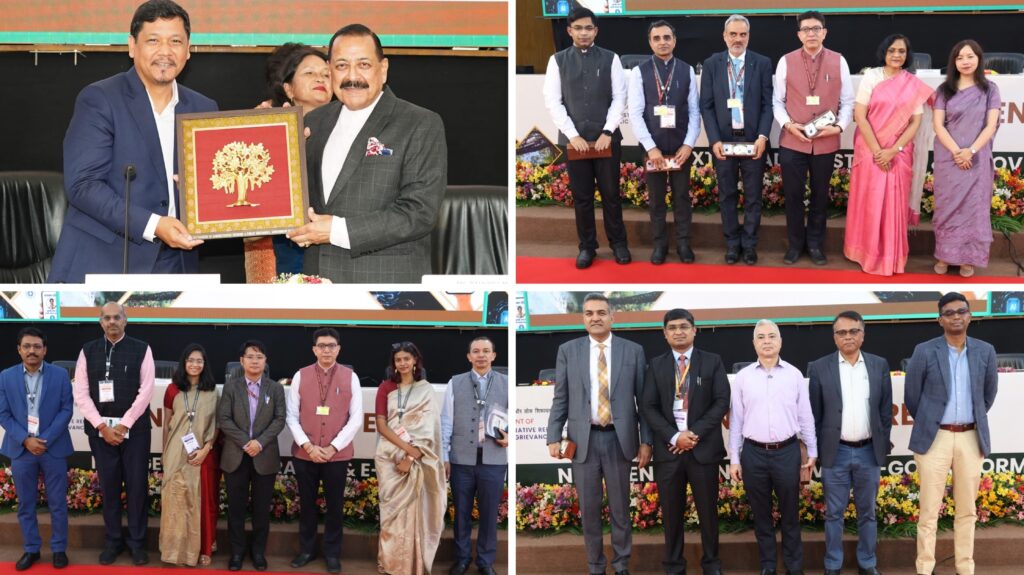
Shillong, July 13: Union Minister Dr. Jitendra Singh on Monday said India was entering the next phase of administrative transformation, with Artificial Intelligence, cybersecurity and digital public infrastructure expected to drive more efficient and citizen-centric governance. He was addressing the inaugural session of the two-day National Conference on Next Generation Administrative and e-Governance Reforms in Shillong.
The conference was jointly organised by the Department of Administrative Reforms and Public Grievances under the Union Ministry of Personnel, Public Grievances and Pensions and the Government of Meghalaya. Meghalaya Chief Minister Conrad K. Sangma, Chief Secretary Dr. Shakil P. Ahammed, DARPG Secretary Nivedita Shukla Verma, Additional Secretary Puneet Yadav and senior Central and state government officials attended the inaugural programme.
Referring to Prime Minister Narendra Modi’s call for a “Reform Express”, Singh said future reforms must incorporate AI, cybersecurity, digital public infrastructure and integrated service-delivery platforms to meet the aspirations of Viksit Bharat 2047. He said administrative reforms had become central to India’s development journey through increased transparency, accountability, digital empowerment and outcome-oriented governance.
Singh said national conferences on governance reforms were increasingly being organised outside New Delhi to strengthen cooperation between the Centre and the states and encourage the sharing of successful administrative practices. He expressed hope that the Shillong conference would culminate in a “Shillong Declaration 2.0” to advance the country’s reform agenda.
The Minister praised Meghalaya’s New Shillong Administrative City project, saying its combination of modern infrastructure and digital governance represented an administrative concept that had not been visualised a decade ago. He also said the Northeast had emerged as a major beneficiary of the Centre’s development initiatives and highlighted Meghalaya’s Living Root Bridges as an example of community-led development.
Highlighting India’s digital governance progress, Singh referred to Jan Dhan accounts, Aadhaar-enabled services, Direct Benefit Transfer and the Unified Payments Interface, which he said had transformed interactions between citizens and the government. He said the Centralised Public Grievance Redress and Monitoring System had grown into one of the world’s largest technology-enabled grievance platforms, with annual grievances increasing from around two lakh in 2014 to nearly 25 lakh.
According to him, the platform now uses AI-supported multilingual chatbot services while retaining human involvement during the final stage of grievance disposal. Singh also highlighted administrative innovations such as facial recognition-enabled Digital Life Certificates, e-Office, Prashasan Gaon Ki Ore and the National e-Services Delivery Assessment.
He said a chatbot had recently been introduced in 22 languages and would be expanded to include more languages. The Minister said nearly 2,000 outdated rules and compliance requirements had been repealed as part of efforts to simplify procedures and establish citizen-friendly governance systems suited to a modern welfare state.
However, he stressed that administrative mindsets must evolve alongside technology. “Technology is advancing rapidly, but our thinking must evolve at the same pace,” Singh said, adding that governments were sometimes unable to make optimal use of available tools because institutional attitudes had not changed sufficiently.
He also highlighted the Special Campaign for Disposal of Pending Matters and Cleanliness, launched in 2021, which he said had generated more than ₹4,000 crore through the disposal of scrap and obsolete materials while freeing nearly 700 lakh square feet of office space. Singh called upon states and Union Territories to adopt successful practices from one another and focus on AI-enabled administration, cybersecurity, evidence-based policymaking and resilient institutions.
Chief Minister Conrad K. Sangma said administrative reforms were necessary to improve government efficiency and the delivery of public services. He said resistance to change and fear of negative outcomes often prevented officials from proposing and implementing innovative ideas. Sangma advocated gradual and continuous improvements in governance and stressed that the ultimate objective of administration should be to serve the public and improve people’s lives.
He highlighted the Meghalaya Government’s CM Connect programme, which uses technology and direct interaction with citizens to receive and resolve complaints and grievances. The Chief Minister also stressed the need to obtain feedback from officials who interact directly with the public, saying their suggestions could help improve decision-making and service delivery.
He referred to the state’s Cabinet Retreat, during which government departments present their plans, challenges and proposals, as an example of inter-departmental collaboration. Sangma said governments should maintain a positive mindset and encourage officials to share both successes and failures so they could learn from one another and remain motivated.
The conference’s plenary session included presentations on Meghalaya’s best governance practices, initiatives by recipients of the Prime Minister’s Awards and programmes undertaken by the Ministry of Development of North Eastern Region.