Shillong , January 27 : In a major step towards global recognition of India’s living heritage, the Permanent Delegation of India to UNESCO has formally submitted the nomination dossier of “Jingkieng Jri / Lyu Chrai Cultural Landscape, Meghalaya” to the UNESCO World Heritage Centre for inclusion in the World Heritage List for the 2026–27 evaluation cycle.
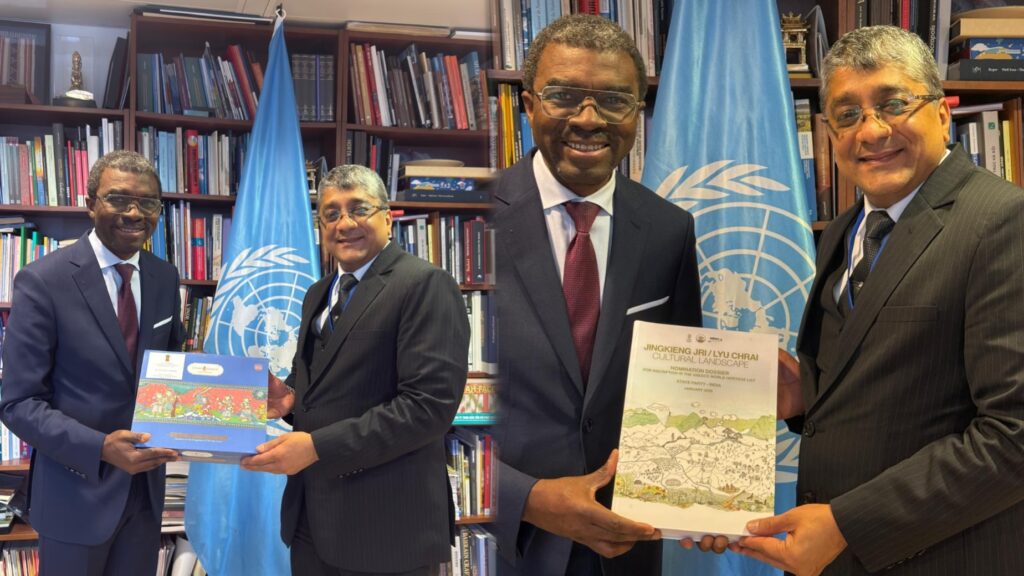
The dossier was officially handed over by Vishal V. Sharma, Ambassador and Permanent Representative of India to UNESCO, to Lazare Assomo Eloundou, Director of UNESCO’s World Heritage Centre, in Paris.
The nominated site, spread across the Khasi and Jaintia Hills of Meghalaya, represents an exceptional living cultural landscape developed over centuries by Indigenous Khasi and Jaintia communities. It showcases a unique blend of traditional knowledge, spiritual values, and ecological harmony — most prominently through the globally admired living root bridges, or Jingkieng Jri.
The cultural landscape, known locally as Lyu Chrai, embodies the Indigenous worldview rooted in Mei Ramew (Mother Earth) — a philosophy centred on respect, reciprocity, and responsibility toward nature. The system reflects a deep connection between people, land, and environment, expressed through sustainable land use, community governance, and traditional conservation practices.
While submitting the nomination, Ambassador Sharma extended gratitude to Prime Minister Narendra Modi, Union Culture Minister Gajendra Singh Shekhawat, Meghalaya Chief Minister Conrad K. Sangma, and Principal Secretary Frederick Kharkongor, along with experts from the Archaeological Survey of India (ASI), the Ministry of External Affairs, and local communities for their contributions to this historic milestone.
The nomination underscores India’s commitment to protecting and promoting its cultural and natural heritage, particularly the living traditions and ecological wisdom of Indigenous peoples. It also strengthens India’s leadership in advancing global heritage conservation efforts through UNESCO.