Jowai, October 23: Jowai Polytechnic Institute organised Technophilia 2, a technical exhibition showcasing students’ creativity, innovation and practical skills as part of its Silver Jubilee celebrations, with a strong emphasis on promoting hands-on learning and industry-oriented technical education. The exhibition was inaugurated by Commissioner and Secretary of the Education Department, Vijay Kumar Mantri, IAS, who attended as the chief guest. Joint Director (Technical) of the Directorate of Higher and Technical Education (DHTE), F.B.S. Ramsiej, attended as the guest of honour, while Deputy Director (General), DHTE, F. Rumnong, was also present.
Addressing the gathering, Mantri stressed the need to move beyond conventional textbook-based education and focus on practical, skill-oriented learning to prepare students for the changing demands of industries. He encouraged technical institutions to introduce hands-on training through laboratories, workshops and real-world projects from the beginning of academic programmes, enabling students to develop practical expertise alongside theoretical knowledge.
Highlighting the increasing accessibility of information through digital platforms and artificial intelligence (AI), Mantri said practical skills, creativity and technical competence have become increasingly important in today’s professional environment. He urged institutions to regularly update their curricula to keep pace with technological advancements and evolving industry requirements. Citing examples from textile design and automobile engineering, he emphasised the importance of developing practical expertise in areas such as garment pattern-making and encouraged students to explore emerging technologies, particularly electric vehicles, through experimentation and prototype development.
Speaking on architectural assistantship, Mantri highlighted the need to combine traditional architectural designs with modern techniques suited to Meghalaya’s geographical and climatic conditions. He stressed that architectural planning in the state must consider local terrain and heavy rainfall, including the provision of sloping roofs and proper drainage systems to prevent water seepage and dampness in buildings.
The Commissioner and Secretary also called for stronger collaboration between technical institutions and industries, suggesting that Jowai Polytechnic explore consultancy services and infrastructure design projects under the internal revenue generation policy. He further proposed collaboration with the office of the Deputy Commissioner to identify opportunities for students and faculty members to participate in upcoming government projects, thereby gaining practical experience. Mantri urged faculty members to maintain close engagement with industries to ensure that technical education continues to equip students with the skills, creativity and adaptability required in an increasingly competitive professional environment.
Speaking on the occasion, F.B.S. Ramsiej congratulated Jowai Polytechnic Institute on completing 25 years and acknowledged the contributions of its former and serving principals, faculty members, staff, students and alumni. He emphasised the importance of modernising laboratories, upgrading academic infrastructure and strengthening educational facilities to develop the institute into a centre of excellence in technical education.
Meanwhile, Deputy Director (General) F. Rumnong highlighted the importance of vocational education and multidisciplinary learning in accordance with the National Education Policy (NEP) 2020. He proposed adopting a hub-and-spoke model to promote collaboration between technical and general educational institutions through shared resources and skill-based courses in architectural design, automobile engineering and garment technology. Rumnong also appreciated the institute for providing students with opportunities to transform classroom knowledge into practical innovations that could benefit society.
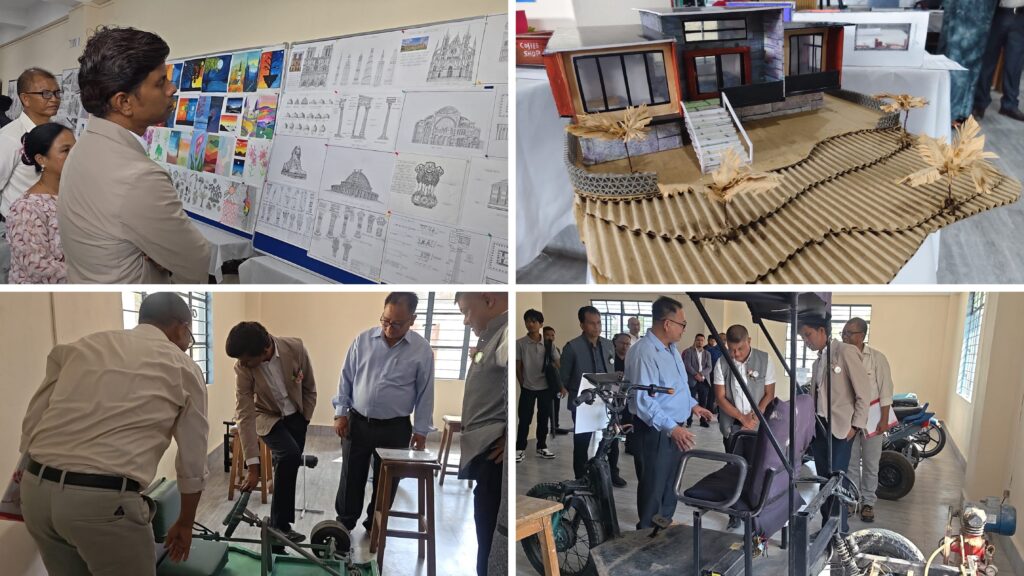
Following the inaugural programme, Mantri inspected the exhibits and interacted with students, discussing their projects, technical concepts and innovative ideas. The exhibition provided a platform for students to demonstrate their technical abilities while highlighting the importance of practical learning, innovation and industry collaboration in shaping the future of technical education in Meghalaya.