Shillong, October 29: Meghalaya Deputy Chief Minister in-charge of Commerce and Industries, Sniawbhalang Dhar, on Thursday emphasised the need to leverage India’s Free Trade Agreements (FTAs) to expand export opportunities for the state’s farmers, artisans, entrepreneurs and businesses by strengthening international market linkages.
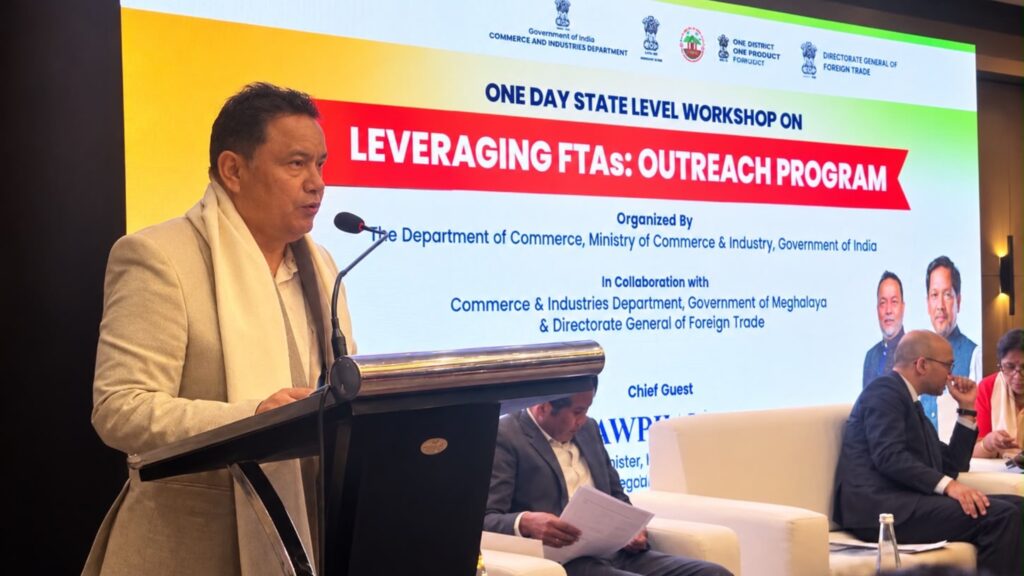
Addressing a State-Level Outreach Programme on Free Trade Agreements held in Shillong, Dhar said the State Government was committed to ensuring that local producers benefit from emerging international trade opportunities.
The programme was organised by the Commerce and Industries Department, Government of Meghalaya, in collaboration with the Department of Commerce, Government of India, and the Directorate General of Foreign Trade (DGFT), to familiarise exporters and entrepreneurs with trade agreements, export promotion schemes and procedures for accessing overseas markets. “The State Government wants our farmers, artisans, entrepreneurs and young people to benefit from the opportunities created by the FTAs, and my Department is committed to making that happen,” Dhar said.
Highlighting Meghalaya’s export potential, Dhar identified horticultural produce, spices, ginger, turmeric, pineapple, honey, bamboo, handloom and handicrafts as key sectors capable of accessing international markets. He also pointed to the state’s strategic location along the Bangladesh border and the importance of the Dawki Land Port in facilitating cross-border trade.
Dhar said India’s trade agreements with countries and regions, including the United Arab Emirates, Australia, the United Kingdom, Oman, the European Union and New Zealand, offer preferential market access to economies collectively accounting for approximately USD 26.8 trillion in GDP and USD 8.2 trillion in goods imports. He highlighted the Central Government’s Export Promotion Mission, approved in November 2025 with an allocation of Rs. 25,060 crore up to 2030–31, which aims to strengthen India’s export competitiveness.
The mission includes two sub-schemes, Niryat Protsahan and Niryat Disha, providing financial and non-financial assistance, including trade finance, market access and export development support.
The Deputy Chief Minister also referred to transportation assistance under the LIFT scheme and government support for participation in international trade fairs and buyer-seller meetings. He encouraged exporters and entrepreneurs to obtain valid Importer Exporter Code (IEC) and Udyam registrations to access available export promotion schemes.
Referring to the Reverse Buyer Seller Meet 2.0 held on October 8 and 9, 2026, Dhar said the event brought together 30 international buyers from 16 countries, two national buyers and around 400 sellers and micro, small and medium enterprises (MSMEs) from all 12 districts of Meghalaya. He informed that more than 100 Memoranda of Understanding (MoUs) were signed during the event, while negotiations for business orders were continuing.
On cross-border trade infrastructure, Dhar highlighted the importance of the Integrated Check Post at Dawki-Tamabil and the state’s existing Land Customs Stations. He said the State Government had proposed the establishment of a new Land Customs Station at Umkiang in East Jaintia Hills and submitted proposals to upgrade the stations at Bagli, Borsora, Bholaganj, Mahendraganj and Dalu into Integrated Check Posts.
Dhar also urged the Central Government to facilitate the reopening of five existing Border Haats along the India-Bangladesh border and operationalise the completed Border Haat at Huroi in East Jaintia Hills.
Speaking at the programme, Joint Secretary in the Union Department of Commerce, Kapil Chaudhary, highlighted the growing importance of India’s international trade agreements, stating that the country had signed around seven FTAs over the preceding five years, expanding access to major global markets. She stressed that trade agreements must translate into measurable export growth through improved product identification, export mapping, logistics infrastructure and stronger international business connections.
Noting that Meghalaya’s exports stood at approximately USD 77 million, Chaudhary emphasised the need to enhance the state’s export performance and identify shipments currently routed through ports outside Meghalaya. She also highlighted 11 intervention areas under the Export Promotion Mission, including market access, transportation assistance, market intelligence and overseas warehousing facilities.
Meanwhile, Commissioner and Secretary of the Commerce and Industries Department, Cyril V. D. Diengdoh, emphasised the importance of coordinated efforts between Central and State authorities, district administrations, financial institutions, Export Promotion Councils and Indian Missions abroad to help local producers enter international markets. “A trade agreement is like a door that has been opened for us, but somebody has to walk through it,” Diengdoh said. He explained that the workshop focused on market and product analysis, pre-shipment finance, trade compliance, logistics and post-shipment finance.
Technical sessions also covered Meghalaya’s export potential, benefits and requirements of FTAs, the Export Promotion Mission, Districts as Export Hubs initiative and the Trade E-connect portal. Representatives of various agencies also participated in discussions on testing, certification and regulatory compliance requirements faced by small exporters.
Reiterating the State Government’s commitment to promoting exports, Dhar stressed that the outcomes of the workshop must be translated into concrete measures at the state and district levels. “The State Action Plan that emerges from this workshop, and the district-level workshops that will follow, must lead to real export results,” he said.
The programme was attended by officials from DGFT, Agricultural and Processed Food Products Export Development Authority (APEDA), Spices Board, Directorate of Horticulture, MSME Development and Facilitation Office, Office of the Development Commissioner (Handicrafts), Meghalaya Industries and Export Chambers of Commerce, District Commerce and Industries Centres and other stakeholders.