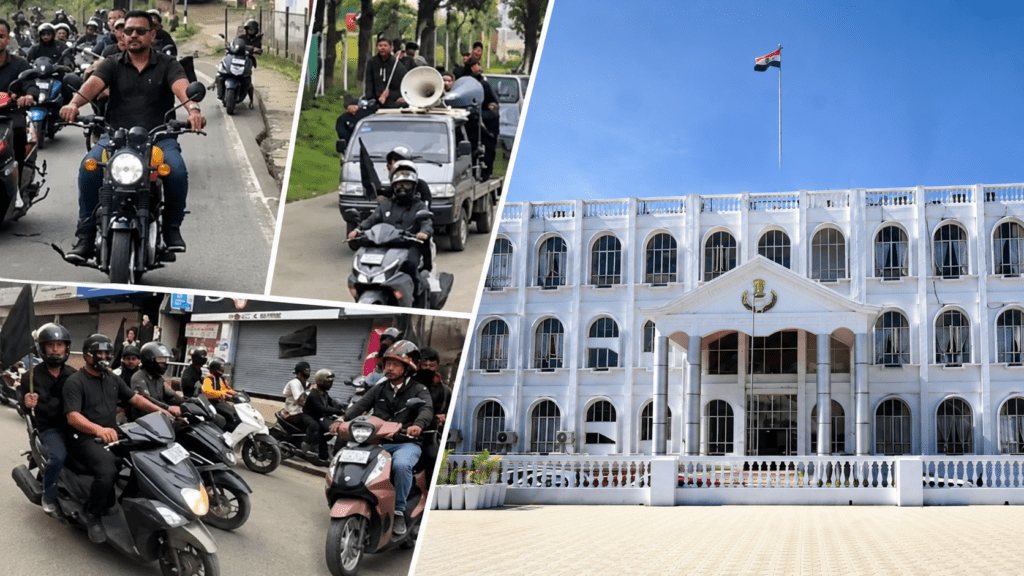
Shillong, November 27: The High Court of Meghalaya has expressed serious concern over the police investigation into the incidents of violence and vandalism during the Khasi Students’ Union (KSU) rally held on August 19, 2026, while questioning the failure of authorities to effectively implement the Supreme Court’s guidelines on preventing mob violence and lynching.
A Division Bench comprising Chief Justice Revati Mohite Dere and Justice W. Diengdoh, in an order passed on November 26 while hearing two Public Interest Litigations (PILs), observed that despite several persons being involved in vandalism and assaults on members of the public, only seven accused had been arrested in connection with the case.
The Court questioned why the police had failed to video-record the rally from its starting point at Jaiaw, Shillong, as mandated by the Supreme Court. It also expressed concern that CCTV footage from Jaiaw was collected only after its earlier intervention.
Referring to an affidavit filed by East Khasi Hills Deputy Commissioner Abhilash Baranwal, the Court noted that around 20 to 25 KSU volunteers had allegedly begun putting up unauthorised banners and posters on the walls and iron grills of the Meghalaya Secretariat at around 11 am on August 19, hours before the rally commenced at 3 pm. The Bench observed that the police ought to have exercised greater vigilance following the incident outside the Secretariat.
The Court also pointed out apparent contradictions between the Deputy Commissioner’s affidavit and an earlier police status report concerning participants covering their faces, carrying lathis and covering vehicle registration plates during the procession. A fresh status report submitted by East Khasi Hills Superintendent of Police Vivek Syiem on behalf of the Special Investigation Team (SIT) stated that further investigation was underway to establish the involvement of other accused persons. CCTV footage from around 32 locations was also submitted before the Court in a sealed envelope.
Meanwhile, the High Court expressed concern over the non-implementation of government directions concerning the prevention of mob violence and lynching, issued in accordance with the Supreme Court’s judgment in the Tehseen S. Poonawalla case. The Court was informed that special task forces had not been constituted by the concerned Superintendents of Police and that the prescribed meetings had not been held.
Observing that government notifications cannot merely remain on paper, the Bench called upon Meghalaya Director General of Police Anurag Agarwal to seek reports from Superintendents of Police across all districts, verify compliance and take appropriate steps against officers found to have failed to implement the directions.
The Court also sought details from the State Government regarding the victim compensation scheme for mob violence and lynching, including whether compensation had been awarded to persons who suffered physical or psychological injuries, loss of earnings, educational or employment opportunities, and medical or legal expenses.
The State Government and concerned authorities have further been asked to submit affidavits detailing their compliance with each of the Supreme Court’s directions contained in paragraphs 40.1 to 40.23 of the judgment.
The High Court has listed the matter for further hearing on December 11, 2026, when the DGP and other concerned officials are expected to submit their affidavits.