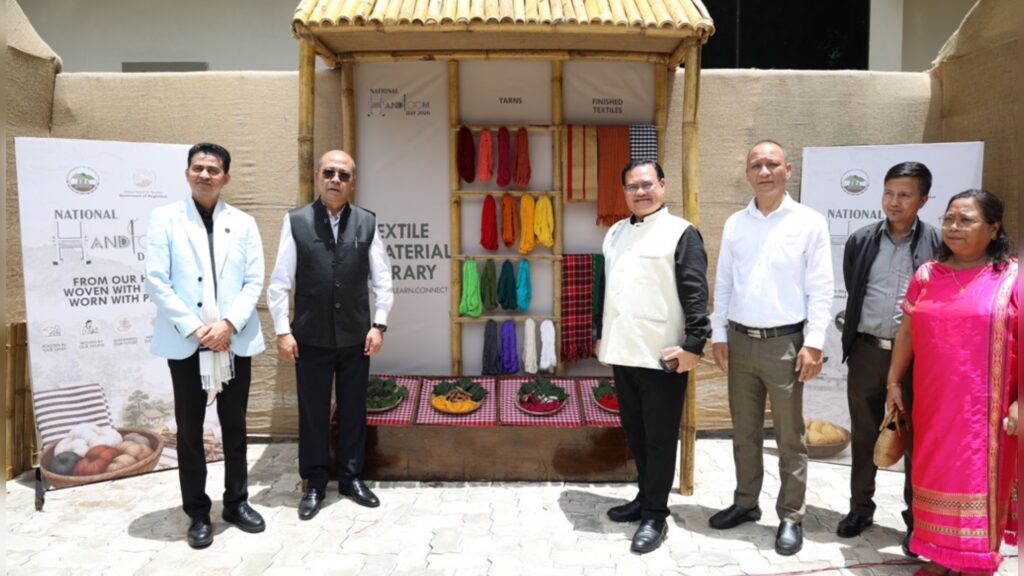
Shillong, August 7: The Meghalaya government on Friday launched Handloom Week as part of the National Handloom Day 2026 celebrations, highlighting the sector’s role in sustaining rural livelihoods and preserving the state’s rich traditional textile heritage.
The programme, organised by the Department of Textiles at the State Guest House in Shillong, was inaugurated by Textiles Minister Metbah Lyngdoh, who also inspected stalls showcasing handloom products made by local artisans. The Minister also received the Indian Tricolour as part of the “Har Ghar Tiranga” campaign.
Addressing the gathering, Lyngdoh said National Handloom Day honours the dedication, skills and craftsmanship of weavers and recognises the collective contribution of stakeholders working to strengthen the handloom sector. He said the handloom industry remains an important source of sustainable rural employment in Meghalaya, supporting the livelihoods of more than 50,000 households, with women accounting for over 70 per cent of the workforce.
The Minister said the importance of handloom goes beyond employment and income generation, describing it as a “living heritage” that reflects the identity, culture and history of Meghalaya’s indigenous communities. Highlighting the significance of National Handloom Day, observed every year on August 7, Lyngdoh said the occasion commemorates the Swadeshi Movement of 1905, which promoted indigenous industries and encouraged the use of locally produced goods.
Referring to this year’s theme, “Weaving for Innovation and Sustainability,” he said the Textiles Department is implementing various state and centrally sponsored schemes aimed at strengthening infrastructure, developing skills and supporting farmers, spinners and weavers. The government is also working to improve market opportunities to ensure artisans receive fair value for their products, he said.
Lyngdoh called for stronger collaboration between educational institutions, entrepreneurs, designers and weavers to diversify products and blend traditional motifs with contemporary designs. He also stressed the importance of sustainable fibres and expanding access to markets through e-commerce and international platforms.
The Minister said Meghalaya has made significant progress in developing its textile sector, particularly the Ryndia or Eri silk industry. He said ongoing initiatives are helping transform the sector into a sustainable livelihood opportunity for farmers, weavers, entrepreneurs and designers while taking Meghalaya’s traditional craftsmanship to national and global markets.
Lyngdoh congratulated the artisans and other stakeholders and urged them to continue working together to strengthen the industry and preserve Meghalaya’s textile traditions for future generations. The programme was also attended by Principal Secretary, Textiles Department, F.R. Kharkongor, IAS, senior government officials and other stakeholders.