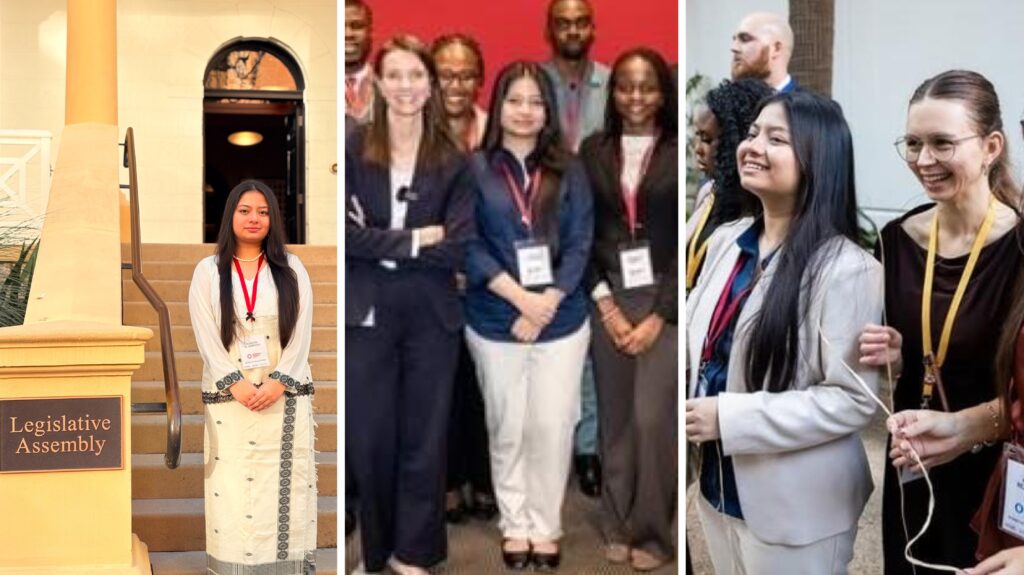
Shillong, July 31: Nandini Ishvi O. Sangma, a Political Science student of Don Bosco College, Tura, represented India at the 13th Commonwealth Youth Parliament held recently in Sydney, Australia, where she highlighted Meghalaya’s unique identity and spoke on issues ranging from gender equality and democracy to the responsible use of artificial intelligence.
During the international forum, Sangma delivered two speeches before delegates from across the Commonwealth, drawing attention to Meghalaya’s matrilineal society, natural landscapes, living root bridges, its distinction as home to some of the wettest places on Earth, and its reputation as the “Rock Capital of India.”
Explaining Meghalaya’s matrilineal system, she said that lineage is traced through the mother and family property is traditionally inherited by the youngest daughter. She, however, clarified that matriliny does not mean that women are placed above men, but represents a distinctive social and family structure that has evolved over generations. Sangma also pointed out that a matrilineal system does not automatically ensure gender equality. She stressed that true equality should be measured by whether every individual receives a fair opportunity to succeed rather than by which gender holds greater power.
Speaking on gender issues at the global level, she questioned why millions of women continue to struggle for equality despite major advances in science and technology. She referred to the denial of education to women in some parts of the world and the continued use of sexual violence in conflicts, calling for stronger commitment towards justice, equality and human dignity.
Sangma also participated in the debate on the Artificial Intelligence and Democratic Integrity Bill 2026, where she advocated for the responsible development and use of artificial intelligence. While recognising AI’s potential to transform education, healthcare, governance and public services, she maintained that technological advancement should strengthen democratic institutions rather than undermine them. She further emphasised that technology cannot replace human conscience, lived experience, democratic judgment or the trust placed by citizens in their elected representatives.
Her participation at the Commonwealth Youth Parliament provided Meghalaya representation on an international parliamentary platform and gave her an opportunity to contribute to discussions on issues of global significance.
Sangma’s participation in the 13th Commonwealth Youth Parliament was nominated by Meghalaya Legislative Assembly Speaker Thomas A. Sangma and supported by Chief Minister Conrad K. Sangma.