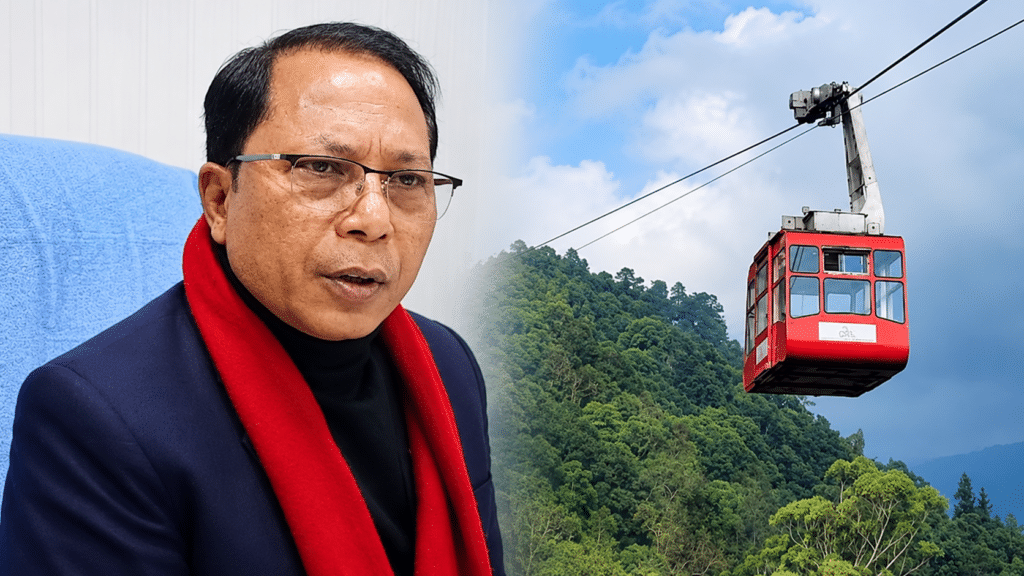
Shillong, November 19: Leader of Opposition Mukul Sangma has accused the Meghalaya Government of being “completely disconnected” from concerns surrounding the proposed Shillong Ropeway project, warning that its implementation at the present location would further aggravate traffic congestion in the city. His remarks came amid an indefinite protest by the Joint Action Committee (JAC), which has been demanding the relocation of the project.
Speaking to reporters on Wednesday, Sangma said the government’s lack of preparedness was evident during discussions on the ropeway project in the last session of the Meghalaya Legislative Assembly. “There was a discussion in the August House in the last session, in fact, I put a supplementary on this ropeway issue, and the government was found to be not prepared with the reply,” he said. He maintained that the government’s response during the Assembly proceedings reflected a lack of understanding of the concerns surrounding the project.
Highlighting Meghalaya’s tourism potential, Sangma said the state’s reputation as a tourist destination had been built over the years through initiatives promoting its natural beauty, cultural heritage and events such as the Cherry Blossom Festival, Tera Madre, Christmas and New Year celebrations. However, he stressed that tourism promotion would remain ineffective unless the government addressed Shillong’s longstanding traffic congestion.
Recalling measures taken during his tenure as Chief Minister, Sangma said tackling traffic congestion had been a priority because of the difficulties faced by residents and visitors. He cited instances in which his wife and daughter were stranded in traffic for 16 hours, while Ampareen Lyngdoh, then a minister, had experienced a similar delay while travelling to Guwahati airport. Sangma said the Shillong Bypass had been prioritised to address traffic congestion and reduce pollution caused by heavy vehicles passing through the city. He also recalled that a 16-member European delegation had identified traffic congestion as one of the biggest deterrents to tourism in Meghalaya. “The biggest deterrent always to any visitor is the traffic jam. Unless you take care of these traffic congestions, you cannot promote the state,” he said.
Questioning the decision to locate the ropeway in an already congested part of Shillong, Sangma asked whether the government had considered developing tourism destinations outside the city. “Is Shillong the only place which can be considered as a product to attract tourists?” he asked, warning that attracting more visitors to an already crowded area would only worsen the situation. He also rejected suggestions that the ropeway would help ease traffic congestion, arguing that it would instead increase tourist footfall and put additional pressure on the city’s road infrastructure. “If somebody is saying that this is going to ease the traffic congestion, I’m sorry, it is going to create congestion,” Sangma said.
While acknowledging that ropeways could be attractive tourism products, the Leader of Opposition maintained that their locations must be carefully selected to avoid creating additional problems. “There are many other potential areas which have been identified for construction of ropeways. Ropeways have their own charms,” he said.
However, he criticised the decision to pursue the project at its present location, describing it as a reflection of poor planning and a failure to anticipate its consequences. “When that particular product becomes a cause of traffic congestion in an already congested city, then it only reflects the bankruptcy of ideas and the lack of power of anticipation,” Sangma said.
Backing the concerns raised by civil society organisations, Sangma said the opposition was not against the ropeway project itself but against its proposed location. He maintained that the protesting groups were urging the government to consider alternative sites where the project could promote tourism without further burdening Shillong’s infrastructure. “Ropeway we will support but not in this particular place,” he said.
Sangma urged the government to scrap the project at its present location and shift it elsewhere, stressing that tourism development should be planned in a manner that improves visitors’ experiences rather than worsening existing traffic problems.