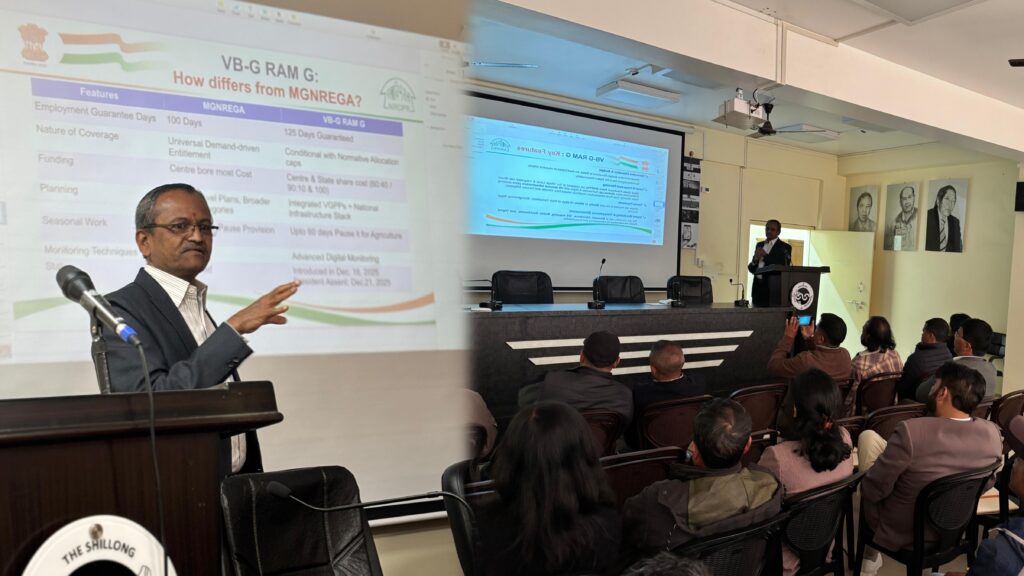
Shillong, January 30: The Press Information Bureau (PIB), Shillong on Friday organised a Varta – Media Workshop on the theme “Viksit Bharat – Guarantee for Rozgar and Ajeevika Mission (Gramin)” (VB–G RAM G) at the Shillong Press Club to engage media professionals on key rural development, employment, and livelihood initiatives of the Government of India.
Delivering the keynote address, Dr. R. Murugesan, Director of the National Institute of Rural Development and Panchayati Raj (NIRD&PR), Guwahati, described the VB–G RAM G Act, 2025 as a decisive policy shift aimed at strengthening rural employment, improving transparency, and enhancing local planning mechanisms.
Dr. Murugesan presented an overview of the historical evolution of rural development policies, noting a transition from programmes focused primarily on basic needs and equity to strategies emphasising economic growth and broader developmental outcomes.
Tracing the progression of wage employment schemes, he referred to early initiatives such as the Rural Manpower Programme and the Crash Scheme for Rural Employment, followed by structured interventions including the National Rural Employment Programme, Rural Landless Employment Guarantee Programme, Jawahar Rozgar Yojana, and Sampoorna Grameen Rozgar Yojana. According to him, these programmes evolved over time to address shifting socio-economic realities.
Highlighting limitations in incremental reforms under the Mahatma Gandhi National Rural Employment Guarantee Act (MGNREGA), Dr. Murugesan said the newly enacted VB–G RAM G framework addresses structural weaknesses while reinforcing employment generation, accountability, and institutional efficiency.
He explained that the Act expands guaranteed employment to 125 days, a move expected to boost household incomes, stimulate rural consumption, and reduce distress-driven migration.
The transition from a central sector scheme to a centrally sponsored framework recognises the localised nature of rural employment and asset creation, he added. The model emphasises Gram Panchayat-led planning, shared responsibility between the Centre and states, and a normative allocation system designed to improve efficiency and curb misuse.
Dr. Murugesan also spoke about persistent challenges in rural India, including inequality, poverty, unemployment, and social stratification, and outlined how the new mission builds upon earlier flagship programmes of the Ministry of Rural Development while aligning with the national vision of Viksit Bharat @2047.
Pavni Gupta, Joint Director, PIB Guwahati, said the newly introduced mission reflects the government’s commitment to periodically reviewing and updating schemes to ensure continued relevance and effectiveness.
She emphasised that workshops such as this provide an important platform for informed discussion and constructive engagement. “There is no need to be apprehensive about the changes being introduced; these reforms are aligned with present-day needs and national development goals,” she said.
During the interactive session, media professionals discussed the proposed scheme, its likely implementation in Meghalaya, and the ways in which it differs from previous programmes. Participants also shared suggestions on strengthening the initiative and maximising its impact on rural livelihoods.
The workshop was attended by officials from the Directorate of Information and Public Relations (DIPR), members of the Shillong Press Club, and journalists and media representatives from Shillong.
The VB–G RAM G Act, 2025 is being positioned as a comprehensive statutory overhaul of MGNREGA, intended to align rural employment with long-term development priorities while enhancing accountability, infrastructure outcomes, and income security.