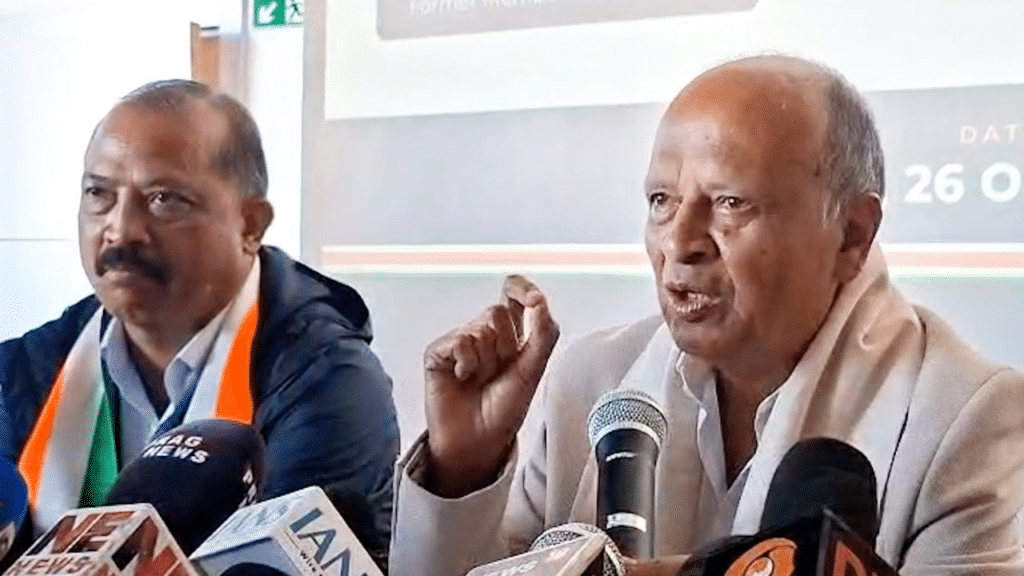
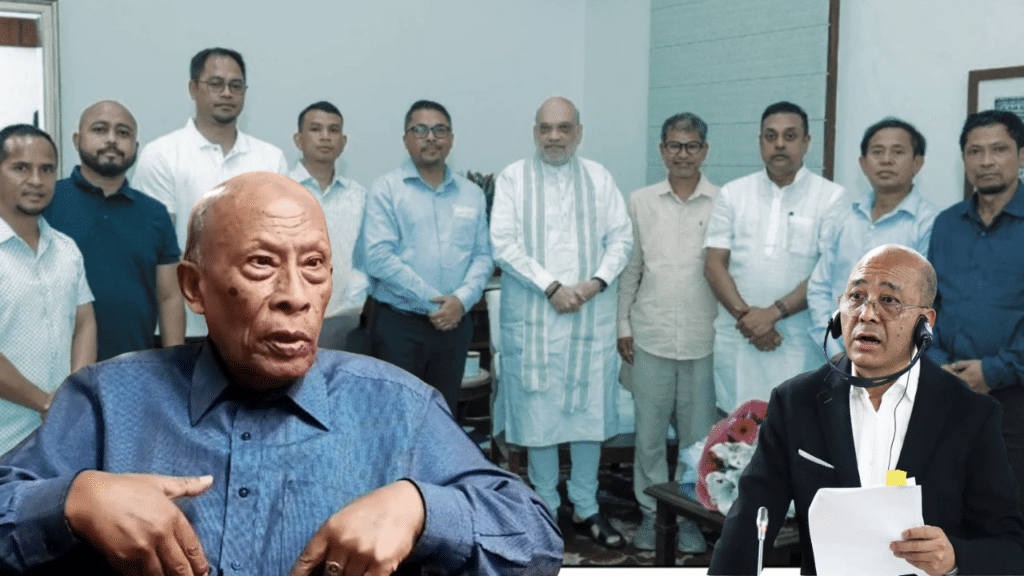
Shillong, October 26: United Democratic Party (UDP) founding leader and former Deputy Chief Minister Bindo M. Lanong has launched a scathing attack on party president Metbah Lyngdoh, holding him solely responsible for what he described as the worst crisis in the party’s history and accusing him of running the political organisation like his personal business.
Reacting to the defection of 11 out of the UDP’s 12 MLAs, with eight joining the BJP and three switching to the NPP, Lanong said the party has been left in shambles and has never experienced such a devastating setback since its formation in 1997. “The party is in shambles now, UDP is in shambles. The party has never faced a crisis of this kind, right from the beginning till now,” Lanong said, adding that even its predecessor regional political organisations had never witnessed such a situation. He attributed the crisis to poor leadership and maintained that Metbah Lyngdoh, as the party president, must take responsibility for the mass defections. Lanong alleged that Lyngdoh’s continued involvement in his business interests had prevented him from devoting sufficient time and attention to the party, governance and the interests of the state.
According to him, managing a business full-time while simultaneously heading a political party is difficult, and he believed Lyngdoh had given greater priority to his personal business interests. “I have seen the real him, that he runs the party the way he runs his business. I am very, very sorry to say this,” Lanong remarked. Expressing disappointment over the developments, the veteran leader said he had never expected Lyngdoh to preside over such a major political setback.
Recalling the early years of Meghalaya’s statehood, Lanong said previous political leaders, despite their modest backgrounds and limited educational qualifications, had demonstrated genuine commitment to the welfare of the people and the state. He also drew a comparison between Lyngdoh and former UDP president late Dr Donkupar Roy, praising the latter for his leadership qualities and commitment to the party and Meghalaya. “Dr Donkupar Roy was a nice person, nowhere to compare between Dr Donkupar Roy and the present president,” he said, stressing that the UDP needs capable leadership to rebuild itself.
On whether Lyngdoh should resign as party president and Cabinet minister following the defections, Lanong expressed doubt that he would voluntarily step down. He accused Lyngdoh of prioritising his own interests over the survival and future of the party, alleging that he would remain in office regardless of how many legislators deserted the organisation.
Responding to calls for the UDP to withdraw support from the Meghalaya Democratic Alliance (MDA) government, Lanong said the matter also depended on Chief Minister Conrad K. Sangma, particularly as the government’s term was nearing its end.
However, he maintained that a leader facing such a humiliating political defeat should take moral responsibility and resign from the Cabinet. “I think it’s a defeat of a worst nature. Going by that, I should have simply informed the Chief Minister to say that I withdraw because of certain reasons. So I will withdraw myself, I will leave the Cabinet,” Lanong said. He further claimed that Lyngdoh was unlikely to relinquish his ministerial position unless the Chief Minister decided to remove him. “He will not do that, he wouldn’t do that until and unless, of course, the Chief Minister himself may one day sack him out,” he said.
Commenting on the future of the UDP and regional political parties in Meghalaya, Lanong acknowledged that political organisations undergo changes over time and that no party can remain in power or retain its influence indefinitely. Nevertheless, he described the UDP’s present condition as particularly unfortunate, asserting that the party had effectively collapsed under Lyngdoh’s leadership. “UDP is gone under the leadership of Metbah Lyngdoh. The UDP is already gone, is already buried,” Lanong declared. He said the unprecedented exodus of legislators had demonstrated the extent of the party’s decline, leaving serious questions about its leadership and political future.