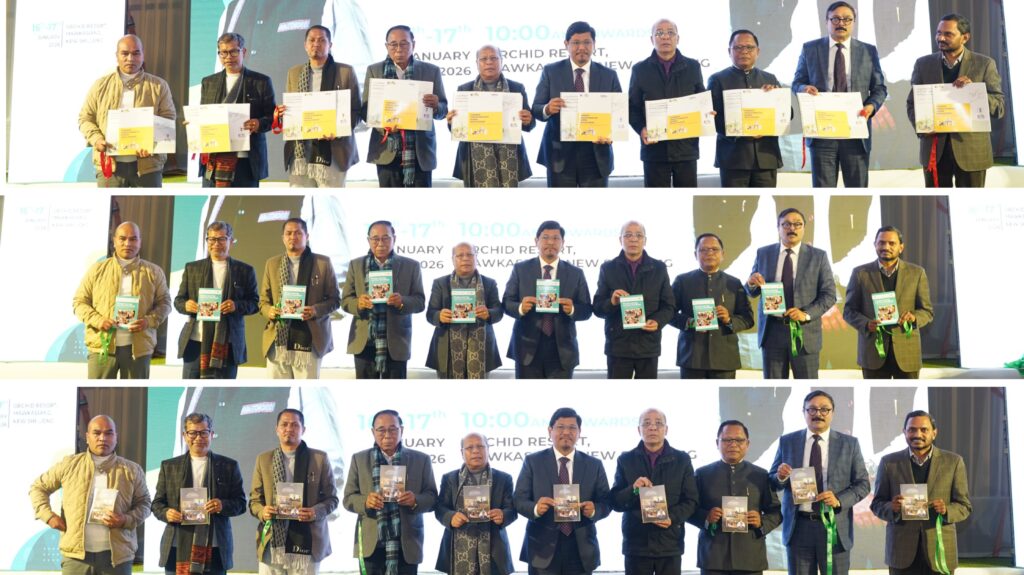
Shillong, January 16 : The third Cabinet Retreat and the first of 2026 began today at Orchid Resort, Mawkasiang, New Shillong, marking a major step in the Government of Meghalaya’s ongoing administrative and developmental reforms. The retreat brought together Chief Minister Conrad K. Sangma, Cabinet Ministers, senior officials, Deputy Commissioners (DCs), Block Development Officers (BDOs), and other grassroots functionaries, highlighting the government’s focus on community-level engagement.
The theme for the opening day revolved around the “10 Commitments under Vision 2032”, which outline the State’s long-term developmental priorities.
In his keynote address, Chief Minister Conrad K. Sangma called for vision-driven implementation of government schemes and reiterated his administration’s dedication to inclusive growth. “Our commitment is to provide affordable healthcare, ensure joyful learning, guarantee piped drinking water for all, and housing for every eligible beneficiary,” he said. “As we move towards becoming a USD 10 billion economy, we must ensure that progress benefits every citizen of Meghalaya.”
Day 1 of the retreat focused on evaluating governance and development across departments. Sessions featured reviews of public service delivery, connectivity, health, education, human capital, and livelihood programs. Presentations from departments were accompanied by on-ground feedback from BDOs and DCs representing four districts, who shared measurable success stories and challenges from their respective regions.
Discussions centered on the State Digital Infrastructure Stack, including initiatives such as Meghalaya One, CM Connect, and DC Connect, which have streamlined citizen services. The government also highlighted significant progress in road connectivity, with 3,210 kilometres of new roads developed since 2018 under various projects including the Meghalaya Integrated Transport Project (MITP).
In the water sector, Meghalaya’s performance under the Jal Jeevan Mission remains above the national average. The Chief Minister directed departments to conduct detailed field surveys to identify supply gaps and strengthen local operation and maintenance systems.
In the power sector, the state is adding 31 new substations while reducing transmission losses through digital grievance systems. Efforts are also underway to enhance internet connectivity, with MeECL expanding optical fibre networks and exploring satellite-based connectivity for remote areas.
Under the Housing for All initiative, the State achieved a substantial increase from 17,000 sanctioned houses in 2016–17 to one lakh in 2023–24, with over 80% completed.
In the health sector, discussions focused on improving Primary Health Centres (PHCs) and Community Health Centres (CHCs), building staff quarters in remote areas, and digitizing processes to allow doctors more time for patients. The government also announced the introduction of Mother’s Kits to support newborn and maternal care, targeting 80,000 kits annually.
On nutrition and early childhood care, the retreat highlighted the engagement of Self-Help Group (SHG) women as caregivers, with notable success in districts like West Jaintia Hills, where 440 Anganwadi Centres have shown significant improvement.
In education and skilling, discussions reviewed programs such as the Meghalaya Community-Based Rural Programme, the Meghalaya Learning Enhancement Programme, and the School Quality Assessment Framework, with plans to identify 20 youth per block for specialised skill development.
The Chief Minister and Cabinet Ministers also launched three key documents during the event : Chief Minister’s Headman Fellowship for Early Childhood Development, Cluster Learning Lab Handbook, Towards Transformative Human Development: From Anganwadis to Integrated Early Childhood Development Centres.
The day’s deliberations reaffirmed Meghalaya’s push towards data-driven, people-centric governance. The retreat concluded with a collective commitment to strengthen inter-departmental coordination, ensure measurable outcomes, and accelerate the State’s journey towards achieving the goals outlined in Vision 2032.