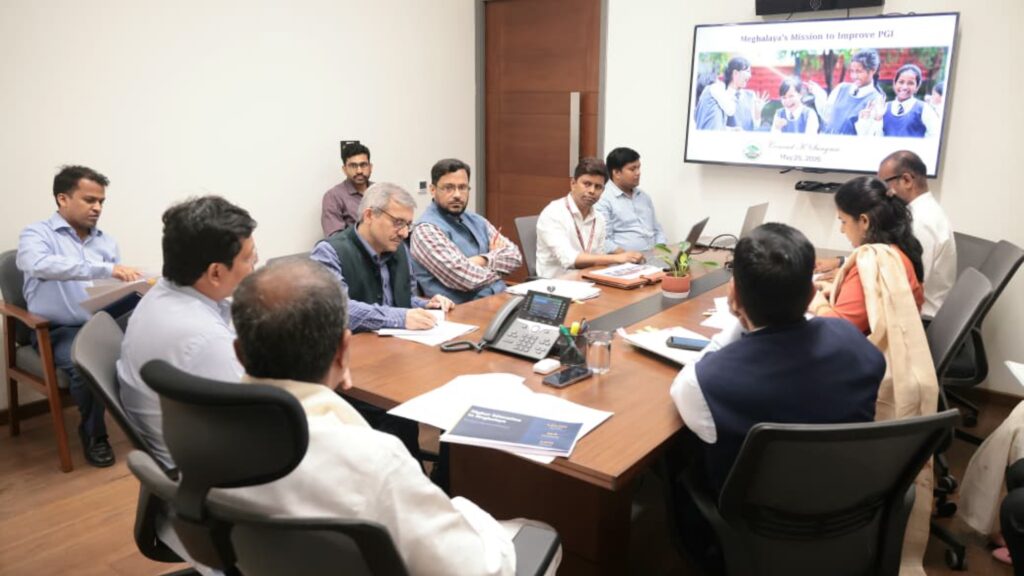
New Delhi, May 25: Meghalaya Chief Minister Conrad K. Sangma on Sunday made a detailed presentation before Union Education Minister Dharmendra Pradhan on the challenges faced by the state in improving its Performance Grading Index (PGI) and outlined a comprehensive roadmap to reform the education sector.
Acknowledging that Meghalaya has remained among the lowest-performing states in the PGI rankings for the past three years, the Chief Minister said the Education Department has identified critical gaps in learning outcomes and has initiated corrective measures to address the issues at their roots.
Sangma highlighted key structural challenges affecting educational outcomes in the state, including the unusually high number of schools, fragmented resource utilisation, multiple layers of grant-in-aid mechanisms and long-standing administrative complexities.
He informed that Meghalaya, with a population of nearly 30 lakh, has around 14,600 schools — the highest among the Northeastern states excluding Assam — surpassing states like Manipur, Mizoram, Arunachal Pradesh and Tripura.
According to the Chief Minister, these structural issues had shifted focus away from improving learning outcomes, prompting the government to adopt reforms aimed at enhancing the quality of education across the state.
Among the major initiatives highlighted was the consolidation and rationalisation of schools to optimise infrastructure and resources. Sangma said this move would help improve student-teacher ratios and provide better access to laboratories and digital facilities.
He also informed that the government is streamlining multiple grant-in-aid (GIA) mechanisms to reduce administrative burdens and enable a stronger focus on academic quality and student performance.
The Chief Minister further briefed the Union Minister on the implementation of a unified pay structure, including structured salaries for SSA teachers. “This reform aims to bring parity, improve morale and enhance accountability across the teaching workforce,” Sangma stated during his presentation.
Emphasising teacher training and professional development, the Chief Minister said the state has introduced DIKSHA-enabled professional development programmes and self-paced learning modules to equip teachers with modern pedagogical tools and continuous learning opportunities.
The presentation also highlighted several reforms under the National Education Policy (NEP), including the implementation of the three-language formula, compulsory learning of Khasi and Garo, play-based and discovery-oriented learning, contextualised textbooks, no summative assessments up to Class II, bagless days during the foundational stage and the use of only resource materials instead of textbooks in pre-schools.
On rationalisation of Lower Primary schools, Sangma informed that out of 14,582 schools, 3,198 schools have been removed to ensure optimum utilisation of resources. He also highlighted the introduction of community-integrated skill learning, where students gain practical knowledge through interaction with family members, community experts and mentors.
The Chief Minister also made a detailed presentation on the recently launched “CM LEAD Fellowship”, aimed at strengthening implementation capacity within the education system. Under the initiative, 12 fellows will be deployed across all 12 districts of the state to support planning, coordination and monitoring of educational reforms.
Another major initiative highlighted was the establishment of the Meghalaya Teachers Training Academy, which will serve as an exclusive teacher training institution to improve Continuous Professional Development (CPD) hours in the state. The academy will also implement the teacher education component under Samagra Shiksha.
“With a clear roadmap and strong political will, Meghalaya is poised to overcome its challenges and significantly improve its PGI performance in the coming years. The Government reiterates its commitment to ensuring that every child in the State has access to quality education and opportunities for a better future,” the Chief Minister said.