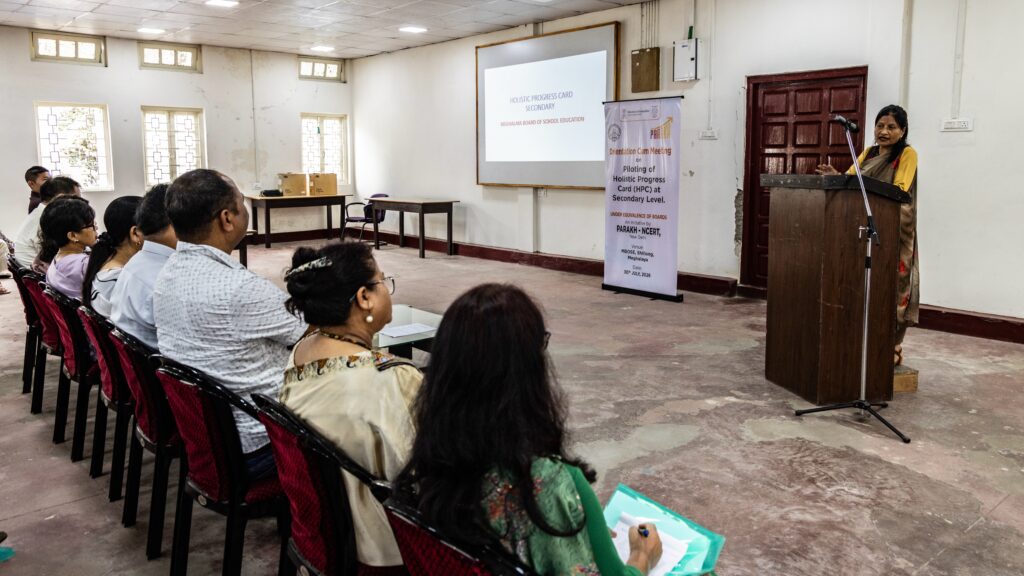
Shillong, July 30: The Meghalaya Board of School Education (MBOSE) on Thursday organised an orientation-cum-meeting on the pilot implementation of the Holistic Progress Card (HPC) for secondary-level students, as part of efforts to introduce competency-based assessment under the National Education Policy (NEP) 2020.
The programme, held at the MBOSE Regional Office in Shillong, is being undertaken under PARAKH — Performance Assessment, Review and Analysis of Knowledge for Holistic Development — an initiative of the Ministry of Education.
The meeting was chaired by M. Marbaniang, Director of the MBOSE Regional Office, Shillong, while MBOSE Executive Chairman D.D. Sangma delivered the welcome address. MBOSE Chief Academic Officer Dr E.J.E. Shongwan presented the keynote address and explained the HPC framework and its proposed role in transforming school assessment practices.
Officials said NEP 2020 seeks to move education away from a system largely centred on memorisation and examinations towards competency-based learning, where students are assessed on their understanding, skills and ability to apply knowledge.
The framework emphasises clearly defined learning goals, mastery of concepts and demonstration of learning through projects, practical activities and real-life applications. It also promotes experiential and multidisciplinary learning, the use of mother tongue and local languages, and the holistic development of students.
Participants were briefed on three key components of the proposed assessment system — Assessment for Learning, involving continuous classroom assessment and feedback; Assessment as Learning, encouraging students to assess their own and their peers’ learning; and Assessment of Learning, involving periodic assessments of competencies achieved.
MBOSE officials said the pilot would help identify classroom, logistical, technical and operational challenges before the system is implemented on a wider scale. Feedback from teachers, school heads and other stakeholders will also be used to refine the framework.
The pilot is proposed to cover all 12 districts of Meghalaya and around 40 to 50 per cent of Community and Rural Development blocks. District School Education Officers will act as district-level coordinators, while principals of selected schools will supervise implementation. Designated teachers will serve as nodal officers and assist other teachers during the pilot.
The day-long orientation also featured sessions by PARAKH State Resource Persons on implementation timelines, monitoring, capacity building and the responsibilities of principals and teachers. An interactive session was held to gather suggestions from stakeholders, followed by the distribution of Holistic Progress Card booklets.
Officials said the pilot is expected to pave the way for a more learner-centred assessment system in Meghalaya and support the NEP 2020 objective of holistic and competency-based education.