New Delhi, August 10: The Government of India has clarified that Unified Payments Interface (UPI) transactions will continue to remain free for citizens, amid concerns over amendments to the Payment and Settlement Systems Act, 2007.
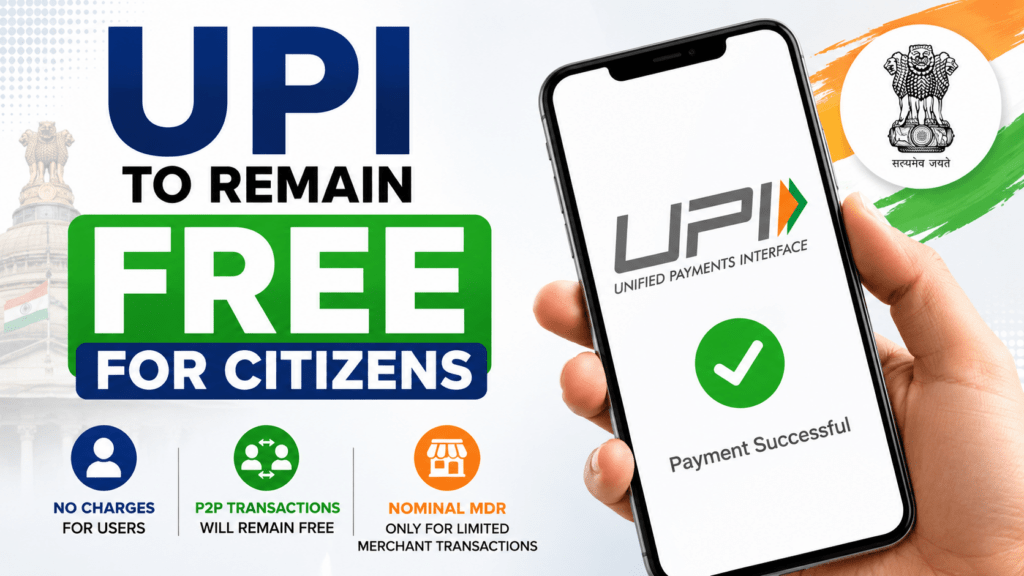
In a statement issued by the Ministry of Finance, the government categorically said consumers making payments through UPI will not face transaction charges, while all person-to-person (P2P) transactions will also continue to remain free.
The government said that even for merchants, the vast majority of UPI transactions will remain free. If a Merchant Discount Rate (MDR) is introduced in the future, it would apply only to a limited category of merchant transactions above a specified threshold and at a nominal rate significantly lower than those applicable to debit or credit cards.
The clarification comes amid debate over the Taxation and Other Laws (Amendment) Bill, 2026, which proposes changes to Section 10A of the Payment and Settlement Systems Act, 2007.
According to the government, once the Bill is passed by Parliament, the UPI and Services Steering Committee headed by the National Payments Corporation of India (NPCI) will decide whether an MDR should be introduced and, if so, the framework under which it would apply.
The government stressed that the proposed amendment is an enabling provision and should not be interpreted as an immediate decision to impose charges on ordinary UPI users.
It said the amendment is aimed at ensuring the long-term sustainability of UPI while supporting technological advancement, cybersecurity, fraud prevention and resilience against emerging risks.
With UPI transaction volumes growing rapidly, the government said substantial and continuous investment is required to upgrade the infrastructure supporting the digital payment ecosystem. It also stressed the need to encourage greater competition and participation by companies in the sector through a sustainable revenue model.
The government maintained that dependence on subsidies alone would not be sufficient to support the next phase of UPI’s expansion, particularly as digital payments reach deeper into rural and semi-urban areas.
Responding to reports suggesting that external influence was behind the proposed policy changes, the government rejected the claims as false and misleading. It pointed out that UPI was introduced in 2016 and has been kept free for citizens and merchants since January 2020.
According to the government, UPI has emerged as the world’s largest real-time payment system. In July 2026 alone, it processed 2,366 crore transactions worth ₹29.9 lakh crore. The payment system is also operational in 11 foreign countries, with several others showing interest.
The government reiterated that its policy remains focused on keeping UPI free for citizens while developing a sustainable framework capable of supporting its continued expansion.
It further urged citizens to rely on information issued by the Ministry of Finance, Reserve Bank of India and NPCI and avoid circulating unverified claims regarding UPI charges.
In its clarification, the government reaffirmed that there will be no charges on everyday UPI transactions for citizens, while any future MDR, if introduced, would be nominal and restricted to a limited set of merchant transactions.