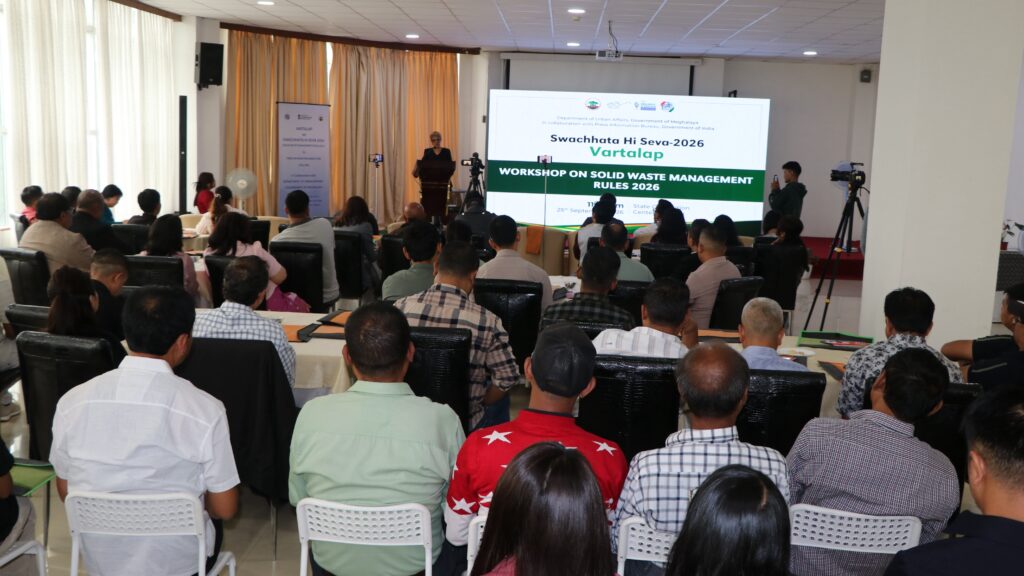
Shillong, September 25: Adviser to the Meghalaya government and East Shillong MLA Dr. Mazel Ampareen Lyngdoh on Friday called for greater public awareness, clear communication and coordinated action among government agencies, Urban Local Bodies (ULBs), pollution control authorities and citizens for effective implementation of the Solid Waste Management Rules, 2026.
Speaking at a Vartalap – Media Workshop organised by the Press Information Bureau (PIB), Shillong, in coordination with the state Urban Affairs Department, Lyngdoh said the provisions of the new Rules must be communicated in a simple and accessible manner so that communities clearly understand their responsibilities. The workshop, held as part of the Swachhata Hi Seva 2026 campaign, brought together government officials, technical agencies, ULBs and media representatives to discuss the new waste-management rules, implementation timelines and strategies for creating public awareness.
Lyngdoh said officials must have a clear understanding of their respective responsibilities and stressed the need to orient legislators and other elected representatives on the Rules so that they can engage effectively with both the administration and the public. She also highlighted the role of the media in informing citizens about the progress of implementation, challenges faced and steps being taken by the government.
Recalling Meghalaya’s progress in urban sanitation since 2014, Lyngdoh said the state did not have a Project Management Unit for urban sanitation at that time and communities largely depended on indigenous practices for dealing with waste. She appreciated the Urban Affairs Department, Project Management Unit, ULBs and municipal engineers for taking forward initiatives related to waste management, sewage treatment and rainwater management.
Urban Affairs Director P.K. Boro outlined Meghalaya’s approach to urban waste management and various initiatives being undertaken by the department and ULBs. Meghalaya State Pollution Control Board Chief Environmental Engineer W.R. Kharkrang, who is also Joint Secretary in the Forest and Environment Department, highlighted the environmental and regulatory aspects of solid waste management, particularly issues relevant to Meghalaya.
CPCB Scientist C Arnab Mandal explained key provisions of the Solid Waste Management Rules, including segregation of waste at source, responsibilities of individual and bulk waste generators, scientific processing, monitoring and compliance.
Wompher Shadap of SBM Urban Meghalaya also presented the status and achievements of waste-management initiatives across 10 Urban Local Bodies in the state. The Solid Waste Management Rules, 2026, notified by the Union Ministry of Environment, Forest and Climate Change on January 27, came into force on April 1.
The Rules mandate segregation of waste at source into four categories — wet, dry, sanitary and special-care waste — and provide for scientific processing, Material Recovery Facilities, Extended Producer Responsibility, environmental compensation under the “Polluter Pays” principle and digital monitoring.
Implementation will be carried out in phases depending on population size.
In urban areas, compliance is to be completed within 18 months in cities with populations of one million and above, within 24 months in urban areas with populations between five lakh and 10 lakh, and within 36 months in other urban areas.
For rural areas, the implementation period is 18 months for areas with populations of 20,000 and above, 24 months for those between 10,000 and 20,000, and 36 months for areas with populations of up to 10,000.
The workshop concluded with discussions on implementation responsibilities, community participation and the need for sustained public communication to strengthen scientific solid waste management across Meghalaya.