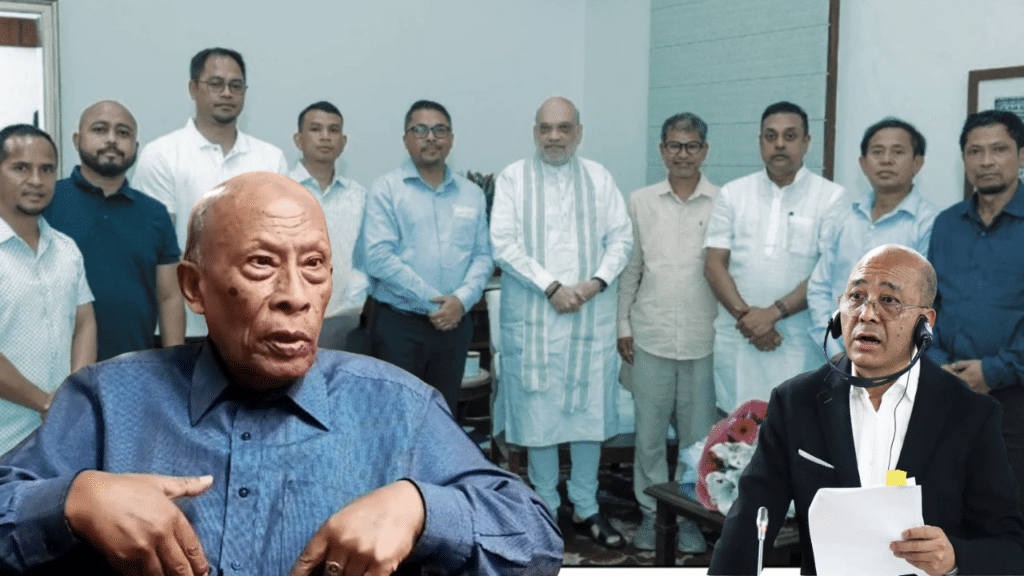
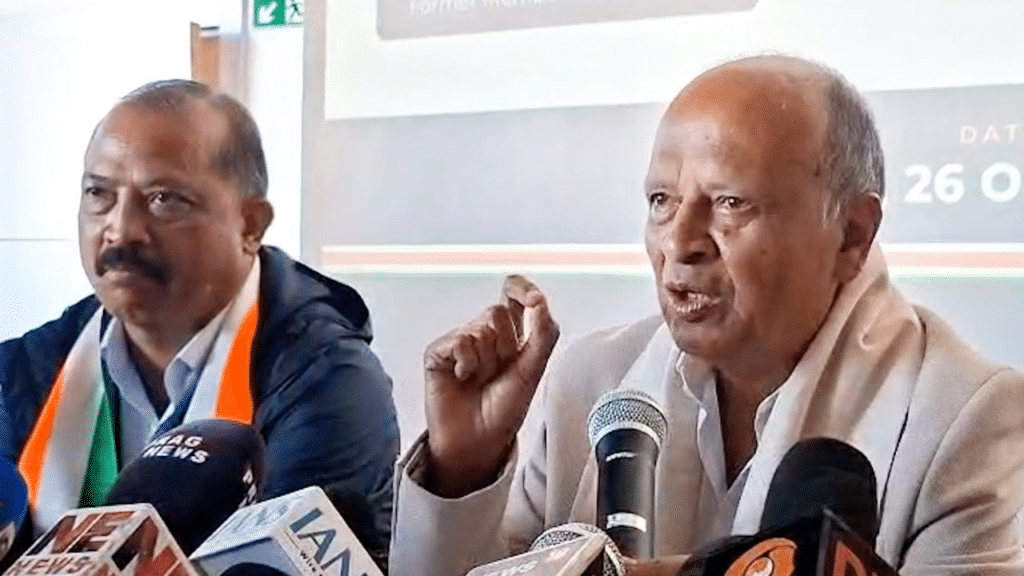
Shillong, October 26: Former Rajya Sabha MP and former National People’s Party (NPP) state president Dr Wanweiroy R. Kharlukhi on Monday announced his support for Congress candidate Vincent H. Pala in the upcoming Shillong Lok Sabha byelection, citing the party’s opposition to the Foreign Contribution Regulation Amendment (FCRA) Bill, 2026, while expressing disappointment over the failure of the National Democratic Alliance (NDA) government at the Centre to address issues concerning Meghalaya.
Addressing a press conference in Shillong, Kharlukhi, who resigned from the NPP about two months ago, said he had decided to support Congress because of its strong opposition to the proposed FCRA amendments, particularly Section 16-A, which he described as a serious concern for Christian minorities. “There has been a lot of speculation after I resigned from NPP, people are asking me what’s next. In today’s press conference I would like to announce what’s next. I have decided to support Congress and its candidate Vincent H Pala in this coming by-election for the Shillong parliamentary seat,” he said.
Kharlukhi expressed strong reservations about the FCRA Amendment Bill, 2026, stating that its provisions posed a threat to the interests of minority communities. “For 79 years of independence, I feel threatened because of this Bill. Section 16-A of the amendment Bill is very disturbing and cannot be accepted,” he said. He credited Congress with preventing the Bill from being passed during the last session of Parliament and said its opposition had resulted in the proposed legislation being referred to a Joint Parliamentary Committee (JPC).
According to him, strengthening Congress in Parliament was necessary to effectively challenge the BJP on national issues, particularly those affecting minority communities. “On national issues you have to look at which party can really counter BJP in Parliament,” he said, adding that the election of Pala would strengthen the opposition’s voice against the proposed amendments.
Reflecting on his experience as a Rajya Sabha MP, Kharlukhi questioned the widespread perception that political parties aligned with the government at the Centre could secure greater benefits for their respective states. He recalled that during his tenure in the Rajya Sabha, when former Tura MP Agatha Sangma was serving in the Lok Sabha, they had approached Union ministers on several matters, including the appointment of the Vice-Chancellor of North-Eastern Hill University (NEHU), but their efforts had yielded little result. “There is a perception that if we are with the party in power in Delhi, we can help our people. But through experience I tell you, once we reach there, they listen but work does not happen,” Kharlukhi said. He revealed that the lack of meaningful response from the Centre had prompted him to stop attending NDA meetings. “There I realised it is not possible. I never attend NDA meetings. I always tell what we bring, they don’t listen,” he stated.
Kharlukhi further said that despite raising issues such as the inclusion of Khasi and Garo languages in the Eighth Schedule of the Constitution, implementation of the Inner Line Permit (ILP), coal mining and the Look South Policy, little progress had been achieved. He argued that political parties having only one or two representatives in Parliament faced serious limitations in influencing national decisions. “Sending 1-2 MPs to Parliament is of no value. I raised Eighth Schedule, ILP, coal mining, Look South Policy, no result,” he said, pointing to the numerical strength of the 543-member Lok Sabha.
Asked about the present relationship between the NPP and BJP, Kharlukhi declined to comment, saying he was no longer associated with the NPP and that its leadership should respond to questions concerning the alliance. On the performance of the Meghalaya Democratic Alliance (MDA) government, he said the electorate had already delivered its assessment through the results of the last two parliamentary elections.
Commenting on the BJP’s increased strength in the Meghalaya Legislative Assembly following the defection of eight UDP legislators, which raised its tally from two to ten, Kharlukhi maintained that the party’s actual electoral strength would only become clear in the 2028 Assembly elections. He drew a parallel with the Trinamool Congress (TMC), which had gained 12 legislators following defections from Congress ahead of the 2023 Assembly elections. “People will test them in 2028, then only we will know,” he said.
Speaking about his departure from the NPP, Kharlukhi dismissed suggestions that he had been sidelined within the party, maintaining that he had voluntarily stepped aside after serving as state president for 17 years, including the period when the organisation was associated with the Nationalist Congress Party (NCP). “I was never sidelined. I left as president on my own feelings. I have been president for 17 years. I thought it was time to give to someone else,” he said. Kharlukhi, who played a significant role in building the NPP from a party with two MLAs into a ruling political force in Meghalaya, also refused to blame anyone for his decision to leave.
He recalled leaving the UDP in 1998 after the party won all seven Assembly seats in Jaintia Hills, maintaining that he had always made political decisions independently. “I always leave my party when they are in power, but I never betray my party when they are out of power,” he stated.
Clarifying that his resignation from the NPP was not solely connected to the FCRA issue, Kharlukhi said his decision to support Pala was based on Congress’ stand in Parliament and the need for a stronger national opposition. He also referred to his earlier opposition to the reservation roster issue, expressing concern that divisions within Meghalaya could threaten the state’s political identity and autonomy. On allegations of corruption and dynastic politics within the NPP, he pointed out that such charges had been raised by the Voice of the People Party (VPP) during the 2024 elections.
Asked whether other NPP leaders were planning to switch allegiance to Congress, Kharlukhi said his political decisions were personal and were not influenced by others. “When I decide to support a party, I decide on my own. When I decide to leave a party, I decide to leave on my own,” he said.
While announcing his support for Congress candidate Vincent H. Pala, Kharlukhi stopped short of confirming whether he would formally join the party. “Time will tell. When we reach the bridge, we will cross the bridge. I am always patient,” he said.
On the possibility of contesting the 2028 Assembly elections, he said he would decide when the time came. Kharlukhi also emphasised that rebuilding a political party required collective leadership rather than depending on any single individual.