Shillong, November 3: The Meghalaya Government has announced plans to engage approximately 5,200 Early Childhood Development (ECD) Fellows across Anganwadi Centres in the state, with nearly 1,400 fellows already onboarded and another 3,800 set to be recruited to strengthen early childhood care, education and development.
The announcement was made during a programme titled “Advancing Care Economy through ECD Fellowship,” organised by the Meghalaya Early Childhood Development Mission (MECDM) and the Development Commissioner Office at Lariti, International Centre for Performing Arts and Culture, Shillong, on Tuesday.
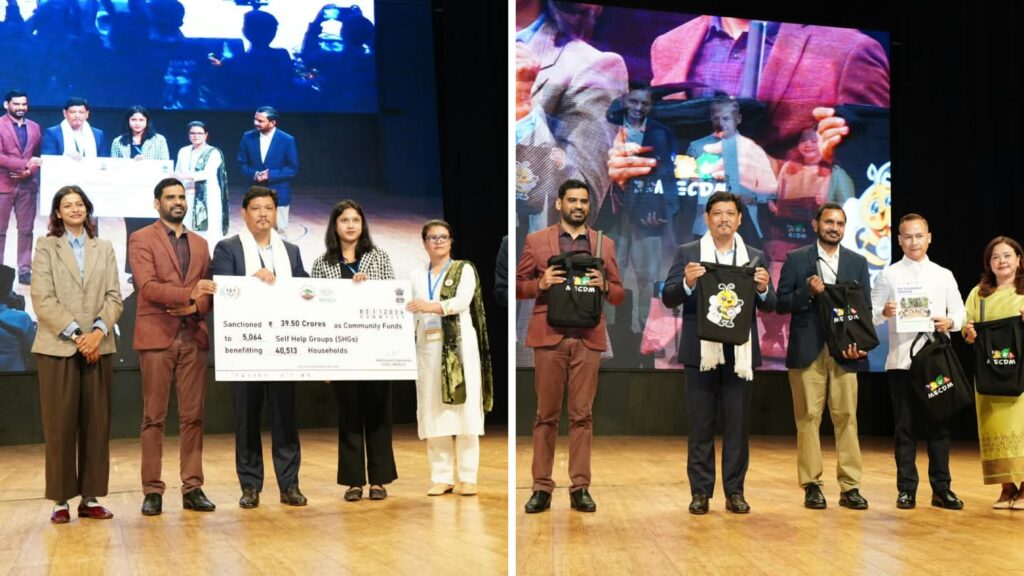
Chief Minister Conrad K. Sangma attended the programme as the chief guest, during which he also handed over Community Funds amounting to Rs 39.50 crore, sanctioned by the Meghalaya State Rural Livelihoods Society (MSRLS), to 5,064 Self-Help Groups (SHGs).
The programme was attended by Additional Chief Secretary, Social Welfare Department and CEO of MECDM, Sampath Kumar; Principal Health Specialist of the Asian Development Bank (ADB), Dr. Dinesh Arora; Director of the National Council for Vocational Education and Training (NCVET), Lt. Col. Vikram Singh Bhati; Director of Social Welfare, Saloni Verma; and MECDM Chief Operating Officer Ronald Kynta. Officials from Tamil Nadu and Odisha, development partners, ECD Fellows, Anganwadi Workers and Self-Help Group members were also present.
According to the Meghalaya Early Childhood Development Mission, nearly 1,400 ECD Fellows have already been engaged, representing approximately 27 per cent of the targeted 5,200 fellows. The government plans to onboard another 3,800 fellows to ensure that every Anganwadi Centre in Meghalaya has at least one ECD Fellow to support early childhood learning and development.
Under the fellowship model, one young person from each village, either a graduate or Class XII pass, is selected through Village Organisations and Village Health Councils to work alongside Anganwadi Workers. The fellows assist in conducting play-based learning activities, including songs and educational engagement, at Anganwadi Centres, in homes and within communities.
The government clarified that the ECD Fellows are intended to work as partners of Anganwadi Workers and not as their replacements. The initiative aims to address existing gaps in early childhood learning, particularly among children below three years of age who remain at home and have limited access to structured learning support. The Mission highlighted that almost 90 per cent of a child’s brain develops by the age of five, making early childhood care, learning and nutrition critical for long-term development.
The fellowship training programme is structured into four phases of three months each, supported by key trainers and master trainers. The programme also includes monthly coaching, monitoring of activities and tracking of home visits to ensure effective implementation. Under the initiative, each ECD Fellow will receive three NCVET-recognised job-role certifications through the Healthcare Sector Skill Council, under a Memorandum of Understanding with the Ministry of Skill Development and Entrepreneurship.
Addressing the gathering, Chief Minister Conrad K. Sangma described the Meghalaya Early Childhood Development Mission as “one of the greatest investments that we can make,” emphasising that children receiving proper care and education today would become the country’s future leaders in 2047.
The Chief Minister also encouraged fellows and stakeholders to bring forward innovative ideas that could improve the implementation and effectiveness of the programme. “ If some great idea comes from one of you, and if I see that it is great and it needs to be scaled up, we will provide the funds,” Sangma assured. He expressed gratitude to the Asian Development Bank, which has provided the majority of the project’s funding, and recalled that the initiative had been recognised as one of the best practices suitable for implementation at the national level when presented before Social Welfare Ministers from across the country.
During the programme, the Chief Minister launched the Climate Smart ECD Centres Photobook and the Saura-e-mitra application developed by the SELCO Foundation. He also distributed ECD Fellows Kits and Guidebooks and presented prizes to winners of the Lullaby Contest and Impact Story Video Contest.
As part of efforts to strengthen climate-smart infrastructure, the Meghalaya Government, in collaboration with the SELCO Foundation, has already solarised 188 Anganwadi Centres across the state. Another 1,000 Anganwadi Centres are planned to be solarised, taking the total to 1,188 centres, representing a more than six-fold expansion of the initiative.
Speaking on the occasion, Additional Chief Secretary Sampath Kumar cited evidence from Tamil Nadu indicating that early childhood development outcomes improve when additional care workers support Anganwadi Centres. He outlined two major goals for the coming year, including transforming every Anganwadi Centre into a happiness centre promoting play-based learning and achieving zero stunting through Mission 1000 Days.
Meanwhile, NCVET Director Lt. Col. Vikram Singh Bhati emphasised the importance of investment in early childhood development as a foundation for building stronger human capital. “Investment in early childhood is not merely a social sector intervention. It is an investment in the human capital and in the future of our society,” he said.
ADB Principal Health Specialist Dr. Dinesh Arora informed that the Department of Economic Affairs plans to study how Meghalaya’s ECD Fellowship model could be replicated across India.
The Meghalaya Early Childhood Development Mission brings together the Social Welfare, Health, Education and Community and Rural Development Departments, with support from the Asian Development Bank.
The Mission also informed that the initiative had been presented before Prime Minister Narendra Modi last month, who subsequently referred to it in his address to all states.
Through the ECD Fellowship programme, the Meghalaya Government aims to strengthen early learning, improve child development outcomes and ensure that every child in the state receives a healthy start in life.
The initiative also seeks to create opportunities for young people to contribute to community-based childcare while building a stronger and more inclusive care economy in Meghalaya.