
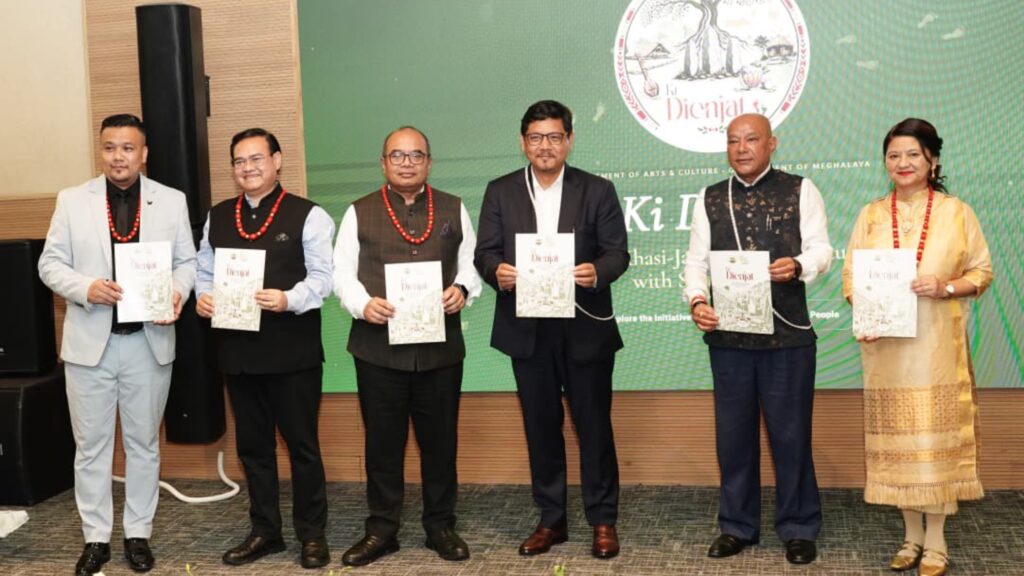
Shillong, August 18 : Chief Minister Conrad K. Sangma on Tuesday launched “Ki Dienjat”, a research initiative aimed at re-examining the socio-cultural linkages of the Khasi-Jaintia people with Southeast Asia.
The launch was attended by Arts and Culture Minister Sanbor Shullai, Justice Hamarsan Singh Thangkhiew, Principal Secretary of Arts and Culture, members of the research team and officials of the department.
Addressing the gathering, Sangma described “Ki Dienjat” as a journey of rediscovery that seeks to reconnect people with their past in order to better understand the present and shape the future.
He said the initiative forms part of the government’s continuing efforts to document, preserve and celebrate Meghalaya’s cultural and historical heritage, while providing people with tools to trace their origins.
The Chief Minister said that, based on early colonial-era records and indigenous knowledge, local scholars and researchers have over time developed a growing view that the Khasi and Jaintia tribes may have migrated from regions corresponding to present-day Cambodia and Laos.
However, he noted that contemporary research to validate such historical linkages has remained limited due to a lack of funding for international fieldwork, logistical and political challenges, absence of structured academic collaboration and limited long-term institutional support.
“To close this gap, we constituted a dedicated study team under the Department of Arts and Culture, bringing together distinguished scholars and officials to lead a comprehensive, interdisciplinary effort to explore, document and analyse the ancestral origins of our tribes,” Sangma said.
The Chief Minister also launched the “Ki Dienjat” e-Portal, which is intended to serve as a centralised platform for accessing information, managing research data and enabling collaboration among researchers, institutions and communities.
He said the portal would help speed up communication, reduce paperwork and administrative costs, and improve transparency and monitoring.
Sangma also said the idea of conducting research into the origins of Meghalaya’s tribes had earlier been emphasised by late P.A. Sangma, particularly in relation to the roots of the Garo people.
He announced that a similar research project for the Garo Hills region will be launched on September 1, 2026, coinciding with the birth anniversary of late P.A. Sangma.
The Chief Minister said the project is intended to have a long-term impact by covering major tribes of Meghalaya and examining various aspects of culture, including language, architecture and music.
While saying that the research could lead to significant and unexpected findings, Sangma also cautioned that the subject involves challenges and sensitivities. He stressed the importance of involving young research scholars and encouraging their participation in the initiative.
“Through this research initiative we reaffirm our commitment to preserving, protecting and celebrating the rich cultural heritage of Meghalaya,” he said.
During the programme, the Chief Minister released the project document and remotely inaugurated the Research Room of “Ki Dienjat” at the Williamson Sangma State Museum in Shillong.
The broader “Tracing the Roots Project” is an interdisciplinary initiative aimed at documenting Meghalaya’s indigenous history, languages, cultures and heritage through oral traditions, indigenous knowledge, historical research, linguistics, archaeology and scientific methods.
The project also envisages collaboration with national and international academic institutions and the creation of digital archives, scholarly publications and educational resources.
Under the programme, 75 scholars are expected to travel to Vietnam, Cambodia and Tibet to study the origins and historical journeys of the Khasi, Jaintia and Garo people.