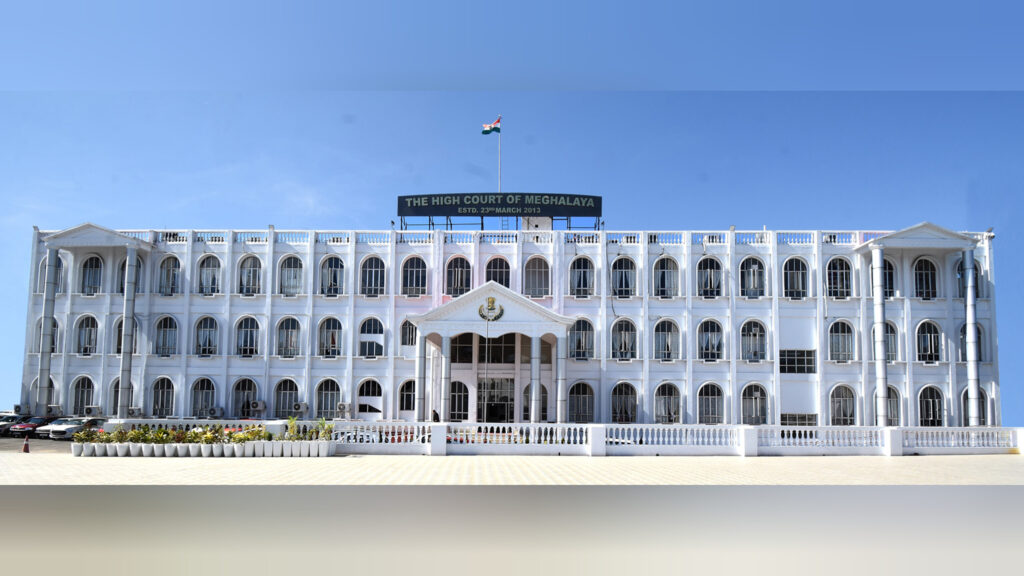
Shillong, November 4: The Meghalaya High Court has quashed criminal proceedings in six separate cases registered under the Protection of Children from Sexual Offences (POCSO) Act after taking into consideration the consensual nature of the relationships, subsequent marriages or cohabitation between the parties, and the welfare of children born from those relationships.
The judgments, delivered by Chief Justice Revati Mohite Dere on October 28 and 30 and uploaded between November 3 and 4, concern cases registered in East Khasi Hills, Eastern West Khasi Hills and East Jaintia Hills districts. While allowing the petitions, the High Court emphasised that although offences under the POCSO Act are considered offences against society, the administration of justice cannot be divorced from the social realities of Meghalaya. The court observed that cases involving adolescent relationships, commonly described as Romeo-Juliet cases, require careful examination of individual circumstances, particularly where the parties are living together as husband and wife and have children.
In one of the cases, the High Court quashed proceedings against Thomas Shylla of Kyndong Tuber village in West Jaintia Hills, who had been booked under the POCSO Act following a case registered at the Khliehriat Women Police Station in 2023. According to the court records, Shylla was 19 years old and the survivor was 16 when they entered into a relationship, which they maintained was consensual. The couple subsequently had a daughter and formally married on October 15, 2026. The High Court took note of a report submitted by the High Court Legal Services Committee confirming that the survivor, now 19, had voluntarily consented to the quashing of the proceedings without any force or coercion. Her mother also expressed no objection to closing the case.
In another case, the court quashed proceedings against Dakhutmeki Shylla, aged 25, of Pamra Paitthlu village in East Jaintia Hills, in connection with an FIR registered at the Khliehriat Women Police Station in 2020. The survivor, now 22, informed the court that she had voluntarily entered into the relationship while studying in Class 10. The couple have a six-year-old son and have been living together as husband and wife since 2023. The court also considered a police verification report confirming that Shylla was providing financial support to the survivor and their child. Taking note of the survivor’s desire to resume her higher education, which she had discontinued due to financial difficulties, the High Court directed the authorities to appoint a support person to assist her in enrolling in an academic course.
In a separate case from Eastern West Khasi Hills, the court quashed proceedings against Elbinson Jana, aged about 29, in connection with a POCSO case registered at Mairang Police Station in 2021. The High Court was informed that Jana was 23 years old and the survivor was 17 when they entered into the relationship. The couple are presently living together with their five-year-old daughter. The court noted that the survivor, now 21, was pursuing her education in Class 9 and had expressed a desire to continue her studies and acquire tailoring skills. Accordingly, the High Court directed the District Child Protection Officer and the District Legal Services Authority in Eastern West Khasi Hills to appoint a support person to assist her in pursuing education or vocational training.
In another case, the High Court quashed proceedings against Obenshon Lyngshiang of Jatah Lakadong in East Khasi Hills in connection with an FIR registered at Madanriting Police Station in 2020. According to the judgment, Lyngshiang and the survivor had entered into a consensual relationship in 2019 and had been living together as husband and wife since 2020. The couple have two children, aged about five and three years, while the survivor was also pregnant with their third child at the time of the proceedings. The High Court considered reports from the Legal Services Committee and Madanriting Police Station confirming their relationship and family circumstances before allowing the petition.
In another case, the court quashed POCSO proceedings against Chandan Thakur of Pynthorbah, Shillong, following a joint petition filed by him and the survivor. The couple are married and have two children, aged four and three years. The court was informed that the survivor had studied up to Class 8 and was interested in undergoing vocational training as a beautician rather than resuming formal education. The proceedings had arisen from an FIR registered at Sadar Police Station in 2024. The High Court also took note of reports indicating that compensation of Rs 4 lakh had been recommended under the Victim Compensation Scheme, of which Rs 2 lakh had been disbursed as interim compensation and placed in a fixed deposit in the survivor’s name.
In the sixth case, the High Court quashed proceedings against Pynshaistar Kharkrang of Mawtharap village in Eastern West Khasi Hills, following a petition jointly filed by the accused, the survivor and her father, who was the original complainant. The court was informed that the couple had been living together for several years and had three children, including a four-year-old daughter, a two-and-a-half-year-old son and a five-month-old infant. The couple formally married on October 27, 2026. The Legal Services Committee report revealed that the survivor was voluntarily living with Kharkrang and had expressed no objection to quashing the proceedings. Her father also supported the petition. The court further noted that Kharkrang, a daily-wage labourer, was the sole breadwinner of the family, while the survivor had expressed an interest in undertaking vocational training in tailoring.
While deciding these cases, the High Court relied on its earlier judgment in Shalenbor Wahlang and Another versus State of Meghalaya and Another, delivered on April 10, 2026. In that judgment, the court had observed that Meghalaya’s social realities, including adolescent consensual relationships resulting in early marriages or cohabitation, must be considered while deciding petitions seeking the quashing of POCSO proceedings. The court also referred to the matrilineal traditions followed by the Khasi, Jaintia and Garo communities, where women enjoy significant independence in choosing their partners and family arrangements are shaped by customary practices.
It emphasised that the power to quash POCSO proceedings under Section 528 of the Bharatiya Nagarik Suraksha Sanhita must be exercised with caution and only in exceptional circumstances. The court stressed that there could be no uniform formula for deciding such cases and that each petition must be examined on its own merits. Among the factors to be considered are the ages of the parties, whether the survivor’s consent is genuine and informed, whether there is any coercion, whether the couple are married or living together, and whether children have been born from the relationship. The High Court observed that the law must maintain a balance between justice, deterrence and rehabilitation, while also ensuring that the welfare and social security of survivors and their children are protected.
Apart from quashing the criminal proceedings, the court issued directions to the concerned District Child Protection Officers and District Legal Services Authorities to facilitate access to eligible Central and State Government welfare schemes. These include the Meghalaya Victim Compensation Scheme, 2022, Mission Vatsalya, Ayushman Bharat, Mission Shakti, the Meghalaya Health Insurance Scheme, child protection programmes and educational assistance schemes. In several cases, the High Court directed the authorities to provide applicable benefits within eight weeks of receiving the orders. The court also directed that where compensation is granted under the Victim Compensation Scheme, the amount should be kept in a fixed deposit until the survivor reaches the age of 25, while allowing her to receive quarterly interest. The High Court further emphasised the importance of educational opportunities and vocational training for survivors who wished to continue their studies or become financially independent.
Although the petitions have been disposed of, the court has scheduled compliance reviews for December 21, 2026, in five cases and January 27, 2027, in the case involving Pynshaistar Kharkrang.
Through the judgments, the High Court reiterated that while the protection of children remains the central objective of the POCSO Act, courts must also consider the consequences of criminal proceedings on families formed through adolescent relationships, particularly where continuing prosecution could adversely affect the survivor and her children.