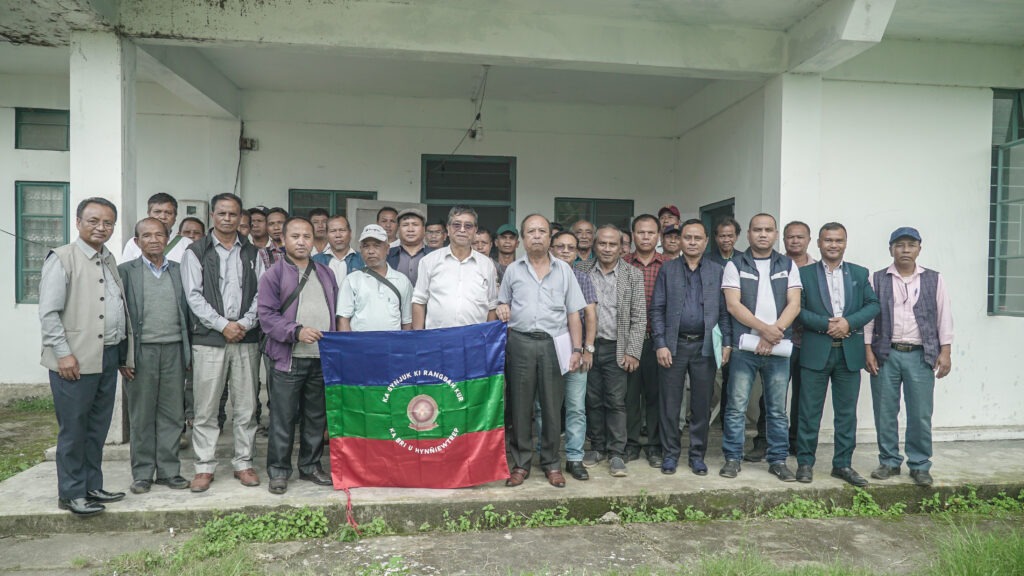
Shillong, July 4: Traditional Khasi institutions have voiced strong opposition to certain provisions of the proposed KHAD (Regulation and Administration of Land) (Amendment) Bill, 2026, alleging that they threaten the constitutional authority of indigenous governance bodies and customary land administration in the Khasi Hills. The concerns were raised during a meeting of the Synjuk Ki Rangbah Kur Ka Bri U Hynñiewtrep held at Mawkyrwat on Saturday, where representatives deliberated on the preservation of the Khasi matrilineal clan system and the implications of the proposed land legislation.
After extensive discussions, the gathering expressed concern that some provisions of the amendment seek to curtail the traditional powers and jurisdiction of the Dorbar Shnong, Dorbar Raij, and Dorbar Hima—institutions that have historically governed land ownership, administration and community affairs under Khasi customary law. The participants maintained that these indigenous institutions enjoy constitutional protection under the Sixth Schedule of the Constitution and have long served as the foundation of grassroots governance and customary land administration in the Khasi Hills.
While acknowledging that the proposed introduction of land ceiling regulations and the digitisation of land records could improve administrative efficiency, transparency and accessibility, the meeting stressed that such reforms should not weaken or override the customary authority and constitutional safeguards of traditional institutions.
The assembly said any reform relating to land administration must respect the spirit of the Sixth Schedule and preserve the customary decision-making powers of indigenous institutions responsible for safeguarding community lands.
The meeting was addressed by eminent legal practitioner Robert June Kharjahrin, former Chief Executive Member of the Khasi Hills Autonomous District Council Manstudy Nongrem, President of the Synjuk Ki Rangbah Kur Ka Bri U Hynñiewtrep R. L. Kharpran, and Secretary of the Synjuk Ki Nongsynshar Shnong R. L. Blah, among other representatives of traditional institutions and civil society.
The meeting unanimously resolved to support the joint initiatives of the Synjuk Ki Rangbah Kur Ka Bri U Hynñiewtrep and the Synjuk Ki Nongsynshar Shnong to defend the Khasi matrilineal clan system, customary land rights and the constitutional authority of traditional institutions.
The participants further resolved that any legislative amendment or administrative intervention that undermines the existing customary legal framework, weakens the authority of the Dorbars, or dilutes the constitutional protections guaranteed under the Sixth Schedule would be firmly opposed.
The gathering also maintained that the existing legal framework governing customary land administration should remain unchanged unless proposed reforms are developed through broad-based consultation and consensus with recognised traditional institutions and custodians of Khasi customary law.
To consolidate its stand, the meeting announced that a joint convention of Rangbah Kur and Nongsynshar Shnong will be held in Shillong on July 7. The convention is expected to formulate a coordinated strategy to safeguard the Khasi matrilineal system, uphold customary land laws, and oppose any move perceived as weakening the traditional institutions and legal framework that underpin Khasi identity and governance.