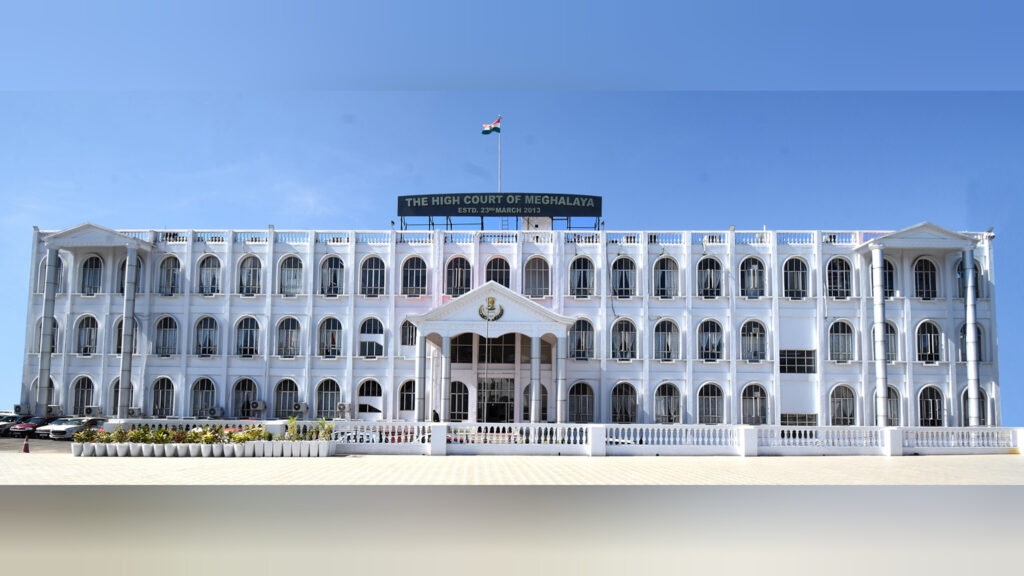
Shillong, June 29: The Meghalaya High Court has acquitted Ashim Sinha in a 2015 murder case, overturning his conviction and life sentence after holding that the prosecution failed to establish his guilt beyond reasonable doubt in a case based entirely on circumstantial evidence.
A Division Bench comprising Chief Justice Revati Mohite Dere and Justice W. Diengdoh allowed the criminal appeal, setting aside the judgment of conviction dated August 1, 2023, and the order of sentence dated August 2, 2023, passed by the Additional Sessions Judge, Shillong, in Sessions Case No. 10 of 2016.
The case stemmed from the recovery of the body of a woman, later identified as Soma Chettri, from a room occupied by the appellant at Jail Road, Shillong, in November 2015. The trial court had convicted Sinha under Section 302 of the Indian Penal Code and sentenced him to life imprisonment along with a fine of ₹50,000.
During the appeal, the defence argued that the prosecution had failed to prove motive, the “last seen” circumstance, exclusive possession of the room, or any complete chain of evidence linking the appellant to the crime. It also contended that the appellant had not absconded but had gone to his hometown after falling ill.
The High Court observed that the prosecution’s case rested solely on circumstantial evidence and reiterated the legal principles laid down by the Supreme Court in Sharad Birdhichand Sarda vs State of Maharashtra, which require every circumstance to be proved beyond reasonable doubt and to form a complete chain pointing only to the guilt of the accused.
After examining the evidence, the Bench found that the prosecution had failed to establish a complete and unbroken chain of circumstances. The Court noted that the evidence at best created suspicion against the appellant, but suspicion, however strong, could not substitute proof beyond reasonable doubt.
Holding that the prosecution had failed to prove its case, the High Court quashed the conviction and sentence, acquitted Ashim Sinha of the murder charge, and directed that he be released forthwith if not required in any other case. The Court also ordered that any fine deposited by the appellant be refunded.