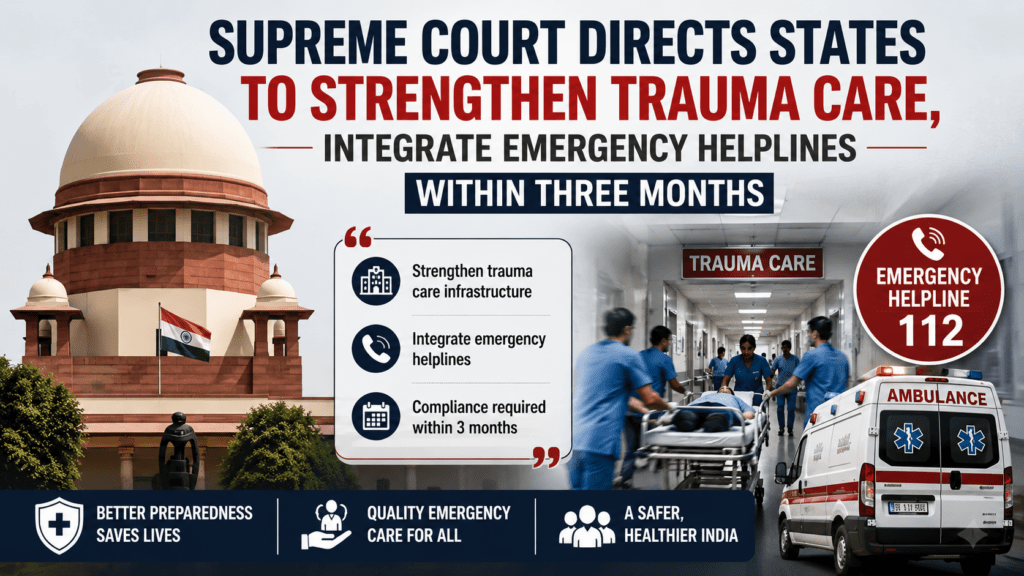
New Delhi, May 26: In a landmark order aimed at improving emergency medical response and reducing preventable road accident deaths, the Supreme Court has directed all States and Union Territories to implement a series of measures to strengthen trauma care systems across the country. The directions were issued while hearing Writ Petition (Civil) No. 726 of 2024, filed by SaveLIFE Foundation and another petitioner seeking comprehensive reforms in trauma care and emergency response.
A Bench comprising Justices J.K. Maheshwari and Atul S. Chandurkar observed that timely trauma care is an integral part of the right to life under Article 21 of the Constitution and stressed the need for a uniform, efficient, and coordinated emergency medical system nationwide.
The Court directed all States and UTs to complete the technical and operational integration of all emergency and ambulance helplines—including 100, 101, 102, 108, 1033 and 1091—into the unified emergency helpline 112 within three months. States have also been asked to undertake extensive public awareness campaigns on the use of helpline 112 and submit compliance reports.
The order further mandates States to establish functional Good Samaritan Grievance Redressal Systems at both State and district levels within three months, with designated nodal authorities and periodic compliance reporting through monthly meetings.
The Union Ministries of Health and Family Welfare and Road Transport and Highways have been permitted to formulate a comprehensive medical rescue protocol for trauma cases within three months. Once issued, States and UTs must operationalise the protocol within the following three months.
The Court also directed all States to ensure that every registered public and private ambulance complies with Automotive Industry Standard (AIS-125), is equipped with GPS or Vehicle Location Tracking Devices linked to helpline 112, and undergoes periodic audits covering response time, quality of care, equipment and outcomes.
In addition, States have been asked to adopt the National Commission for Allied and Healthcare Professions (NCAHP)-notified Emergency Medical Technician curriculum within three months, establish State Trauma Registries, and grade all public and private medical facilities according to the Ministry of Health and Family Welfare’s trauma care guidelines.
The Bench also directed States to fully operationalise the PM RAHAT Cashless Treatment Scheme for road accident victims, including designation of hospitals, onboarding State Health Agencies on the Transaction Management System, and deployment of district police on the electronic Detailed Accident Report (eDAR) platform. The Court clarified that failure to implement these measures would amount to a violation of the Motor Vehicles Act.
Recognising the importance of public awareness, the Court ordered the Union and States to launch sustained multilingual campaigns on helpline 112, Good Samaritan protections under Section 134A of the Motor Vehicles Act, grievance redressal mechanisms and the PM RAHAT scheme within one month. States that have not yet adopted the PM RAHAT scheme have been directed to fully operationalise it within three months.
The Supreme Court directed that copies of the order be sent to the Chief Secretaries of all States and Union Territories to ensure compliance. Authorities have been instructed to submit action-taken reports within the prescribed timelines, after which the matter will be reviewed by the Court after four months for further directions.