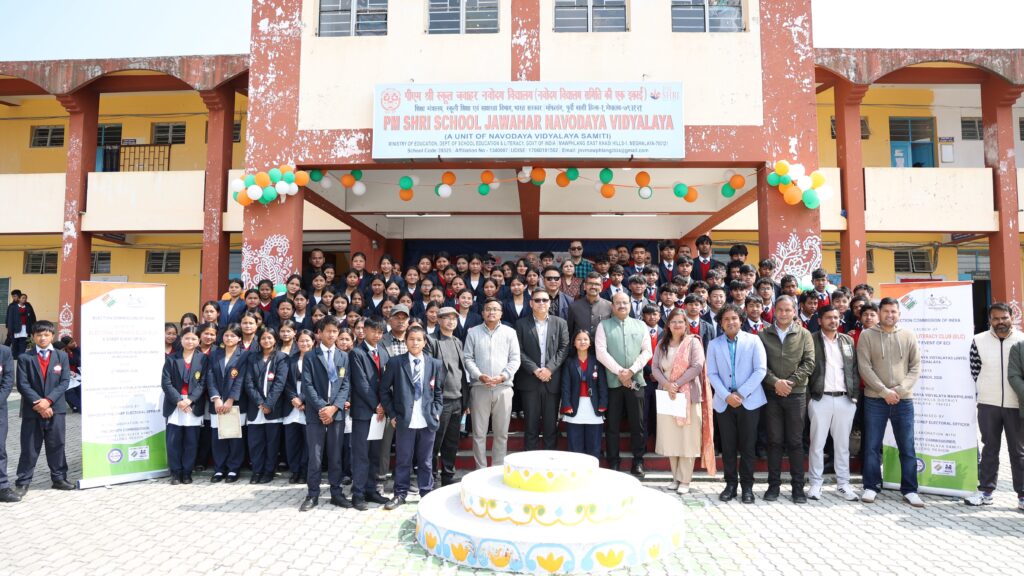
Shillong, March 5 : The Office of the Chief Electoral Officer (CEO), Meghalaya, under the Election Commission of India on Thursday launched an Electoral Literacy Club (ELC) at Jawahar Navodaya Vidyalaya Mawphlang in East Khasi Hills district as part of the SVEEP (Systematic Voters’ Education and Electoral Participation) awareness programme.
The initiative was organised in collaboration with the office of the Deputy Commissioner and the Navodaya Vidyalaya Samiti, Shillong Region, with the aim of promoting voter awareness and electoral literacy among students under the theme “No Voter to be Left Behind.”
Addressing the gathering, Chief Electoral Officer Dr. B. D. R. Tiwari said that the youth represent the future of India and play a crucial role in strengthening the world’s largest democracy. He noted that while India is currently the most populous nation and the largest democracy, its democratic traditions date back to ancient times, citing early republics such as Vaishali.
Tiwari also highlighted the strong grassroots democratic traditions practiced by several tribal societies in the Northeast. Referring to the Khasi community, he said their traditional governance system, including village assemblies known as Dorbars, reflects participatory democracy and is recognised under the Sixth Schedule of the Constitution of India.
Sharing his personal experience, he said that during his early posting in Sohra he had the opportunity to observe village Dorbar meetings and local elections, which he described as an eye-opening experience in understanding grassroots democracy.
Emphasising democratic values, Tiwari said leadership in a democracy requires not only the ability to speak effectively but also the patience to listen and respect differing opinions. Such qualities, he added, help maintain harmony and strengthen democratic institutions.
He further pointed out that India adopted universal adult franchise at the time of independence, even though many established democracies took centuries to extend voting rights to all citizens. Despite the challenges faced during independence, including the integration of princely states, India successfully established a democratic system that accommodates diverse governance structures.
The CEO also referred to traditional governance institutions in the Khasi and Jaintia Hills, where local leaders such as Syiems, Sordars, Lyngdohs and Doloi continue to play important roles in community administration within the constitutional framework.
Tiwari said the Electoral Literacy Club at JNV Mawphlang could serve as a model for other schools in East Khasi Hills district. He noted that residential institutions like Navodaya Vidyalayas provide students with greater opportunities to organise extracurricular activities that promote democratic values, the electoral system and the importance of voting.
He also encouraged students to familiarise themselves with the ECINET mobile application, which integrates multiple election-related services on a single platform. Through the app, voters can use Form 6 for new voter registration, Form 7 for deletion of names due to reasons such as shifting or death, and Form 8 for correction of details in the electoral roll.
The Chief Electoral Officer also spoke about the Special Intensive Revision (SIR) of the electoral roll, stating that the exercise aims to ensure the accuracy of voter lists through a comprehensive verification process. He noted that such revisions had been conducted earlier, including in Meghalaya, and are being implemented in phases across the country.
According to him, the exercise helps verify voter details using various documents and ensures that electoral rolls remain accurate and up to date. He urged members of Electoral Literacy Clubs to understand the process and spread awareness in their communities so that people do not feel anxious or confused during the revision process.
Tiwari added that ELC members could play an important role as grassroots volunteers once the electoral roll revision exercise is implemented in the state.
Among those present on the occasion were Principal of JNV Mawphlang Dr. N. Sharma, System Analyst and SVEEP Nodal Officer in the Office of the CEO Meghalaya K. G. Nongrum, Aditya Prakash Singh, along with students and staff of JNV Mawphlang.